

Free on Tutorly.sg
Practise Algebra with step-by-step help — free to start
On Tutorly.sg/app you can practise unlimited Singapore syllabus questions, get instant explanations when you are stuck, and use past-year papers — no sign-up needed to start.
- ✓ PSLE, O Level, A Level, and more
- ✓ Step-by-step working when you are stuck
- ✓ Works on phone and laptop
Quick answer
Seeing an algebra question in your O Level paper that looks different from your practice can make your heart sink. But you probably already know the concept; it's just the stress that makes you freeze. We'll go through worked examples, so you'll feel more confident and won't lose marks you knew how to get.
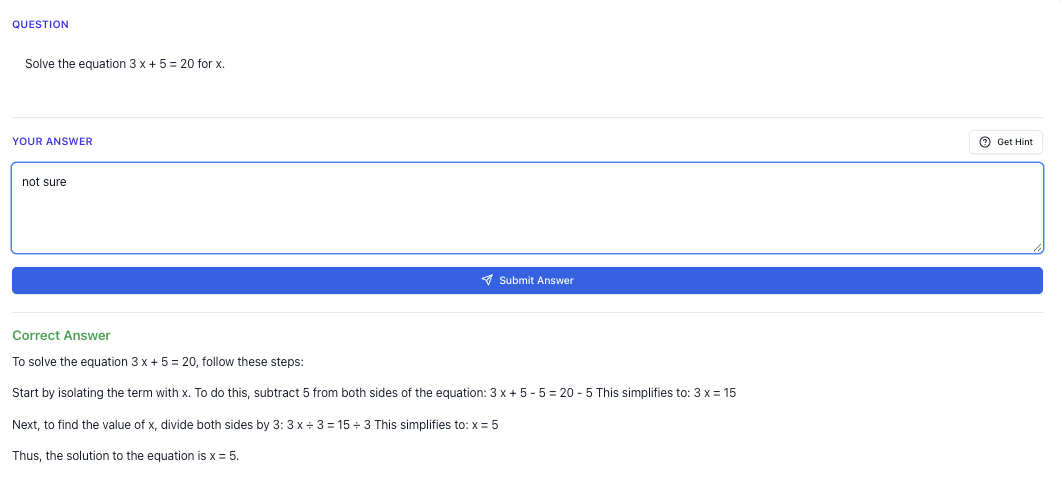
“Stuck on a question? See simple explanations that help you understand fast.”
👉 Give it a try and turn confusion into clarity in minutes.
What you need to know
Algebra is about finding unknown values by using numbers and letters. In your O Level exams, you'll often need to solve equations, which means finding the value of the letter (like 𝑥) that makes the equation true. The questions can look different, but the steps are usually the same.
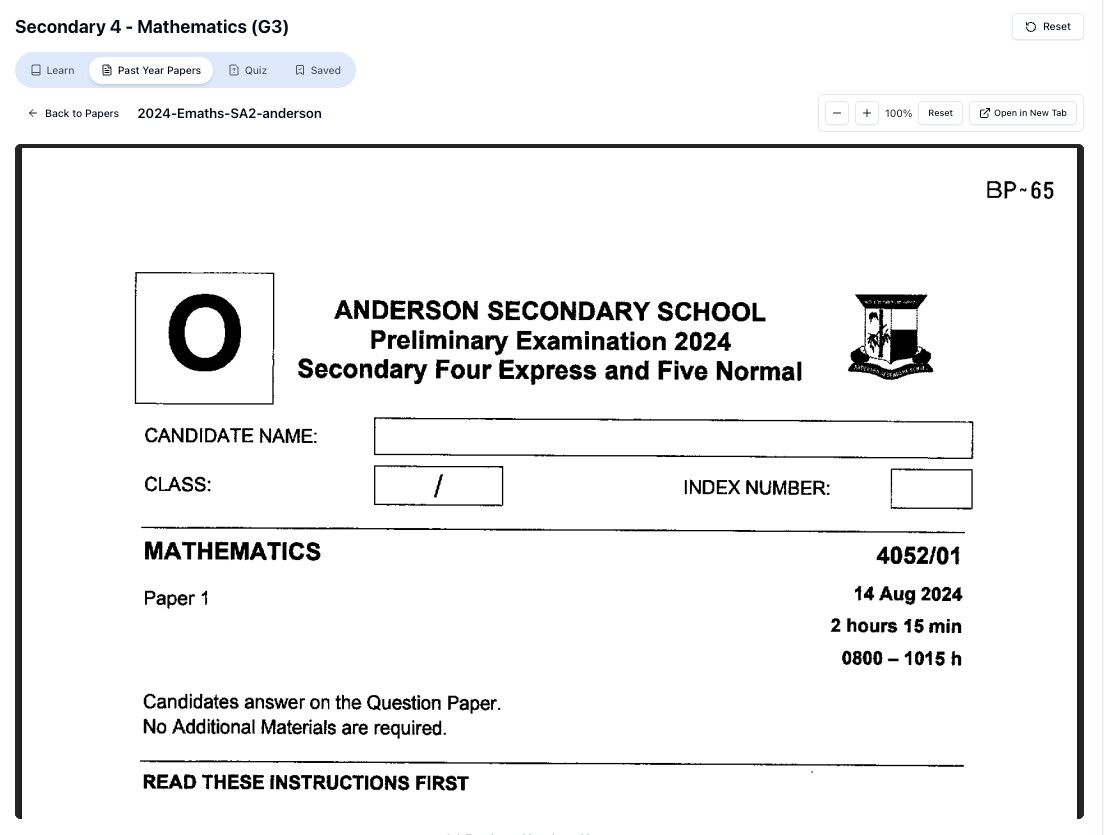
“Access more than 1000+ past year papers to practice”
👉 Start a paper today and test yourself like it’s the real exam.
Overcoming Algebra Exam Panic
Recognising Patterns
The key pattern to recognize is that most algebra questions boil down to a few types of problems: solving equations, expanding expressions, and factorising. Once you see what kind of question it is, you'll know which steps to take.
Slow Down to Avoid Mistakes
Okay, slow down. Many students rush through algebra steps and make careless mistakes. Remember, it's better to take a few extra seconds to check your work than to lose marks for something you actually know.
Quick Check
Try these mini questions:
- Solve for 𝑥: $3 x + 5 = 14$
- Expand: $2(x + 4)$
- Factorise:
Answers:
- $2 x + 8
- (𝑥 + 2)(𝑥 + 3)
Common mistakes students make
- Rushing through steps: This is where many students lose unnecessary marks. Always write down each step clearly to avoid errors.
- Overcomplicating simple questions: Sometimes, students think a question is harder than it is and add extra steps. Stick to the basics.
- Freezing when the question looks different: This is normal. Breathe first and break it down into what you know.
Exam tip
In O Level exams, presentation matters. Write your steps clearly. If you need to solve a quadratic equation, you should immediately think of the formula: . Remember, the more clearly you show your steps, the easier it is to check your work and avoid mistakes.
Worked examples
Question 1
Solve for 𝑥: $2 x + 3 = 11$.
Solution
Step 1: Subtract 3 from both sides: $2 x = 8
Why: We want to isolate 2𝑥 by removing the constant term (3) from the left side.
Step 2: Divide both sides by 2:
Why: Dividing by 2 gives us the value of 𝑥, which is the goal of solving the equation.
Question 2
Expand the expression: $3(x + 2)$.
Solution
Step 1: Multiply 3 by each term inside the bracket: $3 x + 6
Why: We expand to remove the bracket, which helps us combine like terms later if needed.
Question 3
Factorise: .
Solution
Step 1: Find two numbers that multiply to 10 and add to 7: 5 and 2
Why: These numbers will help us split the middle term and factorise.
Step 2: Write as (𝑥 + 5)(𝑥 + 2)
Why: These are the factors of the quadratic expression.
Question 4
“Doing Secondary Science? Pick a topic and practise like it’s a real exam — with clear answers right after.”
👉 Try Tutorly now and start a Science topic in seconds.

Solve for 𝑥: .
Solution
Step 1: Factorise the quadratic:
Why: Factorising turns the quadratic into a product of two binomials.
Step 2: Set each factor to zero: or
Why: If a product is zero, at least one of the factors must be zero.
Step 3: Solve for 𝑥: or
Why: These are the solutions to the equation.
Quick summary
- Rushing leads to mistakes; slow down and write each step.
- Recognise question patterns to avoid freezing.
- Factorising involves finding numbers that multiply and add to specific values.
- Presentation counts in exams — show clear steps.
- Practice similar questions and apply these methods.
FAQ
Q: What if I can't factorise a quadratic equation?
A: Use the quadratic formula: . It works when factorising seems tricky.
Q: How do I know which method to use for solving equations?
A: Look at the equation form. Linear equations () use basic operations; quadratics () often need factorising or the quadratic formula.
Q: Why do I get different answers when solving equations?
A: Check for calculation errors and ensure you've applied the correct operations. Reread the question to confirm the method.
Q: How can I avoid exam panic?
A: Practice regularly and focus on understanding patterns. Remember, the question may look different, but the steps are familiar.
Free on Tutorly.sg
Practise Algebra with step-by-step help — free to start
On Tutorly.sg/app you can practise unlimited Singapore syllabus questions, get instant explanations when you are stuck, and use past-year papers — no sign-up needed to start.
- ✓ PSLE, O Level, A Level, and more
- ✓ Step-by-step working when you are stuck
- ✓ Works on phone and laptop
Free practice
Try it yourself
Practise similar algebra questions with step-by-step help on Tutorly
- ✓ Unlimited similar questions
- ✓ Step-by-step help when you are stuck
- ✓ No sign-up needed to start
Practise with free question sets
Work through more exam-style questions with answers and step-by-step solutions:
Want unlimited similar questions with AI marking? Practise on Tutorly.sg/app
Related Topics You Should Learn Next
- How To Solve Quadratic Equations Step By Step (Singapore Secondary Level Tutorial)
- How To Simplify Algebra: Singapore Secondary Level Tutorial
- How To Factorise Algebraic Expressions: A Step-By-Step Tutorial For Singapore Secondary Students
- O Level EMath: Algebra Mistakes That Cost Marks and How to Fix Them
- O Level EMath Algebra Guide
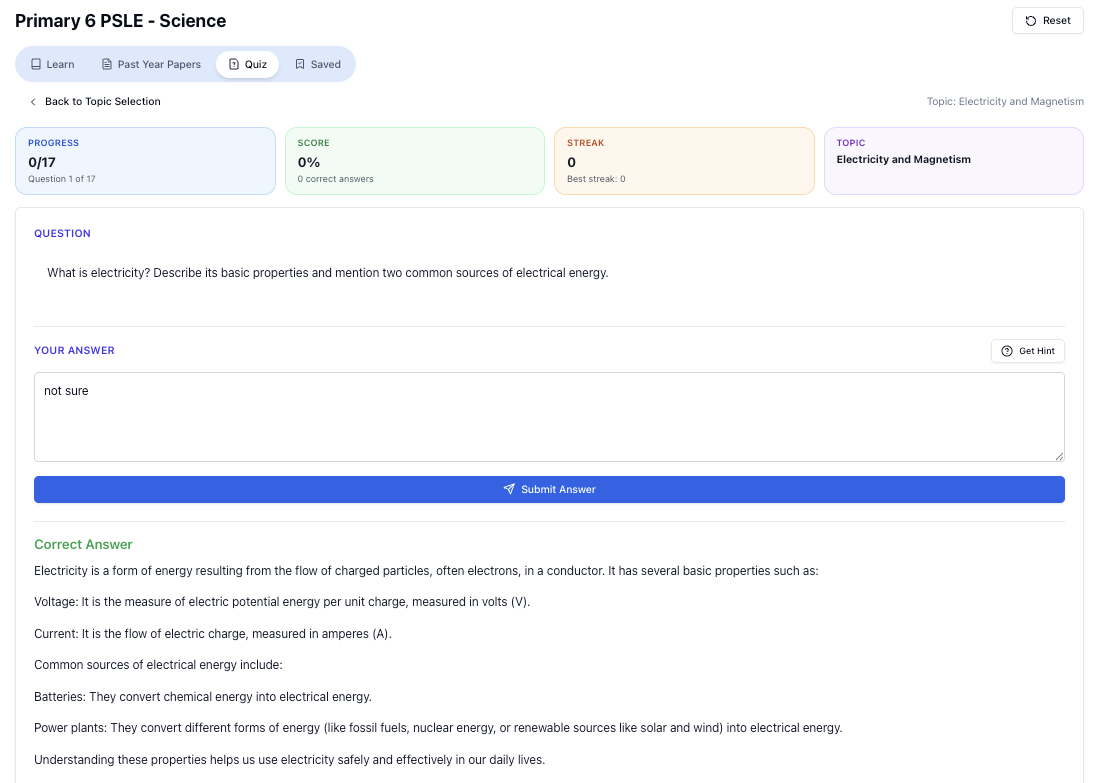
“Practice PSLE Science questions and get clear, step-by-step answers instantly.”
👉 Try a question now and see how fast you can improve.
Free on Tutorly.sg
Practise Algebra with step-by-step help — free to start
On Tutorly.sg/app you can practise unlimited Singapore syllabus questions, get instant explanations when you are stuck, and use past-year papers — no sign-up needed to start.
- ✓ PSLE, O Level, A Level, and more
- ✓ Step-by-step working when you are stuck
- ✓ Works on phone and laptop