

Free on Tutorly.sg
Practise with step-by-step help — free to start
On Tutorly.sg/app you can practise unlimited Singapore syllabus questions, get instant explanations when you are stuck, and use past-year papers — no sign-up needed to start.
- ✓ PSLE, O Level, A Level, and more
- ✓ Step-by-step working when you are stuck
- ✓ Works on phone and laptop
If you’re in Secondary school in Singapore (especially Sec 3–4 doing E Math or A Math), quadratic equations are everywhere.
They show up in:
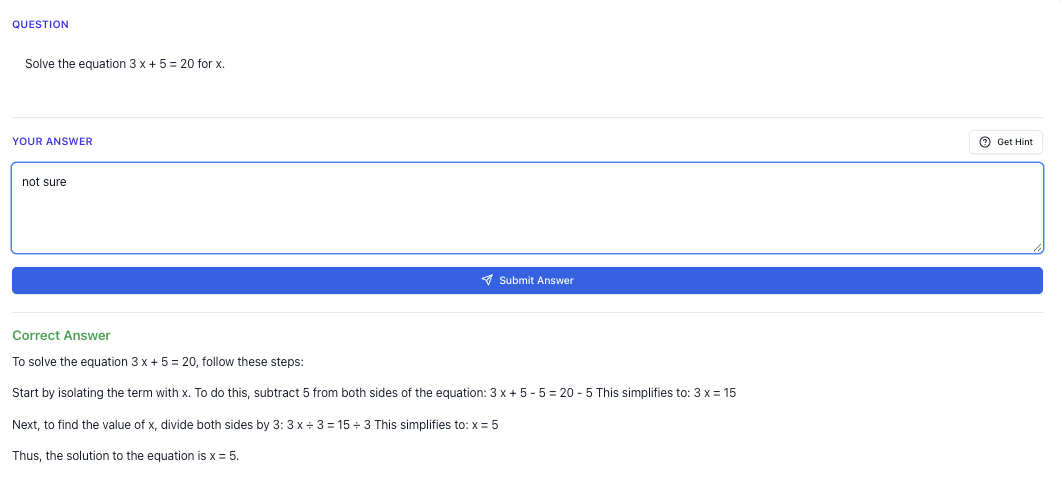
“Stuck on a question? See simple explanations that help you understand fast.”
👉 Give it a try and turn confusion into clarity in minutes.
- Sec 3 algebra topics
- O-Level E Math Paper 1 and Paper 2
- A Math (even more heavily)
- Physics kinematics questions (projectiles, motion)
So if you’re still a bit blur about quadratics, don’t panic. You’re definitely not alone.
This tutorial will walk you through how to solve quadratic equations step by step, in a way that matches what you actually see in the MOE syllabus and O-Level exam papers.
Along the way, I’ll also show you how you can use Tutorly.sg — a AI tutor website built specifically for Singapore students — to get instant practice and explanations whenever you’re stuck.
Tutorly.sg has already been used by thousands of students in Singapore, and has even been mentioned on CNA (Channel NewsAsia), so you’re in safe hands.
Useful links to keep open:
- Main AI tutor page: <https://tutorly.sg/ai-tutor-singapore>
- Go straight to the web app: <https://tutorly.sg/app>
Step-by-step tutorial
1. What is a quadratic equation?
A quadratic equation is any equation that can be written in this form:
where:
- 𝑎, 𝑏, 𝑐 are numbers (real constants)
- (if , then it’s not quadratic anymore)
Examples:
- (here )
In the O-Level syllabus, you usually solve quadratics in three main ways:
- By factorisation
- By completing the square
- Using the quadratic formula
You need to know all three, because exam questions will test them in different ways.
2. Method 1: Solving by factorisation
This is usually the first method you learn in Sec 3.
General idea
You rewrite the quadratic as a product of two brackets, then use the fact that:
If , then either or .
Step-by-step example 1 (simple)
Solve .
Step 1: Factorise
We want:
We need two numbers that:
- multiply to +6
- add up to +5
Those numbers are and .
So:
Step 2: Use “= 0”
So either:
- →
- →
Answer: or
Step-by-step example 2 (with coefficient)
Solve .
Step 1: Factorise
We look for a pair of brackets:
We want:
- Product of constants = -5
- Cross terms add up to -3𝑥
Try (2𝑥 + 2)(𝑥 - 5):
- Multiply:
- Outer + inner: (not correct)
Try (2𝑥 + 5)(𝑥 - 1):
- Multiply:
- Outer + inner: (sign wrong)
Try (2𝑥 - 5)(𝑥 + 1):
- Multiply:
- Outer + inner: (correct!)
- Constant: -5
So:
Step 2: Use “= 0”
So either:
- → →
- →
Answer: or
3. Method 2: Solving by completing the square
This is important for:
- E Math: solving, graphing parabolas, finding minimum/maximum
- A Math: more advanced algebra and functions
General idea
You rewrite the quadratic into this form:
Then take square roots.
Standard steps (when )
Solve .
Step 1: Move constant to the right
Step 2: Add the “magic number”
Take half of the coefficient of 𝑥:
- Coefficient of 𝑥 is
- Half of is
- Square it:
Add to both sides:
Left side becomes a perfect square:
Step 3: Square root both sides
So:
- →
- →
Answer: or
When
Solve .
Step 1: Make coefficient of equal to 1
Divide the whole equation by 2:
Move constant:
Step 2: Complete the square
Half of is , .
Add to both sides:
Right side:
So:
Step 3: Square root both sides
So:
You can leave it in this surd form (usually acceptable in O-Level unless asked otherwise).
4. Method 3: Quadratic formula
The quadratic formula works for any quadratic equation:
For ,
The part under the square root, , is called the discriminant.
- If → 2 distinct real roots
- If → 1 repeated real root
- If → no real roots (in E Math context)
Step-by-step example
Solve using the formula.
Here:
Step 1: Substitute into discriminant
Step 2: Use the formula
So:
Answer: or
5. Which method should you use?
For O-Level style questions:
-
Factorisation:
Use it when the quadratic is “nice” and factorisable with integers.
Faster, and often what examiners expect if they say “solve by factorisation”. -
Completing the square:
Use it when the question asks for maximum/minimum value or vertex form, or explicitly says “by completing the square”. -
Quadratic formula:
Use it when:- Factorisation is hard or impossible with integers
- The question says “hence use the quadratic formula”
- You want a reliable method that always works (but be careful with algebra)
If you’re practising on Tutorly.sg (<https://tutorly.sg/ai-tutor-singapore>), you can actually type:
“Solve by factorisation, then show using quadratic formula”
and the AI tutor will give you:
- The final answers
- Step-by-step worked solution for each method
So you can compare and see how the methods relate.
Exam strategy guide
Quadratic equations are almost guaranteed to appear in O-Level E Math, and very heavily in A Math. Here’s how to handle them efficiently in exams.
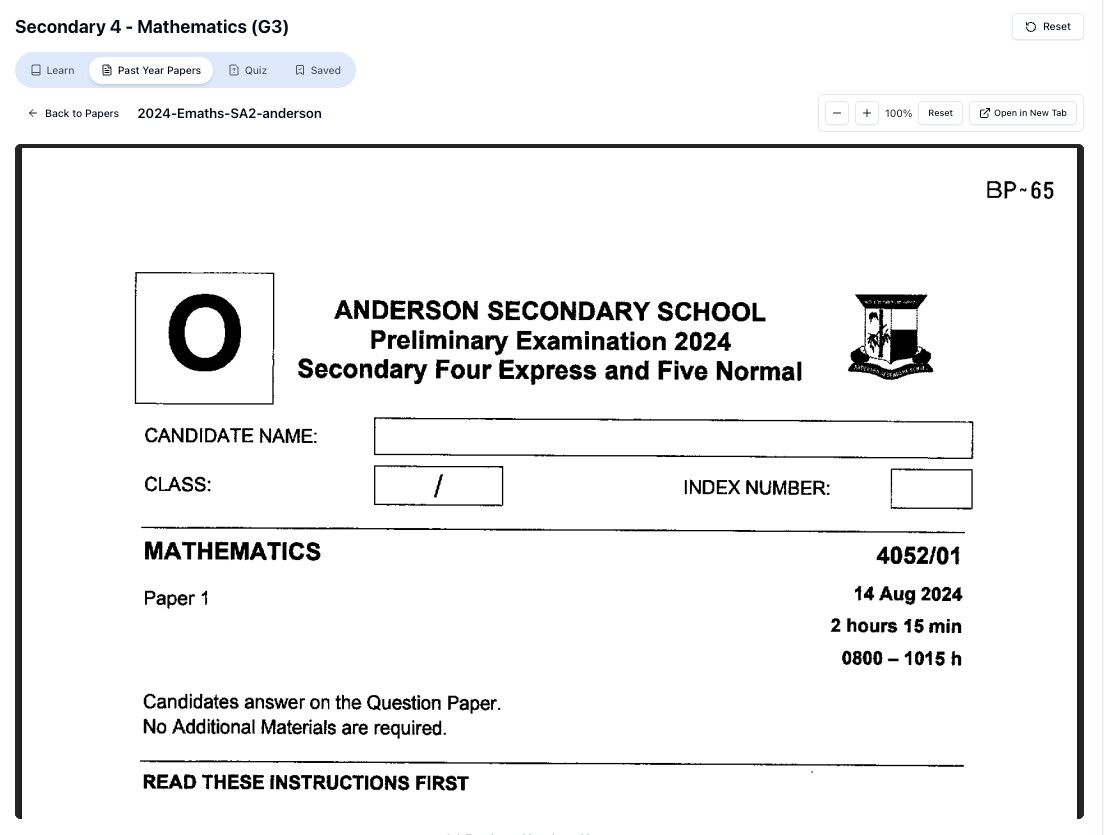
“Access more than 1000+ past year papers to practice”
👉 Start a paper today and test yourself like it’s the real exam.
1. Read the instruction carefully
Look for key phrases:
- “Solve the equation…” → any method (unless specified)
- “Solve the equation by factorisation” → must show factorisation
- “Solve the equation by completing the square” → must use that method
- “Using the quadratic formula, find the roots of…” → use the formula
Free on Tutorly.sg
Practise with step-by-step help — free to start
On Tutorly.sg/app you can practise unlimited Singapore syllabus questions, get instant explanations when you are stuck, and use past-year papers — no sign-up needed to start.
- ✓ PSLE, O Level, A Level, and more
- ✓ Step-by-step working when you are stuck
- ✓ Works on phone and laptop
If you use the wrong method when they clearly specify, you can lose method marks even if the answers are correct.
2. Time management tips
For O-Level E Math:
- Don’t spend more than 3–4 minutes on a single quadratic question in Paper 1.
- If it’s in a long question in Paper 2 (e.g. coordinate geometry, kinematics), the quadratic part is usually just one step. Don’t overthink it.
If you’re stuck:
- Try factorisation quickly.
- If cannot factorise nicely, switch to the quadratic formula.
- If still stuck, leave some working, circle the question, and move on. Come back later.
3. Check your answers smartly
You don’t always have time to substitute back in detail, but you can do quick checks:
-
For , if roots are 𝑝 and 𝑞:
-
Sum of roots:
- Product of roots:
Example:
For , roots found: and .
- Sum: 2 + 3 = 5 → matches
- Product: → matches
If these don’t match, you know something went wrong.
4. Use your calculator carefully
For O-Level, you’re allowed a scientific calculator, but not a CAS calculator that solves equations automatically.
However, you can:
- Use it to compute the discriminant
- Use it to handle fractions and surds accurately
- Check approximate decimal values of your answers
Exam tip: If your exact answer is , don’t write unless they ask for a decimal. Exact forms are usually safer.
5. When quadratics appear inside word problems
Common contexts in Singapore papers:
- Area of a rectangle / garden / field
- Height of a projectile:
- Revenue / profit problems in E Math
- Coordinate geometry: intersection of a line and a parabola
Strategy:
- Translate the situation into an equation.
- Rearrange until you get a standard quadratic form .
- Choose the method (factorisation / formula).
- After solving, interpret the answers in context (reject negative lengths/time if not realistic).
If you want practice with these word problems, you can throw past-year questions into Tutorly.sg (<https://tutorly.sg/app>) and ask it to:
“Explain step-by-step how to form the quadratic equation from this word problem, then solve it.”
You’ll still need to think (it won’t just give you final answers to copy), but you can see each step clearly.
Worksheet practice
Use this section like a mini worksheet. Try each question yourself first, then check with a solution method (you can also use Tutorly.sg to confirm your answers and see steps).
I’ll organise them by difficulty: basic, intermediate, then hard exam-style variants.
A. Basic practice (factorisation focus)
Q 1. Solve by factorisation.
Outline:
- Find two numbers that multiply to +12 and add up to -7.
- Factorise, then solve each bracket = 0.
Q 2. Solve by factorisation.
Outline:
- Look for (2𝑥 + ?)(𝑥 + ?) type.
- Check cross terms carefully.
Q 3. Solve .
Outline:
- First factor out the common factor 3𝑥.
- Then solve each factor = 0.
B. Intermediate practice (completing the square & formula)
Q 4. Solve by completing the square.
Outline:
- Move constant to the right.
- Add the “magic number” (half of 6, then square).
- Form , then take square roots.
Q 5. Solve using the quadratic formula.
Outline:
- Identify 𝑎, 𝑏, 𝑐.
- Compute .
- Substitute into .
Q 6. A quadratic equation has roots and . Form the quadratic equation in the form with integer coefficients.
Outline:
- Use .
- Expand, simplify, write in standard form.
C. Hard exam variants (O-Level style)
These are the kind that can appear in the later part of Paper 1 or inside a structured Paper 2 question.
Q 7. Discriminant and nature of roots
Given the quadratic equation , where 𝑘 is a constant:
- Find the value(s) of 𝑘 for which the equation has equal roots.
- Find the value(s) of 𝑘 for which the equation has no real roots.
Outline:
- Use discriminant .
- Equal roots → discriminant = 0.
- No real roots → discriminant < 0.
Let , , .
Q 8. Word problem – area
The length of a rectangle is (𝑥 + 3) cm and the width is (𝑥 - 2) cm. The area of the rectangle is .
- Form a quadratic equation in 𝑥.
- Solve the equation.
- Hence, find the dimensions of the rectangle.
Outline:
- Area = length × width.
- Set .
- Expand, rearrange to .
- Solve (likely factorisation or formula).
- Reject any value of 𝑥 that gives negative length/width.
Q 9. Application – projectile motion
A ball is thrown upwards from a height of with an initial velocity of . Its height metres above the ground after 𝑡 seconds is given by
“Doing Secondary Science? Pick a topic and practise like it’s a real exam — with clear answers right after.”
👉 Try Tutorly now and start a Science topic in seconds.

- Show that the equation for when the ball hits the ground is .
- Solve this equation, giving your answers correct to 2 decimal places.
- Hence, find the time taken for the ball to hit the ground.
Outline:
- Hits the ground → .
- Rearrange to standard quadratic.
- Use quadratic formula.
- One root will be negative (ignore, not physical).
- Positive root is the time taken.
Q 10. Maximum value (completing the square)
The function represents the profit (in dollars) made by a company when they produce 𝑥 units of a certain product.
- Rewrite 𝑓(𝑥) in the form .
- Hence, find the maximum profit and the number of units that should be produced to obtain this maximum profit.
Outline:
- Factor out -2 from and 8𝑥.
- Complete the square inside the bracket.
- Identify the vertex (, 𝑘).
- Because coefficient of is negative, it’s a maximum.
How to use Tutorly.sg with these questions
If you’re practising alone at home, sometimes you’re not sure if your answer is correct, or you don’t know where your mistake is.
Here’s how you can use Tutorly.sg effectively:
- Go to <https://tutorly.sg/app>.
- Type in one of the questions, for example:
“Q 8: The length of a rectangle is (x + 3) cm and the width is (x - 2) cm… (full question). Please show me the step-by-step solution.”
- Tutorly will:
- Give you the final answer
- Show a clear, step-by-step worked solution that you can follow
You can also ask:
- “Explain why we reject the negative value of 𝑡 in Q 9.”
- “Show how to complete the square for slowly.”
Because it’s built for the Singapore MOE syllabus, the style of solution will feel very similar to what your teacher expects and what you see in Ten-Year Series.
Common mistakes
These are the errors I see most often from Sec 3–4 students, especially under exam stress. If you fix these, your accuracy will improve a lot.
1. Forgetting to write “= 0” before solving
You must rearrange to before using:
- Factorisation
- Quadratic formula
- Completing the square (properly)
Example:
Given .
Wrong: Straight away factorise as (𝑥 + 5)(𝑥 - 2) or something random.
Correct:
Then solve.
2. Sign mistakes in factorisation
Example: .
Students sometimes write:
Check: (totally different).
Correct factorisation:
Always expand quickly in your head to check:
- Product of constants
- Sum of cross terms
3. Dropping the “” when taking square roots
From :
Wrong:
Correct:
Forgetting the negative root loses you half the marks immediately.
4. Mixing up in the quadratic formula
Common mistakes:
- Using 4𝑐 instead of 4ac
- Forgetting that 𝑏 might be negative (e.g. )
Example: For ,
- , ,
- , not
If you’re not careful with signs
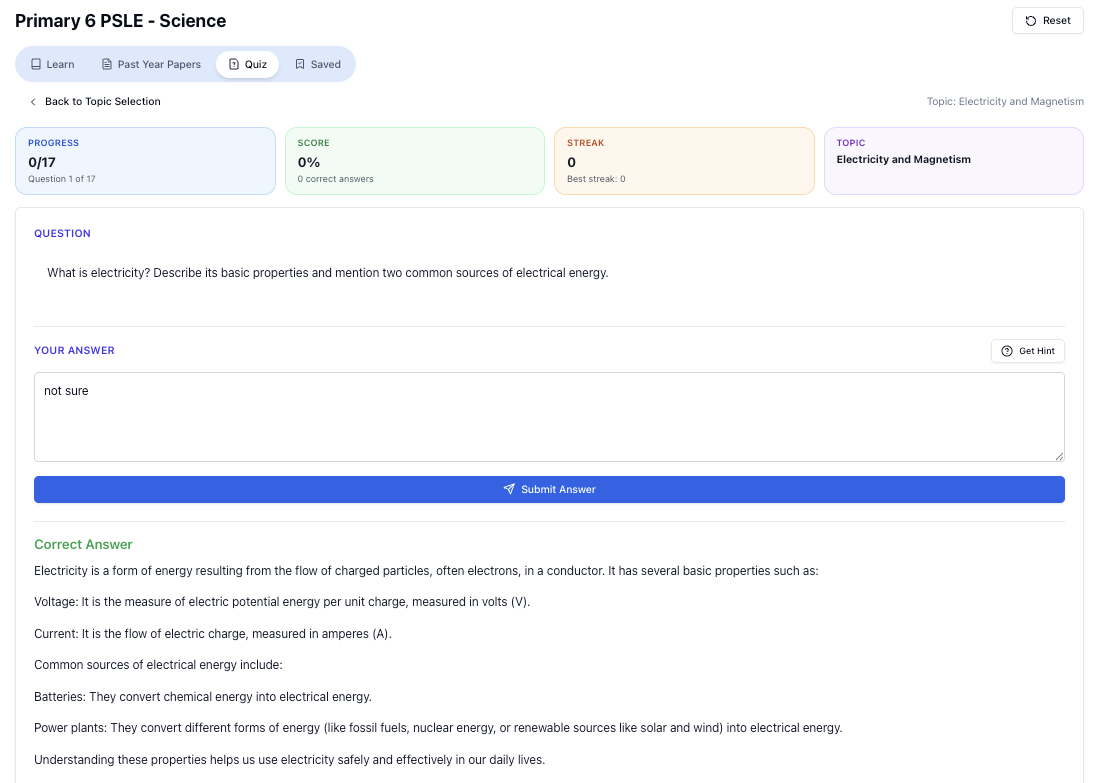
“Practice PSLE Science questions and get clear, step-by-step answers instantly.”
👉 Try a question now and see how fast you can improve.
Ready to practise?
If you want a Singapore-focused AI tutor you can use immediately (website, no sign-up), try Tutorly here:
Related Articles
Free on Tutorly.sg
Practise with step-by-step help — free to start
On Tutorly.sg/app you can practise unlimited Singapore syllabus questions, get instant explanations when you are stuck, and use past-year papers — no sign-up needed to start.
- ✓ PSLE, O Level, A Level, and more
- ✓ Step-by-step working when you are stuck
- ✓ Works on phone and laptop