

Free on Tutorly.sg
Practise Algebra with step-by-step help — free to start
On Tutorly.sg/app you can practise unlimited Singapore syllabus questions, get instant explanations when you are stuck, and use past-year papers — no sign-up needed to start.
- ✓ PSLE, O Level, A Level, and more
- ✓ Step-by-step working when you are stuck
- ✓ Works on phone and laptop
Quick answer
You know the feeling — heart sinking when the algebra question doesn't look like anything you've seen before. Don't worry, once you learn to break it down step by step, you'll see the patterns and know what to do. Let's make sure you don't lose marks from freezing or rushing.
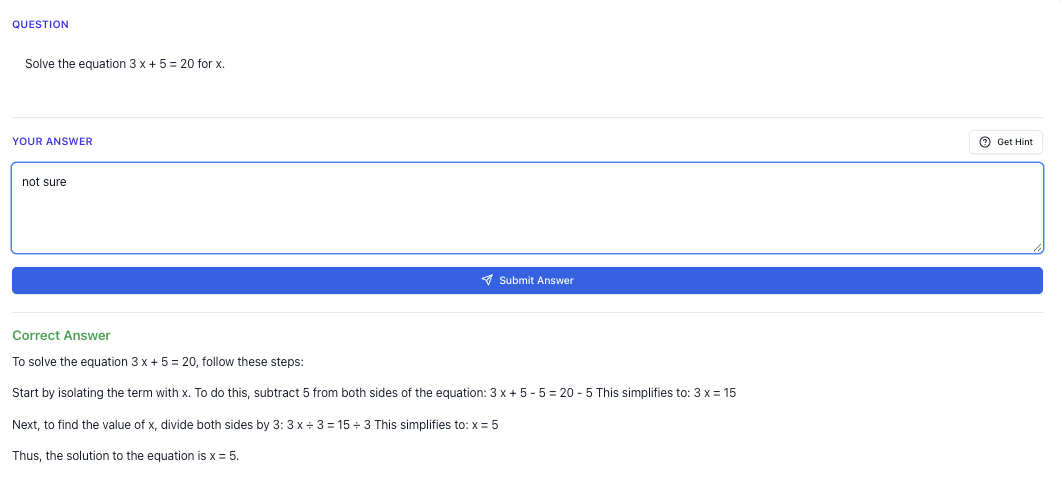
“Stuck on a question? See simple explanations that help you understand fast.”
👉 Give it a try and turn confusion into clarity in minutes.
What you need to know
Algebra is all about finding the value of unknowns (like 𝑥 or 𝑦) in equations. It's important to follow steps carefully to avoid mistakes. Singapore exams often test your ability to apply what you've learned, not just memorize formulas.
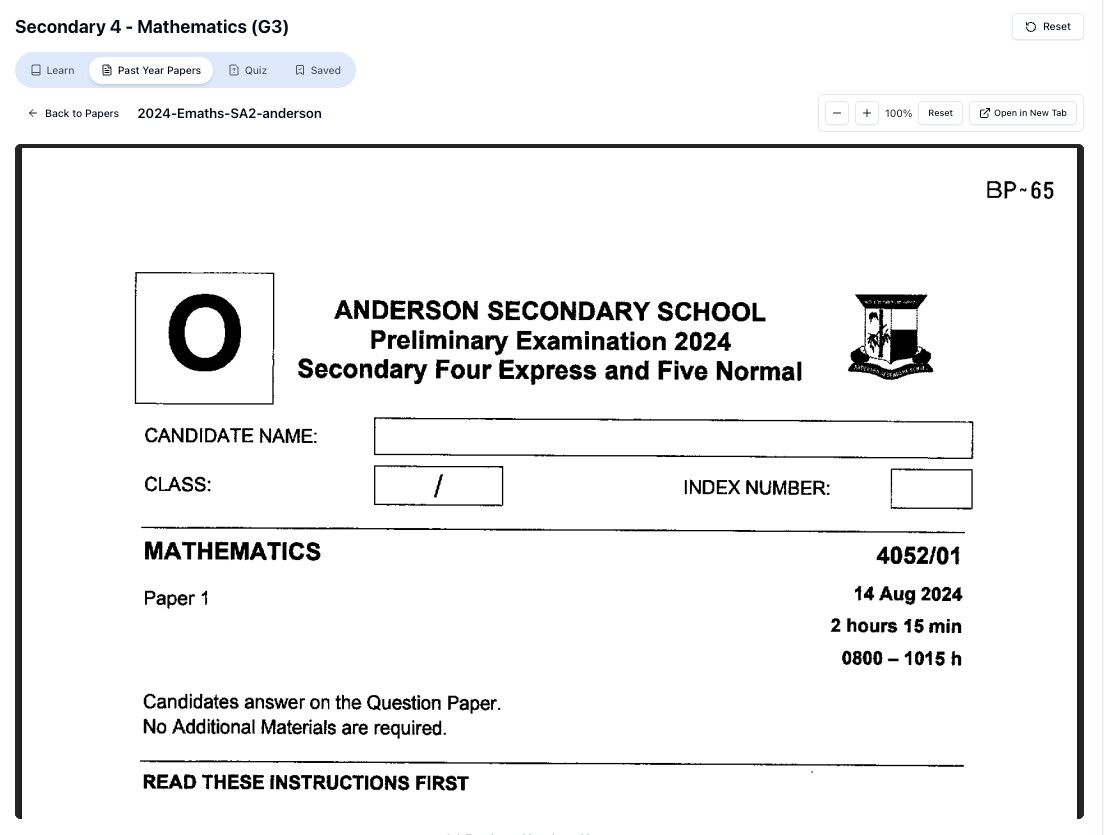
“Access more than 1000+ past year papers to practice”
👉 Start a paper today and test yourself like it’s the real exam.
How to handle different-looking algebra questions
Recognizing key patterns
When you see an algebra question, the first thing to do is to identify what kind of problem it is. Is it asking you to simplify, factorize, or solve for a variable? The key pattern to recognize is what operation or concept to apply. For example, if you see a bracket, you might need to expand it.
Slow down and simplify
Many students rush through algebra steps, which leads to careless mistakes. Okay, slow down. Simplify the problem as you go. This will help you avoid overcomplicating things. Remember, exams are about applying concepts, not just doing long calculations.
Quick check
Try these quick questions to test your understanding:
- Simplify: $3(x + 4)$
- Solve for 𝑥:
- Factorize:
Answers:
- $3 x + 12
- (𝑥 + 2)(𝑥 + 3)
Common mistakes students make
-
Rushing through steps: This often leads to missing out on simple calculations. Take your time to write each step clearly.
-
Not recognizing the problem type: Students sometimes don't see whether they need to factorize or simplify. Look for keywords like "simplify" or "solve".
-
Overcomplicating solutions: Keep it simple. If it looks complicated, you might be doing too much.
Exam tip
Always check your final answer by substituting it back into the original equation. This helps you ensure that your solution is correct and saves you from losing unnecessary marks.
Worked examples
Question 1
Simplify the expression $2(x + 3) + 4 x$.
Solution
Step 1: Expand the brackets: $2(x + 3) = 2 x + 6
Why: We need to remove the bracket before we can combine like terms.
Step 2: Combine like terms: $2 x + 6 + 4 x = 6 x + 6
Why: We group all the 𝑥 terms together to simplify the expression.
Question 2
Solve for 𝑦: $3 y - 5 = 16$.
Solution
Step 1: Add 5 to both sides: $3 y - 5 + 5 = 16 + 5
Why: We want to isolate the 𝑦 term by removing the constant on the left.
Step 2: Simplify to get $3 y = 21.
Why: This makes it easier to solve for 𝑦.
Step 3: Divide both sides by 3:
Why: Dividing isolates 𝑦, giving us the solution.
Question 3
Factorize .
“Doing Secondary Science? Pick a topic and practise like it’s a real exam — with clear answers right after.”
👉 Try Tutorly now and start a Science topic in seconds.

Solution
Step 1: Look for two numbers that multiply to 10 and add to 7. These are 5 and 2.
Why: Factoring requires finding numbers that work with both the product and sum.
Step 2: Write the expression as (𝑥 + 5)(𝑥 + 2).
Why: This expression, when expanded, will give the original quadratic.
Question 4
Solve for 𝑥: .
Solution
Step 1: Add 9 to both sides:
Why: We want to isolate the term.
Step 2: Take the square root of both sides:
Why: The square root of will give 𝑥, and remember that it could be positive or negative.
Quick summary
- Slow down and identify the problem type.
- Simplify expressions step by step.
- Recognize key patterns like brackets and keywords.
- Check your solutions by substituting back.
- Common mistakes include rushing and overcomplicating.
FAQ
-
What if I freeze during an exam question?
Don't panic. Break down the question into smaller steps. Identify the type of problem first. -
How do I know which formula to use?
Look for keywords in the question that indicate whether you need to simplify, factorize, or solve. -
Why do I keep making careless mistakes?
It's usually because you're rushing. Take your time to write out each step clearly. -
How can I improve my algebra skills?
Practice regularly, and review your mistakes to understand where you went wrong. -
What's a common trap in algebra?
Overcomplicating simple problems. Keep your solutions straightforward.
Free on Tutorly.sg
Practise Algebra with step-by-step help — free to start
On Tutorly.sg/app you can practise unlimited Singapore syllabus questions, get instant explanations when you are stuck, and use past-year papers — no sign-up needed to start.
- ✓ PSLE, O Level, A Level, and more
- ✓ Step-by-step working when you are stuck
- ✓ Works on phone and laptop
Free practice
Try it yourself
Want more practice with step-by-step guidance? Head over to Tutorly for interactive questions and solutions
- ✓ Unlimited similar questions
- ✓ Step-by-step help when you are stuck
- ✓ No sign-up needed to start
Related Topics You Should Learn Next
- Mastering Algebra Without Panic
- How To Simplify Algebra: Singapore Secondary Level Tutorial
- Fixing Algebra Mistakes That Cost You Marks
- Scoring in Algebra Without Panic
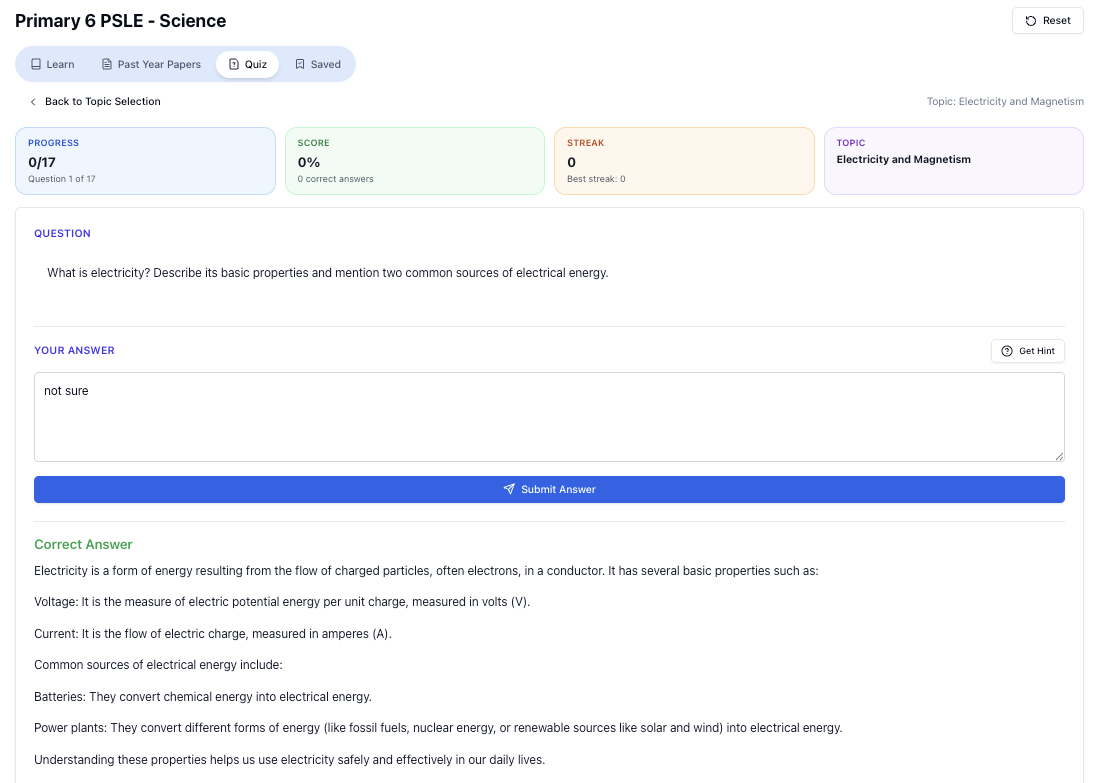
“Practice PSLE Science questions and get clear, step-by-step answers instantly.”
👉 Try a question now and see how fast you can improve.
Free on Tutorly.sg
Practise Algebra with step-by-step help — free to start
On Tutorly.sg/app you can practise unlimited Singapore syllabus questions, get instant explanations when you are stuck, and use past-year papers — no sign-up needed to start.
- ✓ PSLE, O Level, A Level, and more
- ✓ Step-by-step working when you are stuck
- ✓ Works on phone and laptop