

Free on Tutorly.sg
Practise Geometry and measurement with step-by-step help — free to start
On Tutorly.sg/app you can practise unlimited Singapore syllabus questions, get instant explanations when you are stuck, and use past-year papers — no sign-up needed to start.
- ✓ PSLE, O Level, A Level, and more
- ✓ Step-by-step working when you are stuck
- ✓ Works on phone and laptop
Quick answer
Running into panicked moments in PSLE geometry? Don’t worry, I’ve seen it in my students too. With a few exam tips and practice, you can avoid common traps and finish your paper with confidence.
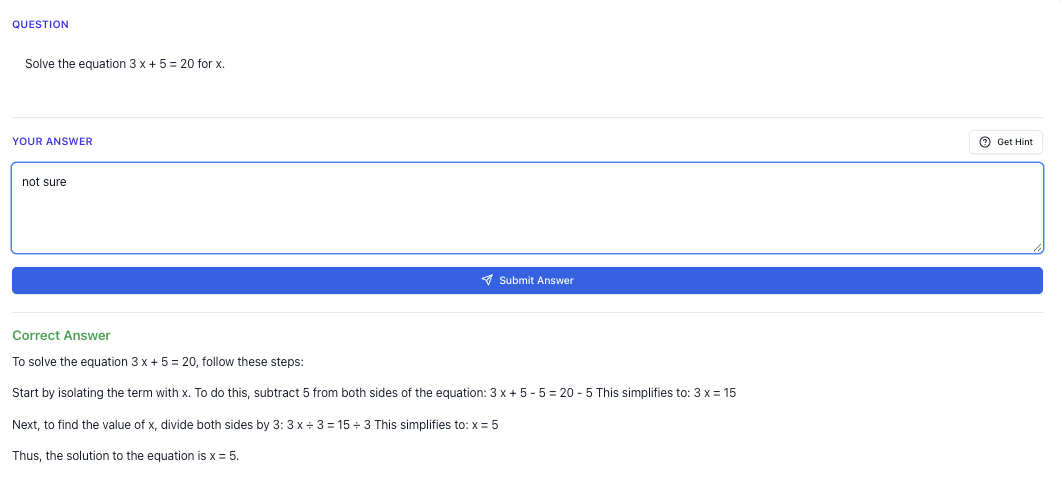
“Stuck on a question? See simple explanations that help you understand fast.”
👉 Give it a try and turn confusion into clarity in minutes.
What you need to know
Geometry and measurement questions in PSLE involve shapes, sizes, and the properties of space. You’ll often need to calculate areas, volumes, and angles. These questions test how well you can see and measure shapes in your mind.
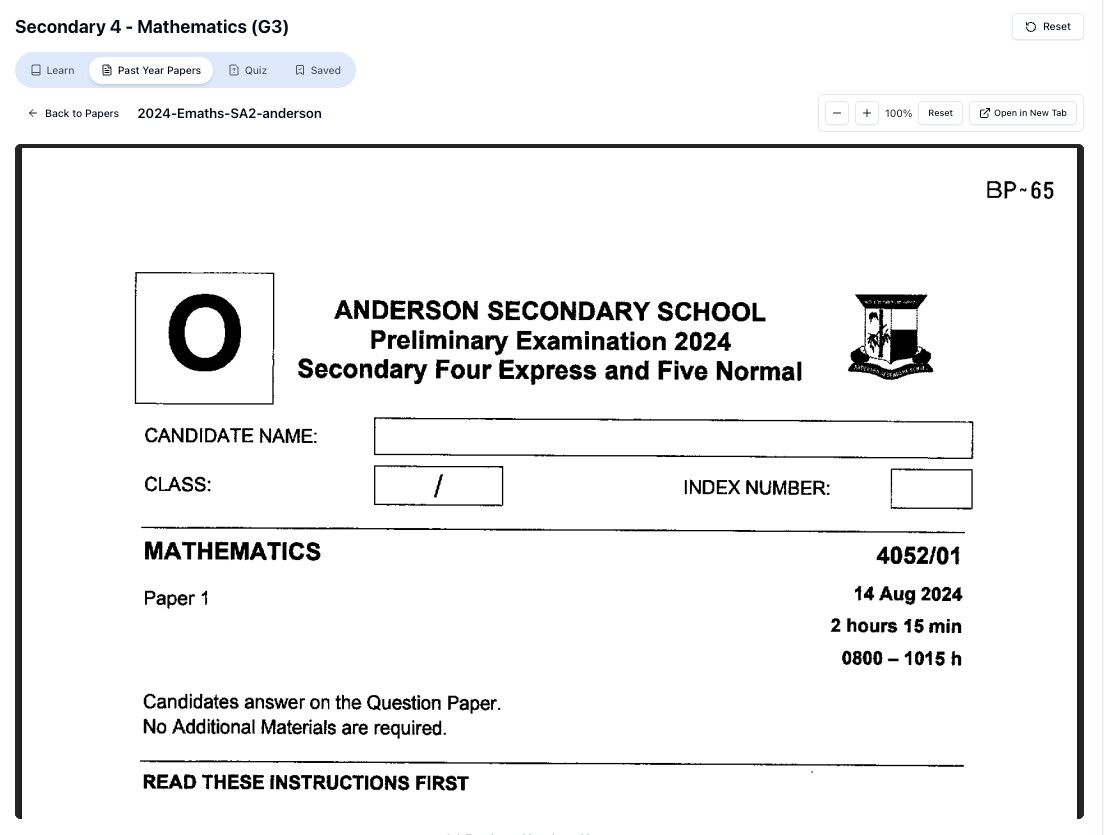
“Access more than 1000+ past year papers to practice”
👉 Start a paper today and test yourself like it’s the real exam.
Breaking Down Geometry and Measurement
Visualise the Problem
Many students struggle because they can't "see" the problem. A simple trick I teach my students is to draw the shapes out. Let’s say you’re working with a triangle or a rectangle — sketch it out first. This helps you understand what the question is asking.
Work in Small Steps
This topic becomes easier when broken into smaller steps. Focus on one part of the question at a time instead of trying to solve everything at once. It’s like building a Lego set — one piece at a time.
Quick Check
- Sketch a rectangle and label its length as 8 cm and width as 5 cm. What is the area?
- Draw an equilateral triangle with each side 6 cm. What is the perimeter?
- If a circle has a radius of 7 cm, what’s the circumference?
(Answers: 1. 40 cm², 2. 18 cm, 3. 44 cm)
Common mistakes students make
-
Misreading the question: Sometimes, students rush and miss key details. Always underline important numbers and units in the question.
-
Forgetting units: Marks are lost when you forget to write cm² for area or cm³ for volume. Check your answers for units before moving on.
-
Confusing formulas: Mixing up area and perimeter formulas is common. Make a small cheat sheet with formulas and practice using them.
Exam tip
Breathe first and don't panic if you’re stuck. Move on to the next question and come back later. Sometimes, seeing other questions can help jog your memory. Remember, PSLE papers are designed to test understanding, not just memorisation.
Worked examples
Question 1
A rectangle has a length of 10 cm and a width of 4 cm. What is the area?
Solution
Step 1: Identify the formula for area of a rectangle: Area = Length × Width
Why: We need the correct formula to calculate the area.
Step 2: Substitute the given values into the formula: Area = 10 cm × 4 cm
Why: Putting numbers into the formula helps us calculate the result.
Step 3: Calculate the area: 10 cm × 4 cm = 40 cm²
Why: This gives us the final answer, which is the area of the rectangle.
Question 2
Find the perimeter of a square with sides of 5 cm.
Solution
Step 1: Identify the formula for perimeter of a square: Perimeter = 4 × Side
Why: The formula helps us find the total length around the square.
“Doing Secondary Science? Pick a topic and practise like it’s a real exam — with clear answers right after.”
👉 Try Tutorly now and start a Science topic in seconds.

Step 2: Substitute the given side length into the formula: Perimeter = 4 × 5 cm
Why: We use the side length to find how long the perimeter is.
Step 3: Calculate the perimeter: 4 × 5 cm = 20 cm
Why: This gives us the total distance around the square.
Quick summary
- Visualise by drawing shapes.
- Break questions into smaller steps.
- Use correct formulas for area and perimeter.
- Pay attention to units — cm², cm³.
- Move to the next question if stuck, then return later.
FAQ
Q1: How do I remember the formulas for geometry?
A: Practice daily with short sessions and use a formula cheat sheet. Linking formulas to simple stories or images can help.
Q2: What should I do if I forget a formula during the exam?
A: Breathe first and try to remember by visualising the shape. Sometimes drawing it out can help jog your memory.
Q3: Why do I always mix up area and perimeter?
A: It’s common! Remember, area is “inside” a shape while perimeter is the “outline” around it. Use this mental picture to guide you.
Q4: How can I manage my time better during the exam?
A: Practice with timed sessions at home. Start with easier questions to build confidence, then tackle harder ones.
Free on Tutorly.sg
Practise Geometry and measurement with step-by-step help — free to start
On Tutorly.sg/app you can practise unlimited Singapore syllabus questions, get instant explanations when you are stuck, and use past-year papers — no sign-up needed to start.
- ✓ PSLE, O Level, A Level, and more
- ✓ Step-by-step working when you are stuck
- ✓ Works on phone and laptop
Free practice
Try it yourself
Practice similar questions with step-by-step help on Tutorly
- ✓ Unlimited similar questions
- ✓ Step-by-step help when you are stuck
- ✓ No sign-up needed to start
Practise with free question sets
Work through exam-style questions with answers and step-by-step solutions:
- [40+ P6 PSLE Speed Questions for (Singapore MOE Syllabus) with Step-by-Step Solutions](/questions/p 6-speed-questions)
- 35+ PSLE Math Geometry and Measurement Questions for (Singapore MOE Syllabus) with Solutions
- Topic study hub
[Practise unlimited questions on Tutorly.sg/app](https://www.tutorly.sg/app)
Related Topics You Should Learn Next
- PSLE Mathematics: Geometry and Measurement Made Simple
- PSLE Mathematics: Avoiding Common Geometry Mistakes
- Online Geometry Tutor: Expert Guide
- Topic cluster hub
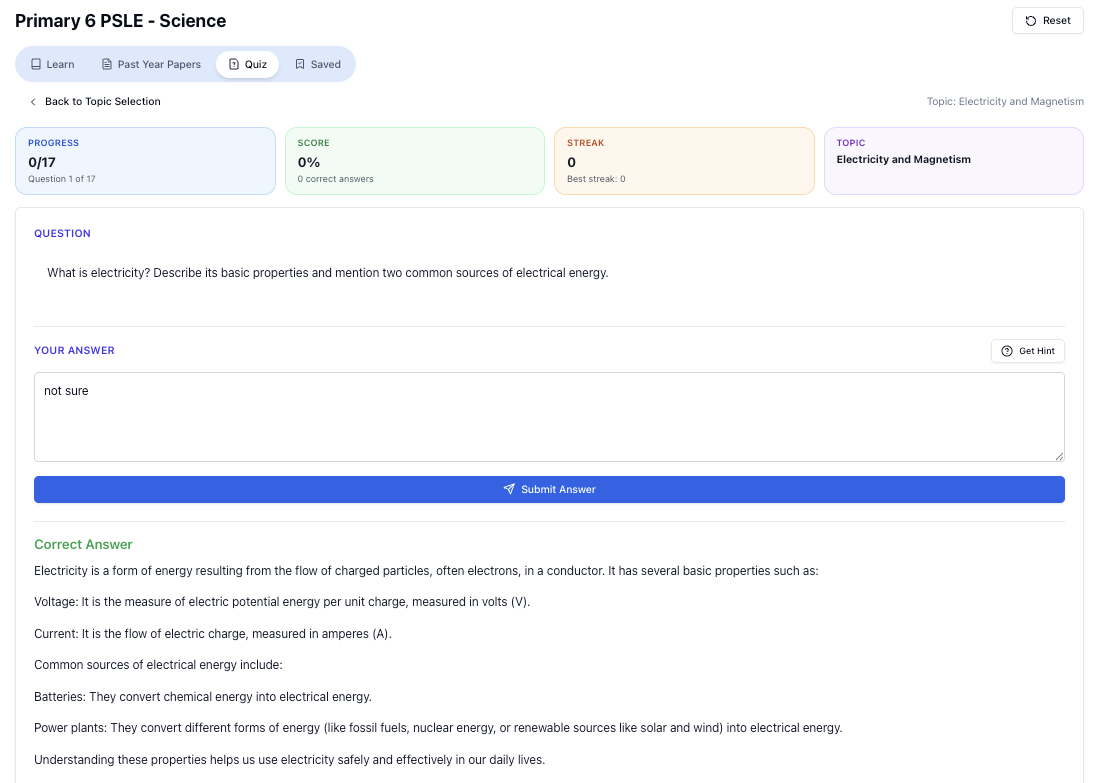
“Practice PSLE Science questions and get clear, step-by-step answers instantly.”
👉 Try a question now and see how fast you can improve.
Free on Tutorly.sg
Practise Geometry and measurement with step-by-step help — free to start
On Tutorly.sg/app you can practise unlimited Singapore syllabus questions, get instant explanations when you are stuck, and use past-year papers — no sign-up needed to start.
- ✓ PSLE, O Level, A Level, and more
- ✓ Step-by-step working when you are stuck
- ✓ Works on phone and laptop