

Free on Tutorly.sg
Practise with step-by-step help — free to start
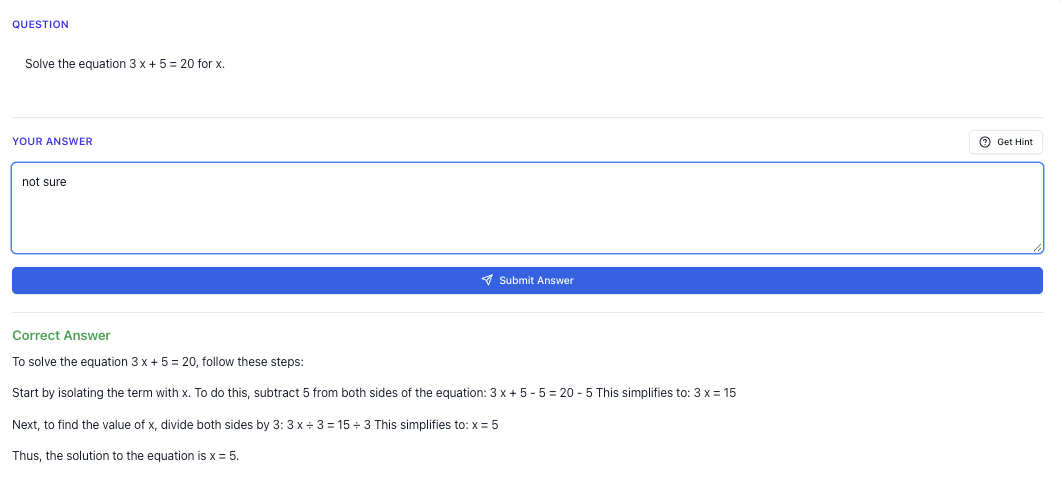
On Tutorly.sg/app you can practise unlimited Singapore syllabus questions, get instant explanations when you are stuck, and use past-year papers — no sign-up needed to start.
- ✓ PSLE, O Level, A Level, and more
- ✓ Step-by-step working when you are stuck
- ✓ Works on phone and laptop
Sec 3 Physics can feel like a huge jump from lower sec science.
Suddenly you’re dealing with formulas, graphs, vectors, and a lot of new terms. On top of that, you’re thinking about O-Levels, CCA, and maybe even tuition schedules.
“Stuck on a question? See simple explanations that help you understand fast.”
👉 Give it a try and turn confusion into clarity in minutes.
This guide is for you if:
- You’re in Sec 3 (or early Sec 4) in Singapore
- You’re following the MOE O-Level Physics or Pure Physics syllabus
- You want to build a solid foundation now, so Sec 4 and O-Levels won’t feel like a nightmare
I’ll walk you through how to:
- Understand the core Sec 3 topics that matter most for O-Levels
- Study Physics in a step-by-step way (not just memorise formulas)
- Practise with exam-style questions, including tougher variants
- Avoid common mistakes that cost marks in O-Level papers
- Use Tutorly.sg, a AI tutor built for Singapore students, to get help any time
Tutorly.sg has already been used by thousands of students in Singapore, and it has even been mentioned on Channel NewsAsia (CNA), so you’re not experimenting with something random off the internet.
You can check it out here:
- Main AI tutor page: https://tutorly.sg/ai-tutor-singapore
- Direct web app: https://tutorly.sg/app
Step-by-step tutorial
Let’s go through a practical, Sec 3-focused Physics roadmap, using topics that almost every Singapore school covers in Sec 3:
- Physical Quantities, Units & Measurement
- Kinematics (Speed, Velocity, Acceleration)
- Forces & Newton’s Laws
- Density & Pressure
- Work, Energy & Power
Instead of trying to “cover everything”, I’ll show you how to think about each topic in a way that prepares you for O-Levels.
1. Physical quantities & units: Get the basics bulletproof
This is usually the first topic, and many students treat it as “easy marks”. But if you’re careless here, those “easy marks” disappear.
Key ideas you must be solid in:
-
Base quantities vs derived quantities
- Base: length (m), mass (kg), time (s), current (A), temperature (K or °C in school), amount of substance (mol)
- Derived: speed (m/s), density (kg/m³), force (N), pressure (Pa), etc.
-
SI units
Always convert to SI units before using formulas:- cm → m
- g → kg
- min, h → s
-
Prefixes
- kilo- (), centi- (), milli- (), micro- ()
Mini practice (try first, then check):
- Convert:
- (a) to m
- (b) to kg
- (c) to s
Answers:
- (a)
- (b)
- (c)
On Tutorly.sg, you can just type something like:
“Convert 5.6 cm to m and explain each step like I’m Sec 3.”
It won’t just spit out the answer; it will walk you through how to think about the conversion, so you can reuse the method in harder questions.
2. Kinematics: From words to equations
Kinematics is a huge foundation topic for O-Levels. If you get this right in Sec 3, later topics like Dynamics and even some Sec 4 questions become much easier.
Key quantities:
- Distance (m) – how far you travelled
- Displacement (m) – how far from start, in a straight line (with direction)
- Speed (m/s) – distance ÷ time
- Velocity (m/s) – displacement ÷ time (with direction)
- Acceleration (m/s²) – change in velocity ÷ time
Core formulas you must know:
- (for constant speed)
Where:
- 𝑢 = initial velocity
- 𝑣 = final velocity
- 𝑠 = displacement
- 𝑡 = time
- 𝑎 = acceleration
Step-by-step example (basic)
A car starts from rest and accelerates uniformly at for .
(a) Find its final velocity.
(b) Find the distance travelled.
Step 1: Identify given values
- Starts from rest →
Step 2: Find final velocity
Use :
Step 3: Find distance travelled
Use :
How to practise this properly
- Always write down given values first.
- Decide which formula fits the given values (don’t blindly use the same one).
- Check if the situation is uniform acceleration or constant speed.
On Tutorly.sg, you can ask:
“Give me 5 Sec 3 kinematics questions with uniform acceleration, and then show full solutions after I try.”
You can attempt each question on your own, then compare your working with the step-by-step solution.
3. Forces & Newton’s Laws: Visualising before calculating
Many Sec 3 students jump straight into formulas like without really understanding what the forces are. That’s when mistakes happen.
Key ideas:
- Force is a push or pull that can change the motion of an object.
- Common forces: weight, normal reaction, friction, tension, applied force.
- Newton’s First Law: If resultant force = 0, object is at rest or moving at constant velocity.
- Newton’s Second Law:
- Newton’s Third Law: Action–reaction pairs (equal in magnitude, opposite in direction, act on different bodies).
Step-by-step example (basic)
A box is pulled horizontally on a smooth surface with a horizontal force of . Find its acceleration.
Step 1: Identify forces
- Horizontal pulling force:
- Surface is smooth → friction is negligible
- Resultant horizontal force =
Step 2: Use
Upgrade to a slightly harder case
Same box, but now there’s friction of opposing motion.
Resultant force:
Acceleration:
Notice how the steps are:
- Identify all forces
- Find resultant force
- Apply
You can practise this style of thinking on Tutorly.sg by asking:
“Give me 3 Sec 3 Newton’s Second Law questions with friction, and explain the concept of resultant force in each solution.”
4. Density & pressure: Don’t just plug numbers
These two topics are common in Sec 3 and appear frequently in O-Level Paper 1 and Paper 2.
Density
- = density (kg/m³)
- 𝑚 = mass (kg)
- 𝑉 = volume (m³)
Pressure
For solids:
- 𝑃 = pressure (Pa)
- 𝐹 = force (N)
- 𝐴 = area (m²)
For liquids (later on):
Step-by-step example
A metal block has mass and volume . Find its density.
In questions where units are tricky (e.g. cm³, g), convert to SI units before using formulas.
5. Work, energy & power: Link to real-life understanding
Key formulas:
- Work done: (when force is parallel to displacement)
- Gravitational potential energy:
- Kinetic energy:
- Power:
Step-by-step example
A object is lifted vertically above the ground. Take .
(a) Find the increase in gravitational potential energy.
(b) If this is done in , find the power.
(a) Potential energy:
(b) Power:
Exam strategy guide
Sec 3 may not be your O-Level year, but how you study now will decide how stressed you’ll be in Sec 4.
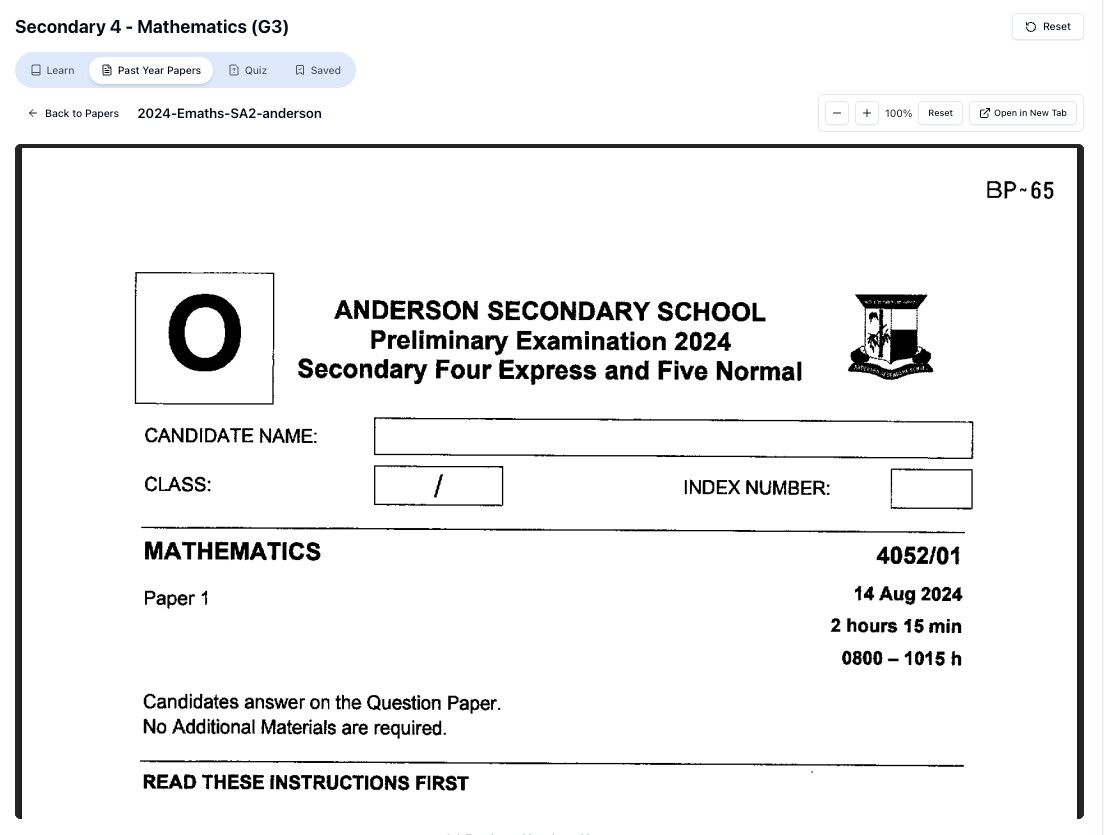
“Access more than 1000+ past year papers to practice”
👉 Start a paper today and test yourself like it’s the real exam.
Here’s a focused strategy for Singapore’s O-Level style Physics.
1. Know the exam structure early
For O-Level Pure Physics (6091), you’ll eventually face:
- Paper 1: MCQ
- Paper 2: Structured & free-response
Even in Sec 3, your school tests usually follow a similar pattern: a mix of MCQs and structured questions.
Use this to your advantage:
- When revising a topic, always do both:
- Quick MCQs (to check conceptual understanding)
- Longer structured questions (to practise explanation and calculation)
On Tutorly.sg, you can alternate like this:
- “Give me 5 Sec 3 Physics MCQs on kinematics.”
- “Now give me 3 structured questions on kinematics at O-Level standard.”
This simulates how real exams test you.
2. Build formulas from concepts, not memory
Instead of memorising a long list of formulas, try to understand:
- What each quantity means (units, physical meaning)
- How the formula is derived (at least roughly)
- When it is valid (e.g. only for uniform acceleration)
For example, in kinematics:
- and come from the idea of uniform acceleration.
- If acceleration is not constant, these formulas don’t apply.
You can ask Tutorly.sg things like:
“Explain why the formula v² = u² + 2as is true, but keep it at Sec 3 level.”
This helps you actually understand, so you’re less likely to mix formulas up under exam stress.
3. Time management during exams
Free on Tutorly.sg
Practise with step-by-step help — free to start
On Tutorly.sg/app you can practise unlimited Singapore syllabus questions, get instant explanations when you are stuck, and use past-year papers — no sign-up needed to start.
- ✓ PSLE, O Level, A Level, and more
- ✓ Step-by-step working when you are stuck
- ✓ Works on phone and laptop
For a typical school exam or weighted assessment:
- Spend the first 2–3 minutes scanning the paper.
- Start with questions you find moderately easy (not the absolute easiest, not the hardest).
- Leave time at the end (5–10 minutes) for:
- Checking units
- Checking significant figures
- Making sure you actually answered the question (not just did some random calculation)
Quick timing rule:
- 1 mark ≈ 1 minute (roughly)
- So an 8-mark structured question should take around 8 minutes, not 20.
When practising with Tutorly.sg, you can simulate timing:
“Give me a Sec 3 Physics structured question worth 6 marks on forces. I will try to finish it in 6 minutes. Show me the full solution after.”
4. Learn to read question keywords
Many students lose marks because they misread the command words:
- “State” → one word or short phrase
- “Define” → exact definition (often must include key phrases)
- “Explain” → link cause and effect (use “because”, “so that”, “therefore”)
- “Describe” → say what happens, in sequence or in detail
- “Calculate” → show working, with units
You can copy a question into Tutorly.sg and ask:
“Explain what the examiner wants when they say ‘Explain’ in this question, and show me a sample answer at Sec 3 level.”
This trains you to answer in the style examiners expect.
5. Use Sec 3 as your “trial year”
Instead of waiting for Sec 4 panic, use Sec 3 to:
-
Figure out your weak topics (e.g. graphs, vectors, algebra in Physics)
-
Practise proper working layout:
- Given values
- Formula
- Substitution
- Final answer with units
-
Build a question bank:
- Save tough questions from school worksheets
- Add similar questions from Tutorly.sg
- Revisit them before major exams
Worksheet practice
Let’s go through some exam-style practice, including harder variants that are closer to O-Level level, but still accessible for Sec 3.
Try each question before looking at the solution.
Practice Set 1: Kinematics
Q 1 (basic)
A cyclist travels at a constant speed of for .
(a) Convert to seconds.
(b) Find the distance travelled.
Solution:
(a)
(b)
Q 2 (intermediate)
A car is moving at and brakes uniformly to rest in .
(a) Find its acceleration.
(b) Find the distance it travels while braking.
Solution:
(a) , ,
(Negative sign means deceleration.)
(b) Use (another valid kinematics formula):
Q 3 (harder variant – closer to O-Level)
A car accelerates uniformly from rest to in . It then continues at this constant speed for another before braking uniformly to rest in .
(a) Find the acceleration during the first .
(b) Find the total distance travelled during the entire motion.
Solution:
(a) , , :
(b) Break into 3 stages.
Stage 1: Accelerating (0–10 s)
Use :
Stage 2: Constant speed (10–40 s)
Speed = , time = :
Stage 3: Braking (40–45 s)
From to in :
Use :
Total distance:
“Doing Secondary Science? Pick a topic and practise like it’s a real exam — with clear answers right after.”
👉 Try Tutorly now and start a Science topic in seconds.

On Tutorly.sg, you could ask:
“Give me a velocity-time graph question similar to this car motion problem, and then explain the solution step-by-step.”
Practice Set 2: Forces & Newton’s Laws
Q 4 (intermediate)
A object is pulled along a horizontal surface by a horizontal force of . The frictional force is .
(a) Find the resultant horizontal force.
(b) Find the acceleration.
Solution:
(a) Resultant force:
(b) Use :
Q 5 (harder variant – two-body system)
Two boxes, 𝐴 and 𝐵, of masses and respectively, are in contact on a smooth horizontal surface. A horizontal force of is applied on box 𝐴, pushing both boxes.
(a) Find the acceleration of the system.
(b) Find the contact force between the two boxes.
Solution:
Total mass =
(a) Acceleration of the system:
(b) Consider only box B (mass ):
- The only horizontal force on B is the contact force from A, call it .
- This force causes B to accelerate at .
So:
This type of question is very common in O-Level papers. Once you’re comfortable with this, you’re on the right track.
You can tell Tutorly.sg:
“Give me 3 more two-box contact force questions at Sec 3 level, and then show the full solutions.”
Practice Set 3: Density & Pressure
Q 6 (basic)
A liquid has density . Find the mass of of this liquid.
Solution:
Use :
Q 7 (harder variant – pressure & area)
A wooden block of weight rests on a horizontal floor. The base of the block has dimensions by .
(a) Find the area of contact with the floor.
(b) Find the pressure exerted on the floor.
(c) The block is turned so that a face of area is in contact with the floor. Find the new pressure and compare.
Solution:
(a) Area:
(b) Pressure:
(c) New area = (given)
New pressure:
In this special case, the area happens to be the same, so the pressure is unchanged. In most other questions, you’ll see pressure increase when area decreases.
You can ask Tutorly.sg:
“Give me a question where changing the orientation of a block changes the pressure, and explain clearly why the pressure changes.”
Practice Set 4: Work, Energy & Power
Q 8 (intermediate)
A object is moving at .
(a) Find its kinetic energy.
(b) If it comes to rest after sliding $
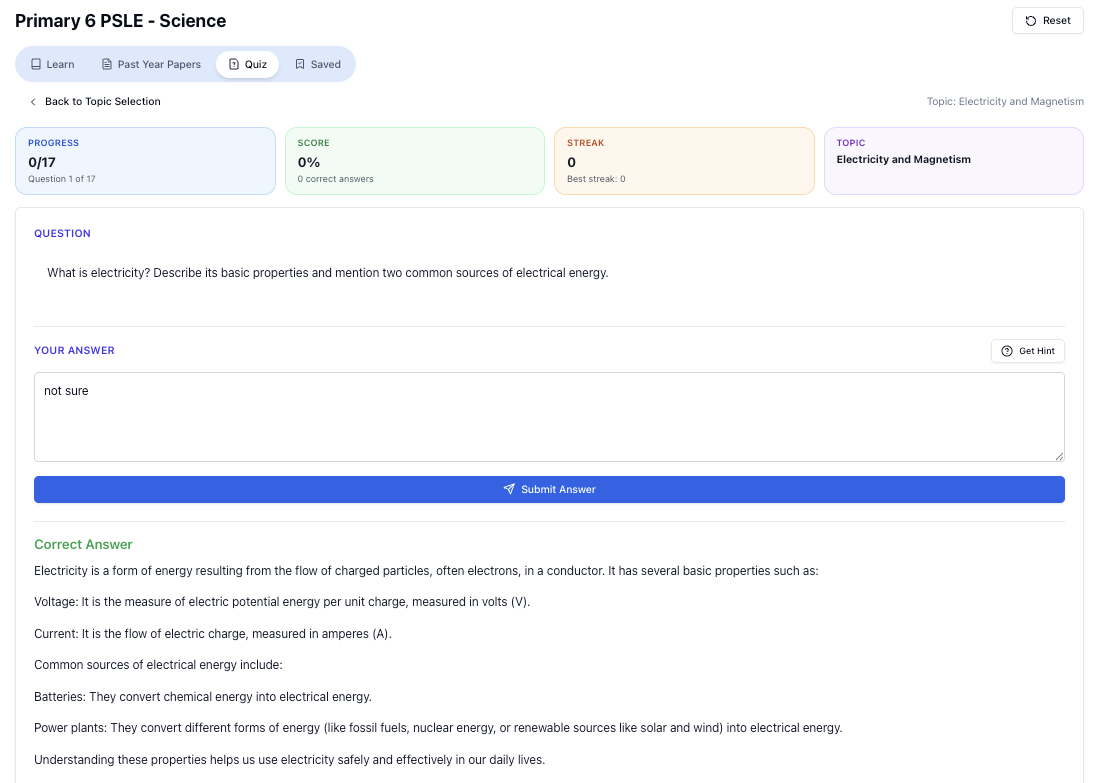
“Practice PSLE Science questions and get clear, step-by-step answers instantly.”
👉 Try a question now and see how fast you can improve.
Ready to practise?
If you want a Singapore-focused AI tutor you can use immediately (website, no sign-up), try Tutorly here:
Related Articles
Free on Tutorly.sg
Practise with step-by-step help — free to start
On Tutorly.sg/app you can practise unlimited Singapore syllabus questions, get instant explanations when you are stuck, and use past-year papers — no sign-up needed to start.
- ✓ PSLE, O Level, A Level, and more
- ✓ Step-by-step working when you are stuck
- ✓ Works on phone and laptop