

Free on Tutorly.sg
Practise with step-by-step help — free to start
On Tutorly.sg/app you can practise unlimited Singapore syllabus questions, get instant explanations when you are stuck, and use past-year papers — no sign-up needed to start.
- ✓ PSLE, O Level, A Level, and more
- ✓ Step-by-step working when you are stuck
- ✓ Works on phone and laptop
If you’re in Sec 3 IP Math right now, you probably already feel it:
- The pace is faster than lower sec
- Questions are suddenly more “twisty”
- Teachers assume you remember everything from Sec 1–2 perfectly
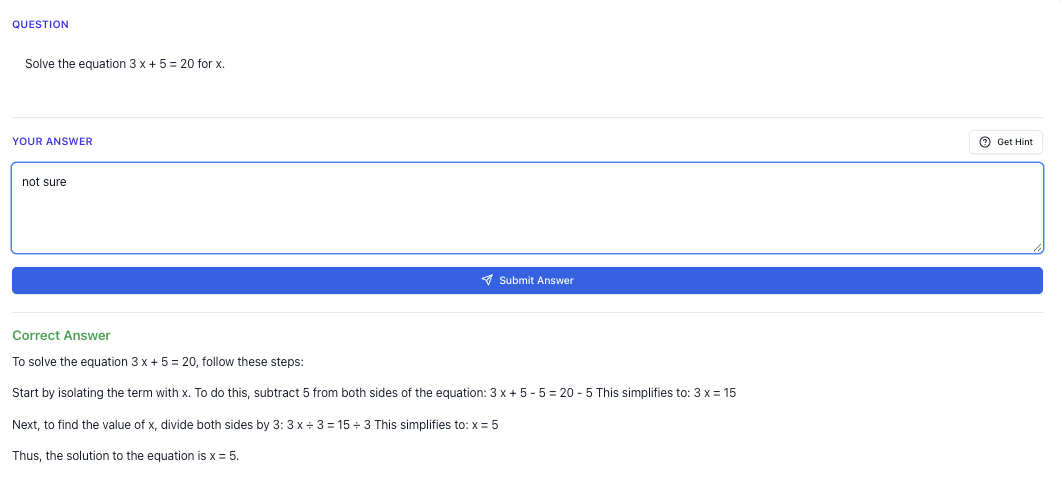
“Stuck on a question? See simple explanations that help you understand fast.”
👉 Give it a try and turn confusion into clarity in minutes.
And on top of that, you know that what you’re learning now feeds straight into Sec 4 IP, then A-Level H 2 Math or equivalent. So it’s normal to feel stressed.
This guide is for you if:
- You’re in Sec 3 IP (or just starting)
- You want to actually understand IP Math, not just copy solutions
- You’re considering tuition or extra support, but don’t want to waste time or money
I’ll walk you through:
- How to rebuild your foundation fast
- A step-by-step way to approach common Sec 3 IP Math topics
- Specific exam strategies for IP-style questions
- How to design your own worksheets (with hard variants)
- Common mistakes IP students in Singapore keep making
And I’ll also show you how to use Tutorly.sg as a “on-call tutor” that fits your school schedule — especially on nights when your brain is fried and your actual tutor is sleeping.
Tutorly.sg is a Singapore-built AI tutor website aligned with the MOE syllabus, used by thousands of students here and even mentioned on Channel NewsAsia (CNA). It’s not a mobile app; you just go to the website and start asking questions.
Why Sec 3 IP Math Feels So Hard (And Why It’s Normal)
Sec 3 IP Math is tough mainly because:
-
Depth jumps, not just content
You’re not just doing more topics; you’re doing harder variations of the same topics. For example:- Not just solving linear equations, but embedding them into functions and graphs
- Not just Pythagoras, but full coordinate geometry proofs
-
Speed of teaching
IP schools often cover content earlier and faster than O-Level tracks, so teachers expect you to be independent. -
Cumulative nature
Weak in algebra? It hits you in:- Quadratic equations
- Functions
- Coordinate geometry
- Trigonometry
So if you feel like “everything is linked and collapsing together”, that’s honestly quite common.
Good news: If you fix your algebra, equations, and basic geometry now, Sec 4 IP and JC will feel much more manageable.
That’s where targeted Sec 3 IP Math tuition — whether with a human tutor or an AI tutor like Tutorly.sg — can really help: not by teaching more, but by fixing the right things.
Step-by-step tutorial
Let’s walk through a structured way to handle Sec 3 IP Math, focusing on three core areas:
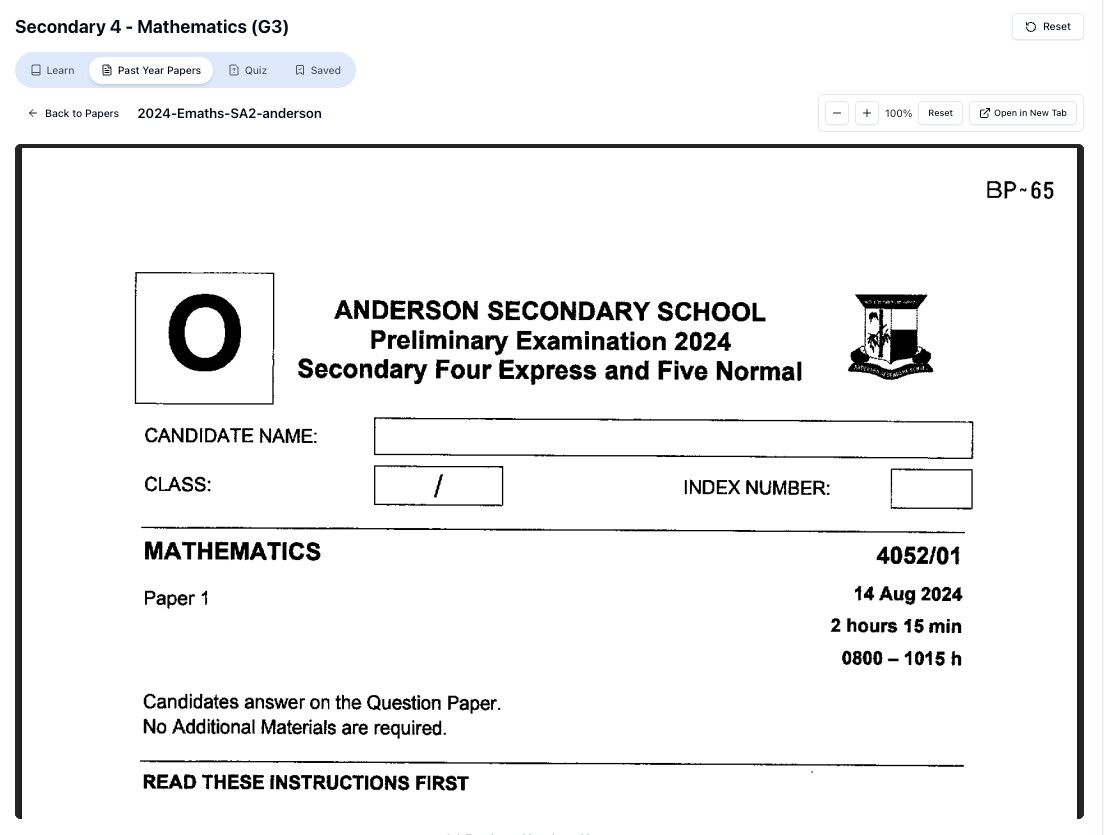
“Access more than 1000+ past year papers to practice”
👉 Start a paper today and test yourself like it’s the real exam.
- Algebra & Quadratics
- Functions & Graphs
- Trigonometry & Coordinate Geometry
I’ll show you how to think, not just what to memorise.
1. Algebra & Quadratics: Your Core Survival Kit
If your algebra is shaky, everything else becomes torture. Here’s a step-by-step way to stabilise it.
1.1 Factorisation and Expansion
You must be 100% comfortable with:
- Common factor
- Difference of squares:
- Perfect square:
- General quadratic:
Step-by-step approach:
-
Identify the pattern
- Check if form?
- Check if it’s a perfect square?
- If not, use splitting middle term (for factorisable quadratics).
-
Try simple factorisation first
Example: Factorise- Multiply
- Find two numbers that multiply to -60 and add to : and -4
- Rewrite:
- Group:
- Factor: 3𝑥(2𝑥 + 5) - 2(2𝑥 + 5)
- Final: (3𝑥 - 2)(2𝑥 + 5)
-
Check by re-expanding (at least for tricky ones)
How Tutorly.sg can help here
If you key in:
“Factorise (Sec 3 IP Math)”
Tutorly will:
- Check your final answer
- Show you a full working solution step-by-step
- Explain why we split the middle term this way
You can then try a similar question and see if you can do it without help.
1.2 Solving Quadratic Equations
You should be able to solve quadratics using:
- Factorisation
- Completing the square
- Quadratic formula:
Step-by-step method (general):
- Bring everything to one side:
- Check if factorisable
- If yes, factor and solve.
- If not, choose:
- Completing the square (good for understanding and graphing)
- Quadratic formula (fast and reliable)
Example: Solve
- Discriminant:
- or
For IP, teachers often expect you to:
- Interpret the discriminant
- Link roots to the graph of
So when you solve a quadratic, always ask:
- Is or <0?
- What does that tell me about the graph?
2. Functions & Graphs: From Equations to Pictures
Sec 3 IP Math usually pushes you harder on functions:
- Function notation: 𝑓(𝑥)
- Domain and range
- Transformations of graphs
- Sketching graphs using key points
2.1 Understanding Function Notation
When you see :
- 𝑓(2) means “substitute ”
- 𝑓(𝑎 + 1) means “substitute everywhere”
Step-by-step:
- Replace 𝑥 with the given expression
- Simplify carefully
- If needed, factor or expand
Example:
, find 𝑓(𝑎+2)
IP questions often hide algebra practice inside function notation, so treat it as an algebra test.
2.2 Graph Transformations (IP Favourite)
You’ll see questions like:
- “The graph of is transformed to . Describe the transformation.”
- “Sketch given the graph of .”
Basic transformations (you should memorise these):
- → shift up by 𝑎
- → shift right by 𝑎
- → shift left by 𝑎
- → reflect in the x-axis
- → reflect in the y-axis
- → vertical stretch by factor 𝑎
Step-by-step when you see a transformed function:
- Identify the base graph (e.g. )
- Write down the transformations in order
- Apply them logically, even if you’re sketching roughly
3. Trigonometry & Coordinate Geometry: The “Application” Zones
These topics often show up in longer IP questions with multiple parts (prove this, hence find that, etc.).
3.1 Trigonometry Basics
You must know:
And key identities:
- \sin^2 \theta + \cos^2 \theta = 1
Step-by-step for a typical problem:
- Draw the triangle (mentally if needed)
- Label sides: opposite, adjacent, hypotenuse
- Choose the right ratio: sine, cosine, or tangent
- Write the equation, then solve
In IP, they like to:
- Mix trig with algebra
- Use angles in radians (depending on your school)
- Embed trig inside coordinate geometry
3.2 Coordinate Geometry
Key formulas you must be automatic with:
- Distance:
- Midpoint:
- Gradient:
- Equation of a line:
Typical IP-style question flow:
- Use midpoint formula to show a point lies on a line
- Use gradients to prove lines are parallel or perpendicular
- Use distance to show a triangle is isosceles or right-angled
- Combine with algebra to find unknown coordinates
Step-by-step approach:
- Write down all coordinates clearly
- Organise: which formula for which part?
- Show full working, not just final answer
- Always state: “ gradient of AB gradient of CD = -1, AB ⟂ CD”
Exam strategy guide
Sec 3 IP exams are often designed to prepare you for Sec 4 IP and A-Level style questions. Here’s how to handle them smartly.
1. Know the Weightage and Style
Most IP Sec 3 papers roughly follow this idea:
- Paper 1: Shorter questions, more direct, no calculator (depending on school)
- Paper 2: Longer, structured questions, more application
Ask your teacher or check past-year papers to see:
- How many marks are usually on algebra, graphs, trig, geometry
- Whether your school likes “prove that” questions
- Whether they test beyond typical O-Level depth
Then you can target your practice more precisely.
2. 3-step Plan for Any IP Question
No matter how weird the question looks, try this:
Free on Tutorly.sg
Practise with step-by-step help — free to start
On Tutorly.sg/app you can practise unlimited Singapore syllabus questions, get instant explanations when you are stuck, and use past-year papers — no sign-up needed to start.
- ✓ PSLE, O Level, A Level, and more
- ✓ Step-by-step working when you are stuck
- ✓ Works on phone and laptop
-
Decode the question
- Underline what they want: “find”, “show that”, “hence”
- Circle key numbers/expressions
- Translate words into math (e.g. “twice as large” → 2𝑥)
-
Plan the method before jumping in
Ask yourself:- Is this algebra, trig, coordinate geometry, or graphs?
- Which formula or concept is this question trying to test?
- Is there a diagram I should mentally picture?
-
Execute slowly but neatly
- One step per line
- Keep your equals signs aligned
- Leave some space between parts
When you’re stuck, write something:
- A formula
- A small sub-result
- A simple substitution
IP marking schemes often award method marks, so don’t leave blanks.
3. Time Management for Sec 3 IP Papers
Let’s say you have a 2-hour paper with 80 marks.
A simple rule:
- 1.5 minutes per mark as a rough guide
- So a 5-mark question: ~7–8 minutes
- A 10-mark question: ~15 minutes
Practical tips:
- Start with questions you know you can do (confidence boost).
- For long questions, glance through all parts (a), (b), (c) first.
- If you’re stuck for more than 3–4 minutes, move on and come back later.
You can even practise this timing using Tutorly.sg:
- Take a question from your school worksheet
- Try it under self-imposed timing
- If stuck, ask Tutorly for a hint or full solution
- Compare your method with the worked solution
4. How to Use Tutorly.sg as “On-demand IP Tuition”
Here’s a practical way to combine school + tuition + Tutorly:
-
After school / tuition
- Take a topic you didn’t fully understand (e.g. “completing the square”)
- Ask Tutorly:
“Explain completing the square for Sec 3 IP Math with a simple example.”
-
While doing homework
- Try the question yourself first
- If your final answer doesn’t match the school answer, ask:
“This is the question: [paste question]. My answer is 5, but the answer key says 7. Show me a step-by-step solution.”
-
Before exams
- Use Tutorly to generate similar practice questions:
“Give me 5 Sec 3 IP-level questions on quadratic graphs with answers.” - Attempt them, then ask for full solutions to check your understanding.
- Use Tutorly to generate similar practice questions:
Since Tutorly.sg is a website, you can access it anytime on your laptop or browser — no need to download anything.
You can explore it here:
- Main AI tutor page: https://tutorly.sg/ai-tutor-singapore
- Direct access to the web app: https://tutorly.sg/app
Worksheet practice
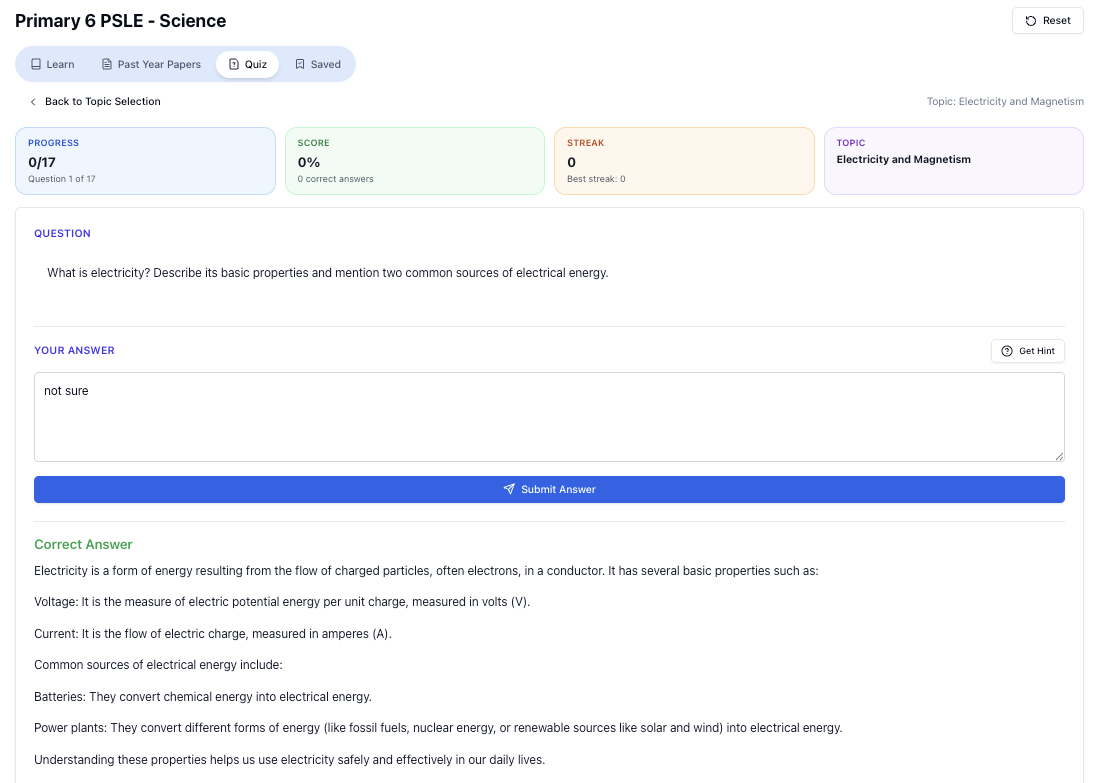
“Doing Secondary Science? Pick a topic and practise like it’s a real exam — with clear answers right after.”
👉 Try Tutorly now and start a Science topic in seconds.

If you want to improve, you need deliberate practice, not just random questions.
Here’s how to structure your own Sec 3 IP Math “mini-worksheets”, with examples — including some harder variants similar to what IP schools like to throw in.
1. Algebra & Quadratics Practice
Basic Level (Warm-up)
-
Factorise:
(a)
(b)
(c) -
Solve:
(a)
(b)
What to do:
- Time yourself: aim for 1–2 minutes per question
- Check answers using Tutorly or your textbook
- If you’re slow or keep making sign errors, you need more of these
Intermediate Level
-
Solve using the quadratic formula:
(a)
(b) (check the discriminant) -
Given that is a root of , find the value of 𝑘.
Harder variant (IP-style):
- A quadratic equation has roots 2 and 5.
(a) Find the values of 𝑝 and 𝑞.
(b) Hence, find the quadratic equation whose roots are and .
This tests your understanding of sum and product of roots, not just mechanical solving.
2. Functions & Graphs Practice
Conceptual Practice
-
Let .
(a) Find 𝑓(0), 𝑓(1), 𝑓(3).
(b) Solve .
(c) Hence, state the 𝑥-intercepts of the graph of . -
Given , find:
(a) 𝑔(3)
(b) 𝑔(𝑎)
(c) 𝑔(2𝑎 + 1)
Harder Graph / IP-style Variants
-
The graph of is transformed to the graph of .
(a) Describe the transformation.
(b) State the coordinates of the vertex of the new graph.
(c) Write down the equation of the axis of symmetry. -
The function 𝑓 is defined by for .
(a) Express 𝑓(𝑥) in the form .
(b) Hence, find the minimum value of 𝑓(𝑥) and the value of 𝑥 at which it occurs.
(c) Solve the equation .
Question 9 is very IP-flavoured: completing the square, interpreting the minimum, then solving a related equation.
You can create more like this by asking Tutorly:
“Generate 5 Sec 3 IP questions on completing the square and graph interpretation, with answers only.”
Then try them under timed conditions.
3. Trigonometry & Coordinate Geometry Practice
Standard Practice
-
In a right-angled triangle, , cm, cm.
(a) Find , , and .
(b) Find the length of BC. -
Points 𝐴(2, 3) and 𝐵(8, -1) are given.
(a) Find the gradient of AB.
(b) Find the length of AB.
(c) Find the coordinates of the midpoint of AB.
Harder IP-style Variants
-
Points 𝐴(1, 2), 𝐵(5, 𝑘) and 𝐶(9, 6) lie on a straight line.
(a) Show that the gradient of AC is 1.
(b) Hence, find the value of 𝑘.
(c) Find the equation of the line passing through 𝐴 and 𝐶. -
In triangle ABC, 𝐴(1, 2), 𝐵(7, 2) and 𝐶(4, 8).
(a) Show that triangle ABC is isosceles.
(b) Find the area of triangle ABC.
(c) Find the equation of the perpendicular bisector of AB.
These questions force you to combine:
- Distance formula
- Gradient
- Basic geometry reasoning
If you want more challenging variants, you can ask Tutorly:
“Give me a hard Sec 3 IP coordinate geometry question involving perpendicular bisectors and midpoints, with full solution.”
How to Mark and Learn From Your Practice
When you finish a mini-worksheet:
-
Mark your final answers first
-
For every wrong answer, ask:
- Did I misunderstand the concept?
- Or was it just a careless mistake?
-
For conceptual mistakes:
- Re-do the question from scratch without looking
- Then ask Tutorly to show a step-by-step solution and compare
-
For careless mistakes:
- Circle them in a different colour
- Note patterns (e.g. sign errors, miscopying numbers)
This is how you turn practice into actual improvement, not just “doing more questions”.
Common mistakes
Here are some of the most common issues I see with Sec 3 IP Math students in Singapore — and what you can do differently.
1. Weak Algebra but Jumping to “Hard” Questions
Many students want to “practise hard IP questions” but still:
- Struggle to expand (𝑥+2)(𝑥-3) correctly
- Mix up signs when factorising
- Can’t solve without help
Fix:
Spend 1–2 weeks doing pure algebra drills:
- Factorisation
- Expansion
- Solving linear and quadratic equations
Use Tutorly to generate sets of 10–15 questions each day and clear them quickly. You’ll see your confidence in every topic rise.
2. Memorising Steps Without Understanding
Example: You know how to “complete the square” because you memorised the pattern, but:
- You don’t know what the vertex actually means
- You can’t apply it when the numbers change slightly
Fix:
-
After doing a question, ask yourself:
“What did this method help me find?”
E.g. “Completing the square helps me find the vertex and minimum/maximum value.” -
Occasionally, ask Tutorly:
“Explain why we complete the square for quadratics, in Sec 3 IP context.”
Understanding the why makes it much easier to adapt to IP-style twists.
3. Skipping Working Steps
In IP, examiners care a lot about:
- Logical flow
- Clear reasoning
- Proper statements (especially in geometry)
If you jump from line 1 to line 4 with no explanation, you lose method marks even if your final answer is correct.
Fix:
- Force yourself to write one logical step per line
- Use proper math language:
- “ , triangle ABC is isosceles.”
- “
“Practice PSLE Science questions and get clear, step-by-step answers instantly.”
👉 Try a question now and see how fast you can improve.
Ready to practise?
If you want a Singapore-focused AI tutor you can use immediately (website, no sign-up), try Tutorly here:
Related Articles
Free on Tutorly.sg
Practise with step-by-step help — free to start
On Tutorly.sg/app you can practise unlimited Singapore syllabus questions, get instant explanations when you are stuck, and use past-year papers — no sign-up needed to start.
- ✓ PSLE, O Level, A Level, and more
- ✓ Step-by-step working when you are stuck
- ✓ Works on phone and laptop