

Free on Tutorly.sg
Practise Fractions and Ratios with step-by-step help — free to start
On Tutorly.sg/app you can practise unlimited Singapore syllabus questions, get instant explanations when you are stuck, and use past-year papers — no sign-up needed to start.
- ✓ PSLE, O Level, A Level, and more
- ✓ Step-by-step working when you are stuck
- ✓ Works on phone and laptop
Quick answer
When PSLE fraction questions look different from what you've seen, it's normal to feel stuck. Remember, they're just different shapes of the same puzzle. I'll show you how to break down four tricky examples step-by-step, so you won’t freeze up in exams.
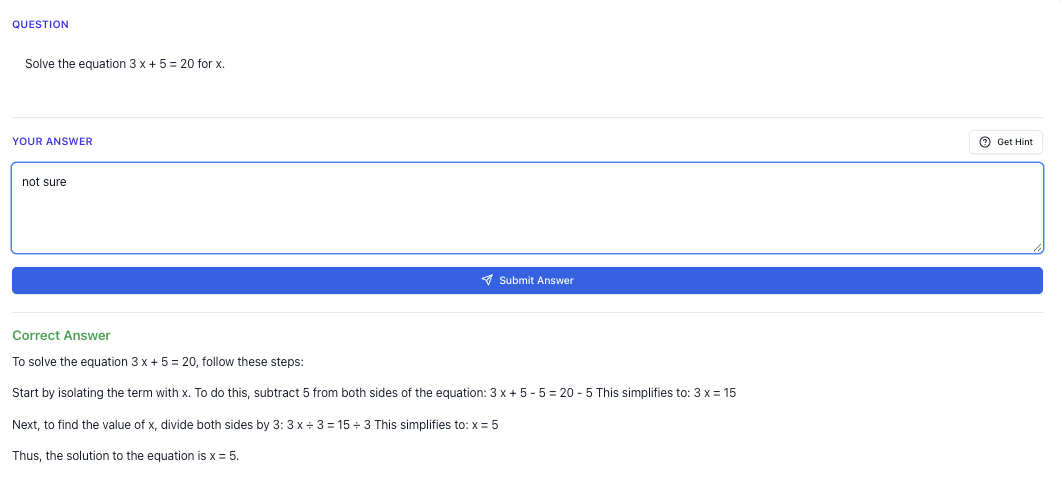
“Stuck on a question? See simple explanations that help you understand fast.”
👉 Give it a try and turn confusion into clarity in minutes.
What you need to know
Fractions are parts of a whole. For example, if you cut a cake into eight slices and eat one, you've eaten of the cake. Ratios compare two quantities, like 2:3, meaning for every 2 apples, there are 3 oranges. They're like recipes or directions.
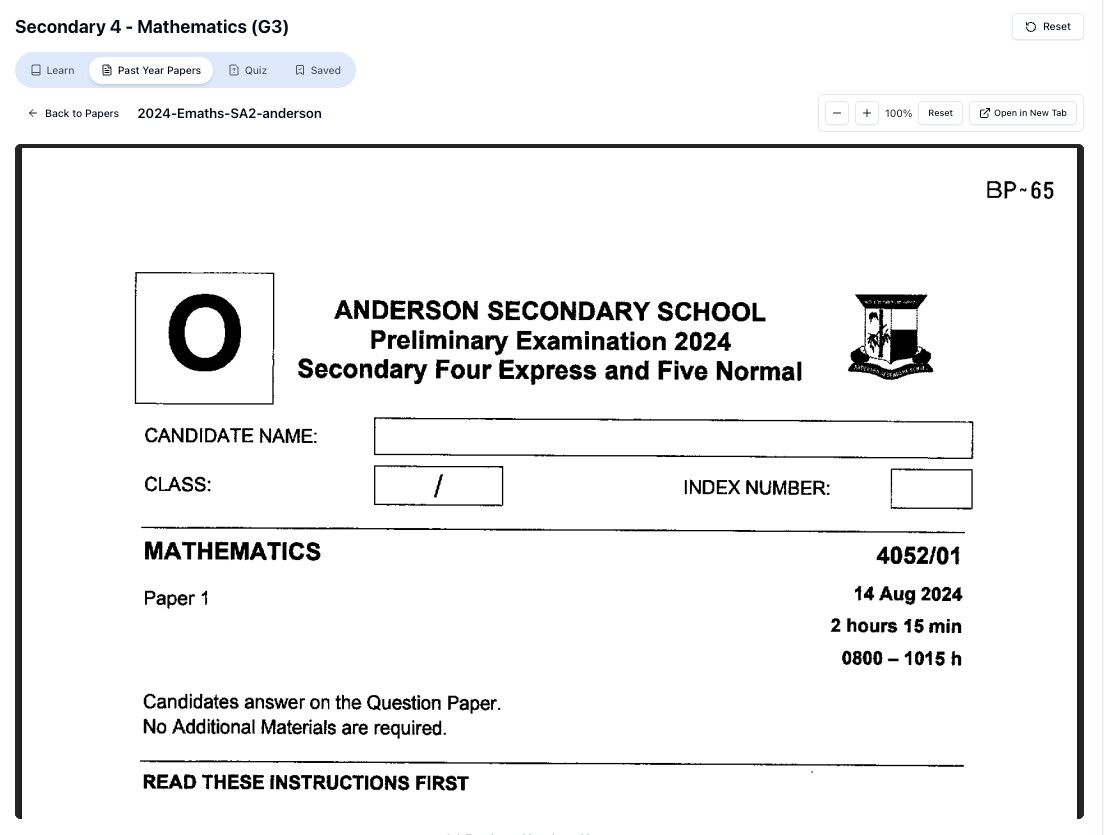
“Access more than 1000+ past year papers to practice”
👉 Start a paper today and test yourself like it’s the real exam.
Understanding Fractions and Ratios
Fractions
Fractions show how many parts of a whole you have. The top number is the numerator (how many parts you have), and the bottom number is the denominator (total parts).
Ratios
Ratios are comparisons. If you see 2:3, it says for every 2 of one thing, there are 3 of another. Like 2 cups of rice to 3 cups of water.
Quick check
- What is of a pizza?
- If the ratio of cats to dogs is 1:2, how many dogs are there if you have 3 cats?
Common mistakes students make
- Mixing up numerators and denominators: Remember, the numerator is on top, the denominator is below. Check if you flip them.
- Forgetting to simplify: Always simplify fractions unless the question says not to. becomes .
- Incorrect ratio comparison: Ensure the order is right. 2:3 is not the same as 3:2.
Exam tip
In exams, presentation matters. Write your fractions neatly, and always label your answers. If you’re comparing ratios, check the order twice. Time management is key—don't spend too long on one question. Move on and come back if needed.
Worked examples
Question 1
A pizza is cut into 8 slices. You eat 3 slices. What fraction of the pizza did you eat?
Solution
Step 1: Identify the total number of slices (denominator) and the slices eaten (numerator).
Why: This sets up the fraction.
Step 2: Write the fraction: .
Why: It shows the part you ate out of the whole pizza.
Step 3: Check if it can be simplified. It can't.
Why: Always check to make sure your answer is in its simplest form.
Question 2
In a class, the ratio of boys to girls is 3:4. If there are 12 boys, how many girls are there?
Solution
Step 1: Set up the ratio 3:4 = 12:x (boys to girls).
Why: This creates an equation to solve for x.
Step 2: Cross-multiply to find x: .
Why: Cross-multiplication helps us find the unknown value.
Step 3: Simplify to solve for x: .
Why: Divide by 3 to find the number of girls.
Question 3
You have of a chocolate bar and give of it to a friend. How much do you have left?
Solution
Step 1: Find of by multiplying: .
Why: Multiplying fractions finds parts of parts.
Step 2: Simplify to .
Why: Simplifying gives the clearest answer.
Step 3: Subtract from by converting to common denominators: .
Why: Common denominators let you subtract directly.
Step 4: Simplify to .
Why: Always simplify for final answers.
Question 4
“Doing Secondary Science? Pick a topic and practise like it’s a real exam — with clear answers right after.”
👉 Try Tutorly now and start a Science topic in seconds.

A recipe needs a ratio of 5:2 for flour to sugar. If you have 10 cups of flour, how much sugar is needed?
Solution
Step 1: Set the ratio 5:2 = 10:x.
Why: Set up an equation to find the unknown quantity.
Step 2: Cross-multiply: $5 x = 20.
Why: This eliminates the fraction to solve for x.
Step 3: Solve for x: .
Why: Divide by 5 to find how much sugar you need.
Quick summary
- Fractions are parts of a whole; ratios compare quantities.
- Always simplify fractions unless told otherwise.
- Set up equations for ratios to solve unknowns.
- Cross-multiply to solve ratio problems.
- Practice makes perfect—try daily revisions.
FAQ
Q 1: What is the easiest way to understand fractions?
A: Think of fractions as slices of cake. The denominator is total slices, the numerator is slices you have.
Q 2: How do I solve a fraction subtraction problem?
A: Find a common denominator, then subtract the numerators.
Q 3: How can I remember to simplify fractions?
A: Always check if both numbers can be divided by the same number after every step.
Q 4: What if I mix up ratios?
A: Write the items in the order given—first number matches first item.
Free on Tutorly.sg
Practise Fractions and Ratios with step-by-step help — free to start
On Tutorly.sg/app you can practise unlimited Singapore syllabus questions, get instant explanations when you are stuck, and use past-year papers — no sign-up needed to start.
- ✓ PSLE, O Level, A Level, and more
- ✓ Step-by-step working when you are stuck
- ✓ Works on phone and laptop
Free practice
Try it yourself
Try similar questions with step-by-step help on Tutorly
- ✓ Unlimited similar questions
- ✓ Step-by-step help when you are stuck
- ✓ No sign-up needed to start
Practise with free question sets
Work through more exam-style questions with answers and step-by-step solutions:
- [40+ Primary 5 Fractions Practice Questions for 2026 (based on Singapore MOE Syllabus)](/questions/p 5-fractions-questions)
- [35+ Primary 6 PSLE Ratio Practice Questions for 2026 (based on Singapore MOE Syllabus)](/questions/p 6-ratio-questions)
- 35+ Primary 6 PSLE Heuristics Practice Questions for 2026 (based on Singapore MOE Syllabus)
- Topic study hub
Want unlimited similar questions with AI marking? Practise on Tutorly.sg/app
Related Topics You Should Learn Next
- PSLE Math Fractions & Ratios: Clear Steps to Stop Losing Marks
- How to Solve PSLE Math Word Problems: Step-by-Step Guide (2026)
- PSLE Math Heuristics Questions Singapore: Clear Steps To Tackle The Tricky Ones
- Common PSLE Math Question Types In Singapore (With Strategies & Practice)
Breathe first, see ah, once this clicks, the rest is easier!
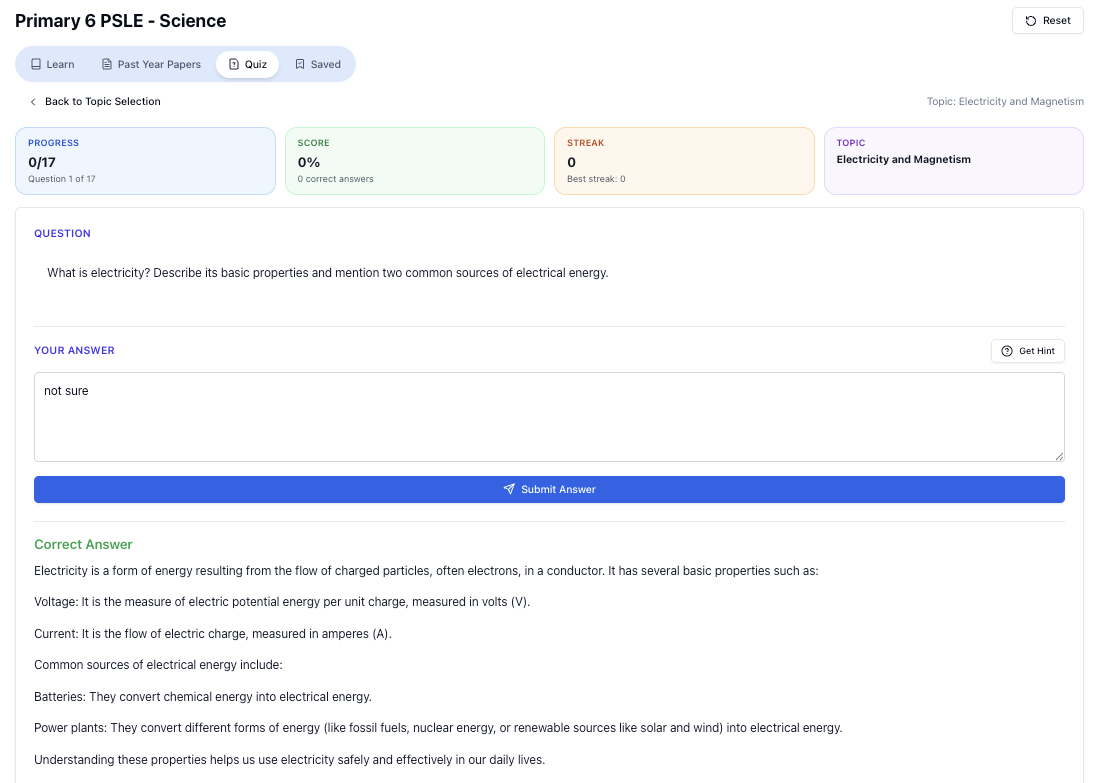
“Practice PSLE Science questions and get clear, step-by-step answers instantly.”
👉 Try a question now and see how fast you can improve.
Free on Tutorly.sg
Practise Fractions and Ratios with step-by-step help — free to start
On Tutorly.sg/app you can practise unlimited Singapore syllabus questions, get instant explanations when you are stuck, and use past-year papers — no sign-up needed to start.
- ✓ PSLE, O Level, A Level, and more
- ✓ Step-by-step working when you are stuck
- ✓ Works on phone and laptop