

Free on Tutorly.sg
Practise Vectors with step-by-step help — free to start
On Tutorly.sg/app you can practise unlimited Singapore syllabus questions, get instant explanations when you are stuck, and use past-year papers — no sign-up needed to start.
- ✓ PSLE, O Level, A Level, and more
- ✓ Step-by-step working when you are stuck
- ✓ Works on phone and laptop
Quick answer
Vectors in O Level Mathematics often trip students up because they look different from the examples you’ve practised. But don’t worry. Once you understand how to break down the problem step by step, you’ll find that most of the methods you need are familiar. This guide will help you tackle vectors questions without freezing up.
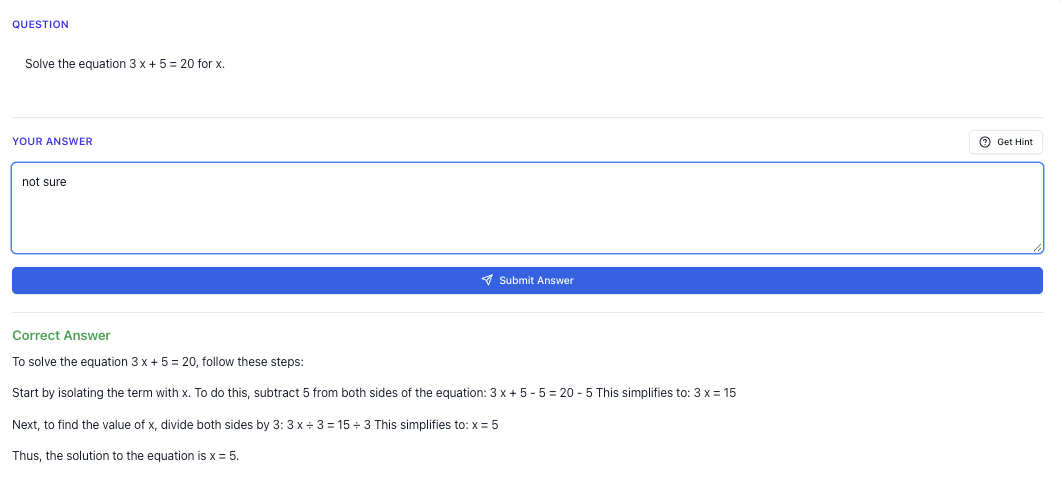
“Stuck on a question? See simple explanations that help you understand fast.”
👉 Give it a try and turn confusion into clarity in minutes.
What you need to know
A vector is a mathematical object with both magnitude (size) and direction. In simpler terms, it tells you not only how far something moves but also where it's moving to. You'll usually see them represented as arrows or in coordinates like (𝑥, 𝑦). In O Level exams, vectors often appear in questions that require you to find resultant vectors, magnitudes, or directions.
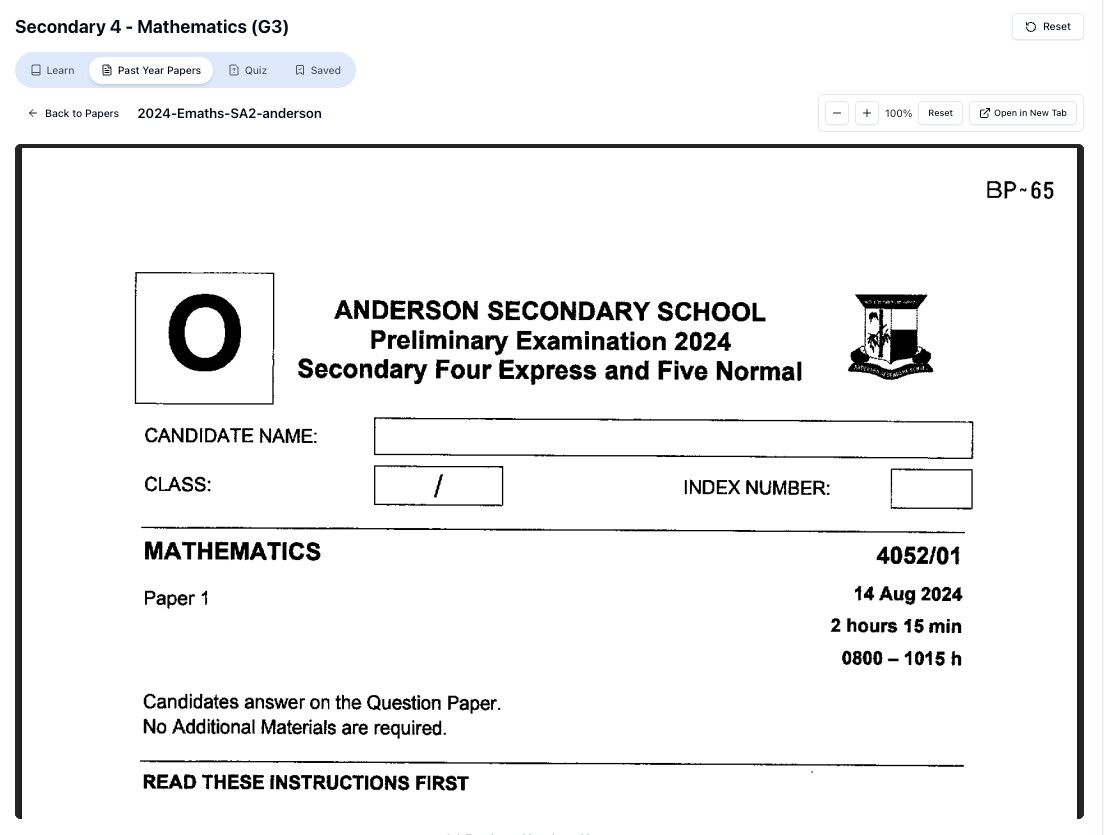
“Access more than 1000+ past year papers to practice”
👉 Start a paper today and test yourself like it’s the real exam.
Key concepts
Recognising vector notation
In exams, vectors are often presented in bold (like u) or with an arrow on top (like ). They can also be written in coordinate form, such as (2, 3), meaning 2 units in the x-direction and 3 units in the y-direction.
Vector addition and subtraction
To add or subtract vectors, you simply add or subtract their corresponding components. For example, if a = (2, 3) and b = (1, 4), then a + b = (2+1, 3+4) = (3, 7).
Multiplying a vector by a scalar
When you multiply a vector by a scalar (a single number), you multiply each component of the vector by that number. For instance, if you have 2a and a = (2, 3), then 2a = (22, 23) = (4, 6).
Common mistakes students make
- Freezing when the question looks different: Remember, vectors are just like directions on a map. Break them down into steps you know.
- Rushing algebra steps: This is where many students lose unnecessary marks. Slow down and check each component.
- Ignoring vector direction: Sometimes students calculate the magnitude but forget the direction. Always check both parts.
Exam tip
When you see a vector question, quickly sketch a diagram if possible. It helps to visualise the problem and often reveals the solution. Remember, clear working and neat presentation can gain you marks even if the final answer is wrong.
Worked examples
Question 1
Find the resultant vector of u = (4, -3) and v = (-1, 5).
Solution
Step 1: Add the corresponding components of the vectors.
Why: This gives you the resultant vector, which is like finding the total movement in both directions.
u + v = (4 + (-1), -3 + 5)
Step 2: Simplify the expression.
Why: Simplification gives you the final answer in a clean, readable form.
Resultant vector = (3, 2)
Question 2
Calculate the magnitude of the vector w = (3, 4).
Solution
Step 1: Use the formula for magnitude, .
Why: This formula gives you the length of the vector, similar to finding the length of the hypotenuse in a right triangle.
Magnitude of w =
Step 2: Calculate the square of each component and add them.
Why: This step is necessary to apply the Pythagorean theorem.
=
Step 3: Take the square root of the sum.
Why: The square root gives you the actual length of the vector.
=
Question 3
Determine the vector p if 3p = (6, 9).
Solution
Step 1: Divide each component by the scalar 3.
Why: This reverses the multiplication by a scalar to find the original vector.
“Doing Secondary Science? Pick a topic and practise like it’s a real exam — with clear answers right after.”
👉 Try Tutorly now and start a Science topic in seconds.

p =
Step 2: Simplify the components.
Why: Simplification gives you the final answer in a clean, readable form.
p = (2, 3)
Question 4
If a = (2, 3) and b = (5, -2), find the vector from a to b.
Solution
Step 1: Subtract the coordinates of a from b.
Why: This gives you the vector pointing from one point to another.
Vector from a to b = (5 - 2, -2 - 3)
Step 2: Simplify the expression.
Why: Simplification gives you the final answer in a clean, readable form.
= (3, -5)
Quick summary
- Vectors have both direction and magnitude.
- Add/subtract vectors by their components.
- Multiply vectors by scalars by multiplying each component.
- Use the formula to find vector magnitude.
- Draw diagrams to visualise vector problems.
FAQ
Q 1: What is a vector?
A vector is a quantity that has both magnitude (how much) and direction (where to).
Q 2: How do I find the magnitude of a vector?
Use the formula , which is like finding the length of the hypotenuse in a triangle.
Q 3: What does it mean to multiply a vector by a scalar?
It means you multiply each component of the vector by the scalar number, changing the vector's magnitude but not its direction.
Q 4: How can I visualise vectors better?
Draw them as arrows on a graph. The length shows magnitude, and the arrow points in the direction.
Free on Tutorly.sg
Practise Vectors with step-by-step help — free to start
On Tutorly.sg/app you can practise unlimited Singapore syllabus questions, get instant explanations when you are stuck, and use past-year papers — no sign-up needed to start.
- ✓ PSLE, O Level, A Level, and more
- ✓ Step-by-step working when you are stuck
- ✓ Works on phone and laptop
Free practice
Try it yourself
Practise similar vector questions with step-by-step help on Tutorly
- ✓ Unlimited similar questions
- ✓ Step-by-step help when you are stuck
- ✓ No sign-up needed to start
Related Topics You Should Learn Next
- O Level Elementary Mathematics: Vectors and How to Master Them
- O Level Elementary Mathematics: Vectors Explained Simply
- O Level EMath Vectors Guide
- Learn More About Vectors
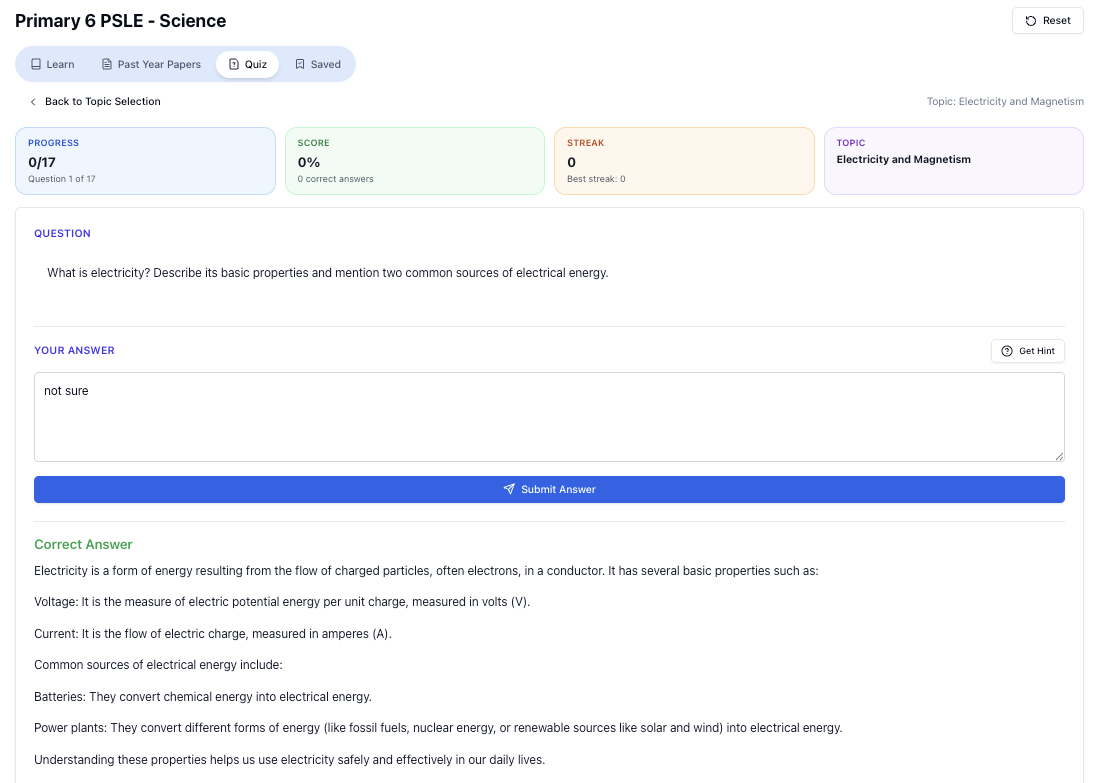
“Practice PSLE Science questions and get clear, step-by-step answers instantly.”
👉 Try a question now and see how fast you can improve.
Free on Tutorly.sg
Practise Vectors with step-by-step help — free to start
On Tutorly.sg/app you can practise unlimited Singapore syllabus questions, get instant explanations when you are stuck, and use past-year papers — no sign-up needed to start.
- ✓ PSLE, O Level, A Level, and more
- ✓ Step-by-step working when you are stuck
- ✓ Works on phone and laptop