

Free on Tutorly.sg
Practise with step-by-step help — free to start
On Tutorly.sg/app you can practise unlimited Singapore syllabus questions, get instant explanations when you are stuck, and use past-year papers — no sign-up needed to start.
- ✓ PSLE, O Level, A Level, and more
- ✓ Step-by-step working when you are stuck
- ✓ Works on phone and laptop
If you’re wondering whether getting an O Level Math tutor in Singapore actually helps, the short answer is: yes, a good tutor can easily be the difference between a C and an A, especially from Sec 3 onwards. The key is knowing how to use that help properly, and what options (private tutor, tuition centre, or an AI tutor like Tutorly.sg) fit your budget and schedule.
This guide walks you through:
- what expert O Level Math tutors really do,
- a step-by-step way to study each topic,
- concrete exam strategies for E Math and A Math,
- how to practise with harder variants (like actual O-Level style),
- and the common mistakes that keep Singapore students stuck at B 3–C 6.
“Stuck on a question? See simple explanations that help you understand fast.”
👉 Give it a try and turn confusion into clarity in minutes.
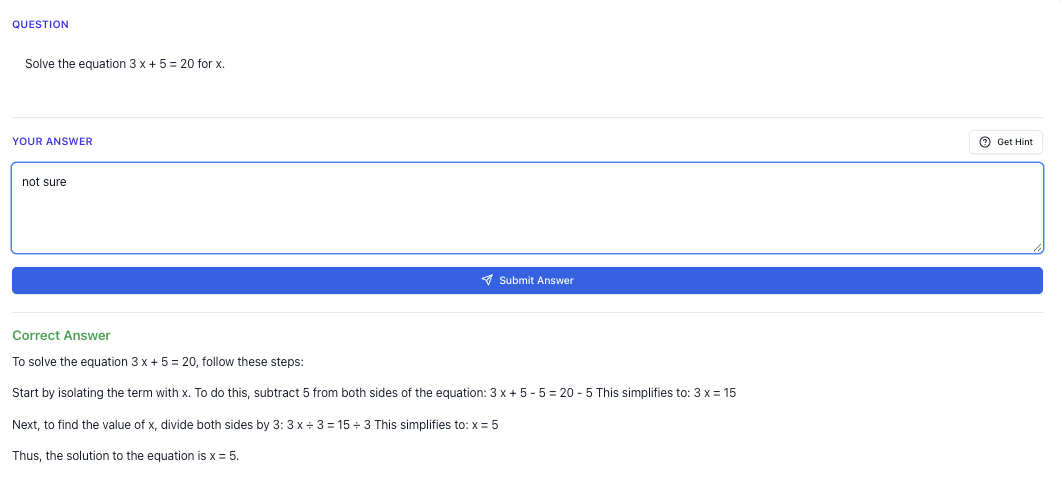
Throughout, I’ll also show you how to use Tutorly.sg alongside (or instead of) traditional tuition so you’re not just “doing more questions”, but actually improving.
Why an O Level Math Tutor Helps More Than Just “Practice”
By Sec 3–4, Math isn’t about memorising formulas anymore. It’s about:
- spotting patterns quickly,
- choosing the right method under time pressure,
- and avoiding careless mistakes when you’re tired.
A strong O Level Math tutor helps you:
-
Fill specific gaps fast
Maybe you’re okay with algebra, but indices and surds still confuse you. Or you can do bearings but always mess up trigonometry with 3 D diagrams. A good tutor zooms in on your weak areas instead of repeating what your teacher already covered. -
Translate MOE syllabus into exam-style thinking
The MOE syllabus is clear, but exam questions are often twisted: multi-step, real-world context, or mixing topics (e.g. algebra + graphs + inequalities in one question). Tutors who know the O Level trend can show you, “When you see this phrase, think of this method.” -
Give you exam-level questions early
School worksheets sometimes stay at the “basic” level for too long. An experienced tutor brings in harder questions—past year O Levels, top school prelims, or modified versions—to prepare you for the actual standard. -
Keep you consistent
With CCA, projects, and other subjects (Chem, Physics, Humanities…), it’s normal to push Math revision to “later”. Weekly sessions with a tutor or structured use of an AI tutor forces you to sit down and grind through the hard topics.
If you want a way to get step-by-step help anytime (even at 11.45pm the night before your test), you can try Tutorly instantly. It’s a AI tutor built specifically for Singapore’s MOE syllabus, and it’s been used by thousands of students here, even being mentioned on Channel NewsAsia (CNA).
What Are Your Options: Private Tutor vs Tuition Centre vs Tutorly.sg
Here’s a quick comparison of the three main choices Singapore students usually consider:
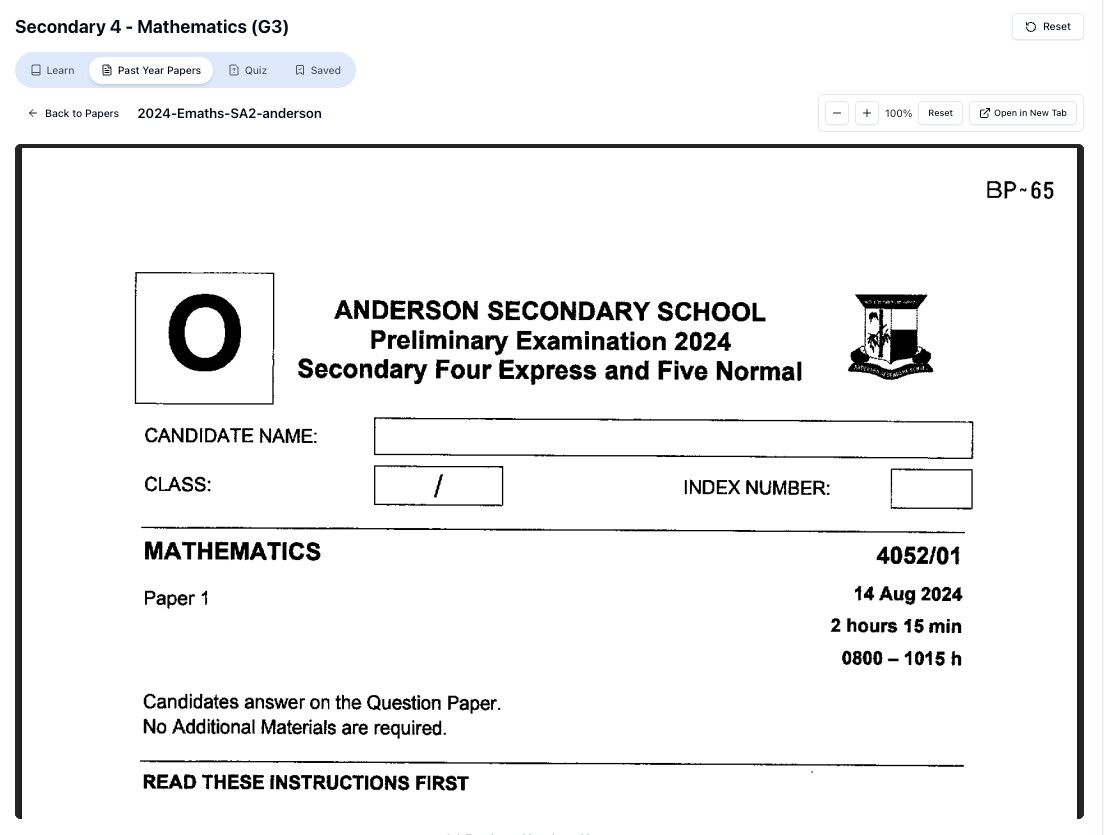
“Access more than 1000+ past year papers to practice”
👉 Start a paper today and test yourself like it’s the real exam.
| Option | Price (rough Singapore range) | Flexibility | Availability / Urgency |
|---|---|---|---|
| Private tutor | About $40–$120/hour depending on level & experience | High – can arrange 1-to-1, change timing if needed | Limited to tutor’s schedule; hard to get last‑minute help |
| Tuition centre | About $150–$400/month for weekly group lessons | Fixed slots; less flexible around CCA/exams | Must follow centre timetable; no instant help |
| Tutorly (website) | Free tier + affordable paid plans (no hourly rate) | Very high – use any time, any duration, from home | instant access; great for urgent questions and revision |
How to choose?
- If you struggle with fundamentals and need someone to watch you do questions live, a private tutor or small-group centre can be very helpful.
- If your basics are okay but you keep getting stuck on harder variants or exam twists, you might not need to pay $60/hour. A combination of school + Tutorly.sg + occasional consults can be enough.
- Many students do both: centre or private tutor weekly, and Tutorly nightly for homework and last-minute exam prep.
Step-by-step Tutorial: How to Learn an O Level Math Topic Properly
Let’s walk through a structured way to tackle any O Level Math topic, using quadratic equations (E Math) as an example. You can apply the same approach to indices, coordinate geometry, trigonometry, etc.
Step 1: Get the big picture
Before jumping into questions, you should know:
- What does this topic cover?
- What are the main types of questions that come out in exams?
For quadratics, the core ideas are:
- Standard form:
- Methods to solve: factorisation, completing the square, quadratic formula
- Graph interpretation: shape of parabola, roots, maximum/minimum point
Use your school notes or textbook to skim the chapter first. If something feels confusing (e.g. “Why complete the square?”), ask Tutorly or your tutor to explain in simple words before you start practising.
On Tutorly, you can go to Tutorly.sg/ai-tutor-singapore, choose your level and Math subject, and ask directly:
“Explain what quadratic equations are for O Level E Math, and show me the 3 main types of questions that usually come out.”
You’ll get a short, focused overview plus example questions.
Step 2: Master one method at a time
Using quadratics again:
-
Factorisation
Practise simple ones first:
Then move to trickier ones with coefficients:
-
Completing the square
First, do it when :
Then move to :
-
Quadratic formula
Use it when factorisation is messy or impossible:
For each method:
- Write down the steps in your own words.
- Do 5–10 questions of that type in one sitting.
- Check answers, then review why you got any wrong.
If you’re stuck, you can paste a question into Tutorly.sg/app, and it will give you the final answer and full working so you can compare with your own steps.
Step 3: Mix methods in one question
Exams rarely tell you which method to use. You need to decide.
Create or find questions like:
Solve
Solve
Solve
Ask yourself each time:
- Can this be factorised easily?
- If not, should I complete the square or use the formula?
You can even ask Tutorly:
“Give me 10 mixed quadratic equations for O Level E Math where I have to choose the method, and then show me the answers after I try.”
Do a batch, then check your answers. For any wrong one, don’t just accept the solution—figure out which decision you made wrongly (e.g. tried to factorise when it was messy, or made sign error in the formula).
Step 4: Apply to real exam-style problems
Once you’re okay with pure algebra questions, move to word problems and graphs:
- “Area of rectangle” questions that form a quadratic.
- Maximum profit / minimum cost questions.
- Graphs of , finding roots, vertex, and axis of symmetry.
This is where many students drop from A 1/A 2 to B 3 because they never practised forming the equation themselves.
Use your school exam papers, Ten-Year Series, or ask Tutorly:
“Give me 5 O Level E Math word problems that involve forming and solving quadratic equations, with answers and full working.”
Do them timed (e.g. 10–12 minutes per long question) to simulate Paper 2.
Step 5: Summarise and review
At the end of the topic:
- Write a one-page summary:
- Key formulas
- When to use each method
- Common mistakes you personally made
- File it in a topic folder. Before exams, these summaries are gold.
Exam Strategy Guide: E Math & A Math (Singapore O Levels)
1. Know the paper structure and mark distribution
For O Level E Math (subject code 4048):
- Paper 1: 1 h 30min, 80 marks, no calculator.
- Paper 2: 2 h, 100 marks, calculator allowed.
For A Math (subject code 4049):
- Paper 1: 2 h, 90 marks.
- Paper 2: 2 h, 90 marks.
Your strategy needs to match the paper:
- Paper 1 (no calculator) = speed + accuracy with algebra, indices, surds, standard form, simple geometry.
- Paper 2 = problem solving, word problems, graphs, coordinate geometry, trigonometry, probability, statistics.
2. Timing strategy
A simple rule that works well:
- For E Math Paper 1: 1 minute per mark (80 marks, 90 minutes).
- For E Math Paper 2: about 1.2 minutes per mark (100 marks, 120 minutes).
- For A Math: about 1.3 minutes per mark.
Practical approach:
- Circle the “long” questions (5–7 marks) at the start.
- Start with the shorter, straightforward questions to secure marks quickly.
- If you’re stuck for more than 3 minutes on a 2–3 mark question, move on and come back later.
You can practise this at home by doing a TYS paper under timed conditions, then checking with Tutorly to see where you spent too long.
3. How to handle different question types
Algebra-heavy questions
- Always simplify step-by-step.
- Write intermediate steps clearly to reduce careless mistakes.
- For A Math, especially in differentiation/integration, show substitution clearly.
Coordinate geometry & graphs
- Sketch a quick, rough graph in the margin.
- Label intercepts, turning points, asymptotes (for A Math).
- For inequalities with graphs, shade the region lightly and double-check the boundary lines ( vs <).
Trigonometry & geometry
- For 3 D trig (E Math), redraw the triangle flat with all lengths/angles labelled.
- Always check if the angle is between the sides you’re using (cosine rule) or opposite one side (sine rule).
- For bearings, mark the north line and measure clockwise.
4. Using past papers effectively
Don’t just do random questions. Use a cycle:
- Attempt a section (e.g. all algebra questions from 3 past papers).
- Mark using the answer scheme.
- For any question you lose marks on:
- Identify if it’s conceptual (don’t understand) or careless (silly mistake).
- Ask your tutor or Tutorly to re-explain that exact type in simpler terms.
- Redo the same question a few days later to see if the error is fixed.
If you’re practising late at night and your tutor isn’t around, paste the question into Tutorly.sg/app and ask:
“Show me step-by-step how to solve this E Math question, and explain where students usually make mistakes.”
Worksheet Practice: From Basic to Hard Exam Variants
Here’s how you can structure your own practice, even without a stack of assessment books. I’ll use E Math algebra & graphs as an example, but you can adapt this for other topics.
Level 1: Core skills (warm-up)
Aim: Build confidence and speed.
Examples:
-
Simplify:
-
Solve:
-
Factorise:
Free on Tutorly.sg
Practise with step-by-step help — free to start
On Tutorly.sg/app you can practise unlimited Singapore syllabus questions, get instant explanations when you are stuck, and use past-year papers — no sign-up needed to start.
- ✓ PSLE, O Level, A Level, and more
- ✓ Step-by-step working when you are stuck
- ✓ Works on phone and laptop
- Expand and simplify:
You should be able to do these almost mechanically. If this feels hard, you need to revisit lower sec basics with your tutor or ask Tutorly for a “Sec 2 algebra refresher” before pushing into O Level standard.
Level 2: Standard O Level style
Aim: Match typical mid-level exam questions.
Examples:
- Solve the simultaneous equations:
\begin{cases} 2𝑥 + 3𝑦 = 7 \\$𝑥 - 𝑦 = 4 \end{cases}6. The linel has equation 𝑦 = 2𝑥 - 3. (𝑎) Find the gradient of 𝑙. (𝑏) Find the 𝑦-intercept of 𝑙. (𝑐) 𝐴 point 𝑃(5, 𝑘) lies on 𝑙. Find 𝑘. 7. 𝐴 quadratic function is given by 𝑦 = 𝑥^2 - 4𝑥 + 3. (𝑎) Find the coordinates of the 𝑦-intercept. (𝑏) Factorise the quadratic and hence find the 𝑥-intercepts. (𝑐) Sketch the graph, showing all intercepts. These are the kind of questions you see in school tests and mid-year exams. ### Level 3: Hard exam variants (what pulls you up to 𝐴1) Now let’𝑠 look at questions that are more like **𝑂 Level / top school prelim**. **Hard Variant 1 – Mixed algebra & inequalities** > The cost, in dollars, of producing 𝑥 items is given by >𝐶 = 5𝑥 + 120> and the revenue, in dollars, from selling 𝑥 items is given by >𝑅 = 12𝑥 - 30
(a) Write down an expression for the profit 𝑃 in terms of 𝑥.
(b) Find the value of 𝑥 for which the company breaks even.
(c) Find the range of values of 𝑥 for which the company makes a profit.
This combines algebraic manipulation and inequalities in a real-world context. Many students can do (a) and (b) but fumble (c).
Hard Variant 2 – Graph interpretation
The diagram shows the graph of cutting the 𝑥-axis at the points (1, 0) and (5, 0).
(a) Find the value of 𝑘.
(b) Hence, or otherwise, find the minimum value of 𝑦.
Here you’re expected to link roots, factorisation, and completing the square.
Hard Variant 3 – A Math flavour (if you take A Math)
The function 𝑓 is defined by .
(a) Express 𝑓(𝑥) in the form .
(b) Hence, state the minimum value of 𝑓(𝑥) and the corresponding value of 𝑥.
(c) Solve the equation .
This is standard A Math, but the thinking is similar to E Math quadratics at a deeper level.
How to use Tutorly for worksheet practice
“Doing Secondary Science? Pick a topic and practise like it’s a real exam — with clear answers right after.”
👉 Try Tutorly now and start a Science topic in seconds.

Instead of just flipping through assessment books, you can:
- Go to Tutorly.sg/app.
- Ask for a custom worksheet, for example:
- “Give me 15 O Level E Math questions on simultaneous equations, from easy to hard, but don’t show answers until I ask.”
- Do them on paper.
- Check your final answers using Tutorly. For any wrong one, ask:
- “Show me step-by-step how to solve Question 7 and explain the main idea.”
This way, you get infinite practice without waiting for your tutor, and you only pay attention to the questions you actually got wrong.
Common Mistakes Singapore Students Make in O Level Math
Even hardworking students in Singapore often get stuck at B 3/B 4 because of a few recurring issues. Here are the big ones and what to do about them.
1. Memorising methods without understanding “when to use what”
Example: For quadratics, some students try to use the quadratic formula for everything, even when factorisation is faster and less error-prone.
Fix:
- For each topic, make a small decision guide, e.g. for quadratics:
- “If it factorises nicely → factorise.”
- “If not, and I need vertex/min value → complete the square.”
- “If messy or time is short → quadratic formula.”
You can ask Tutorly:
“Summarise when I should use factorisation vs completing the square vs quadratic formula for O Level E Math, in a table.”
Copy it down and keep it in your summary notes.
2. Weak algebra foundations
By Sec 4, topics like vectors, coordinate geometry, and even probability all rely on clean algebra. If you still:
- mix up signs,
- can’t factorise confidently,
- or expand brackets wrongly,
you will bleed marks everywhere.
Fix:
- Spend 2–3 weeks doing pure algebra drills daily (10–20 questions).
- Ask your tutor to focus one whole session just on algebra corrections.
- Use Tutorly to generate quick practice:
- “Give me 20 quickfire algebra simplification questions for E Math.”
It’s boring, but this is like strength training—everything else becomes easier.
3. Not showing enough working
Especially in E Math Paper 2 and both A Math papers, working = marks. If you only write final answers and they’re wrong, you get 0. If you show methods clearly, you can still get method marks.
Fix:
- Train yourself to write every key step, especially:
- Substitution into formulas.
- Rearranging equations.
- Squaring / square rooting both sides.
- When using Tutorly solutions, compare:
- “What steps did I skip that the model wrote out?”
Adjust your own style accordingly.
4. Ignoring the command words
Words like:
- “Show that…”
- “Hence, or otherwise…”
- “Find the exact value…”
have specific expectations.
Example: “Exact value” usually means no rounding, often leaving answers in surd or fraction form.
Fix:
- Underline command words in the question.
- At the end of each answer, quickly check:
- Did I round when I shouldn’t?
- Did I use the result from the previous part when it said “hence”?
You can ask Tutorly:
“Explain what ‘hence’ and ‘show that’ mean in O Level Math questions and how marks are awarded.”
5. Panicking when the question looks unfamiliar
Real-life scenario:
It’s one week before O Levels. You’re doing a 2021 Paper 2 and suddenly hit a question about a water tank with a weird shape. You’ve never seen that diagram before. Your mind blanks out, and you skip the whole 8-mark question.
This is very common.
Fix:
- Remember: questions look new, but they are built from old concepts.
- Ask yourself:
- Is this really just volume/area?
- Is this a rate of change problem in disguise?
- Is this a linear/quadratic relationship?
If you really can’t see it during practice, paste the question into Tutorly and ask:
“What topic is being tested in this question, and what’s the first step I should try?”
You’ll learn to recognise patterns instead of memorising fixed templates.
How Expert Tutors (and Tutorly) Fit Into Your Weekly Routine
To make all this practical, here’s how you can structure a typical Sec 4 week if you’re serious about improving your O Level Math grade.
Weekly structure (example)
1–2 sessions with a human tutor or centre (1.5–2 hours each)
Focus on:
- Explaining new or tough topics (e.g. trigonometry, coordinate geometry).
- Going through your school tests and prelim papers.
- Targeted teaching on your weak areas.
3–5 short self-study sessions (30–60 minutes each)
Use:
- School worksheets / TYS / assessment books.
- Tutorly.sg/app for:
- Instant checking of answers.
- Step-by-step guidance on hard questions.
- Generating extra practice for weak topics.
Weekend longer session (1.5–2 hours)
Do:
- One full Paper 1 or Paper 2 under timed conditions.
- Mark using answer schemes and Tutorly explanations.
- Summarise key mistakes in a notebook.
If you don’t have a regular tutor, you can still follow this routine using:
- School notes,
- TYS,
- and Tutorly as your on-demand tutor whenever you’re stuck.
Final Thoughts: Getting From Where You Are Now to Your Target Grade
Whether you’re aiming to:
- pull your E Math from C 6 to B 3 so you can pass overall,
- push from B 3 to A 1 for poly / JC entry,
- or manage both E Math and A Math without burning out,
the formula is similar:
- Fix your foundations (algebra, basic trig, number work).
- Learn each topic properly using a clear step-by-step approach.
- Practise exam-style questions, including hard variants.
- Analyse your mistakes instead of just doing more and more questions.
- Get consistent support—from a tutor, a centre, or a tool like Tutorly.
Thousands of students in Singapore have already used Tutorly.sg to get through stressful exam periods, and it’s even been mentioned on CNA for how it supports MOE students. If you’re feeling stuck, you don’t have to figure everything out alone at 1am.
Ready To Get Help Now?
You can start using Tutorly in under a minute:
- Go to https://tutorly.sg/app
- Choose your level and Math subject
- Ask your first question—anything from “explain this concept” to “help me with this exact exam question”
Use it alongside your school lessons and any tuition you already have. With consistent practice, smart strategies, and the right support, your O Level Math grade can move up—one topic, one worksheet, one paper at a time.
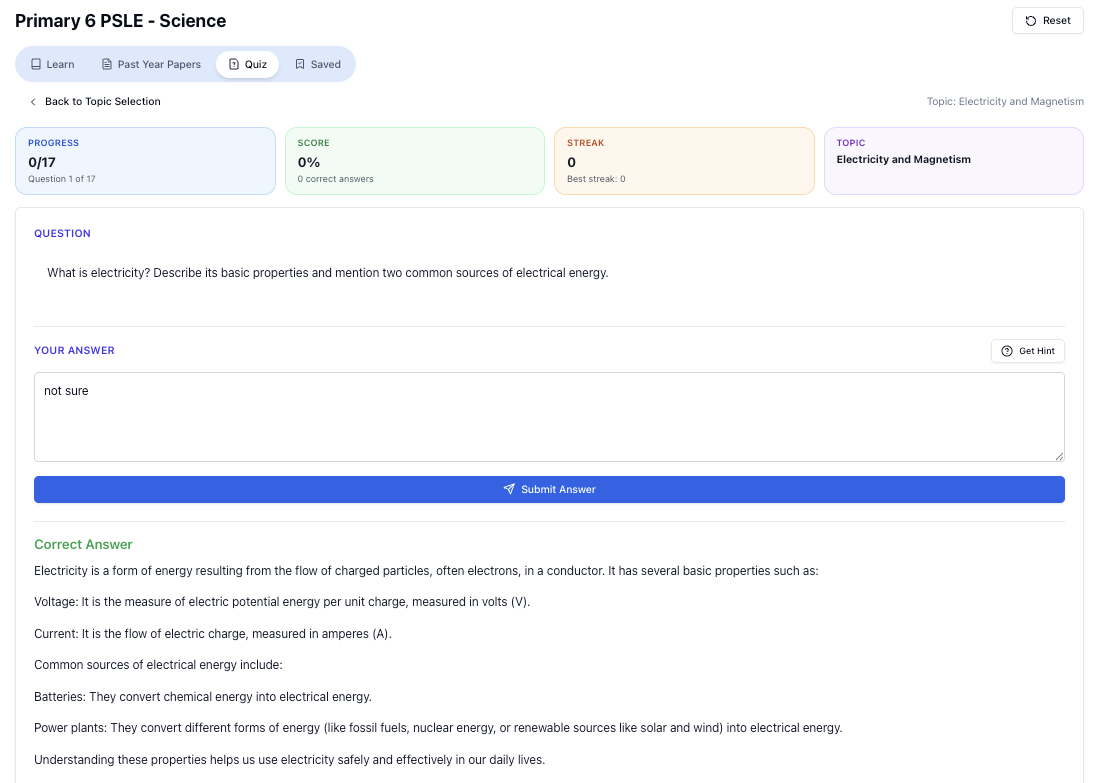
“Practice PSLE Science questions and get clear, step-by-step answers instantly.”
👉 Try a question now and see how fast you can improve.
Ready to practise?
If you want a Singapore-focused AI tutor you can use immediately (website, no sign-up), try Tutorly here:
Related Articles
Free on Tutorly.sg
Practise with step-by-step help — free to start
On Tutorly.sg/app you can practise unlimited Singapore syllabus questions, get instant explanations when you are stuck, and use past-year papers — no sign-up needed to start.
- ✓ PSLE, O Level, A Level, and more
- ✓ Step-by-step working when you are stuck
- ✓ Works on phone and laptop