

Free on Tutorly.sg
Practise with step-by-step help — free to start
On Tutorly.sg/app you can practise unlimited Singapore syllabus questions, get instant explanations when you are stuck, and use past-year papers — no sign-up needed to start.
- ✓ PSLE, O Level, A Level, and more
- ✓ Step-by-step working when you are stuck
- ✓ Works on phone and laptop
If you’re preparing for O Levels in Singapore, you need a clear plan: know the syllabus, practise exam-style questions regularly, and fix your weak topics early. With a structured roadmap, consistent practice, and the right tools (like Tutorly.sg), you can turn a stressful year into something manageable and score the grades you’re aiming for.
This guide walks you through a realistic, Singapore-specific O Level exam preparation strategy — not just “study hard”, but exactly how to plan your months, weeks, and days.
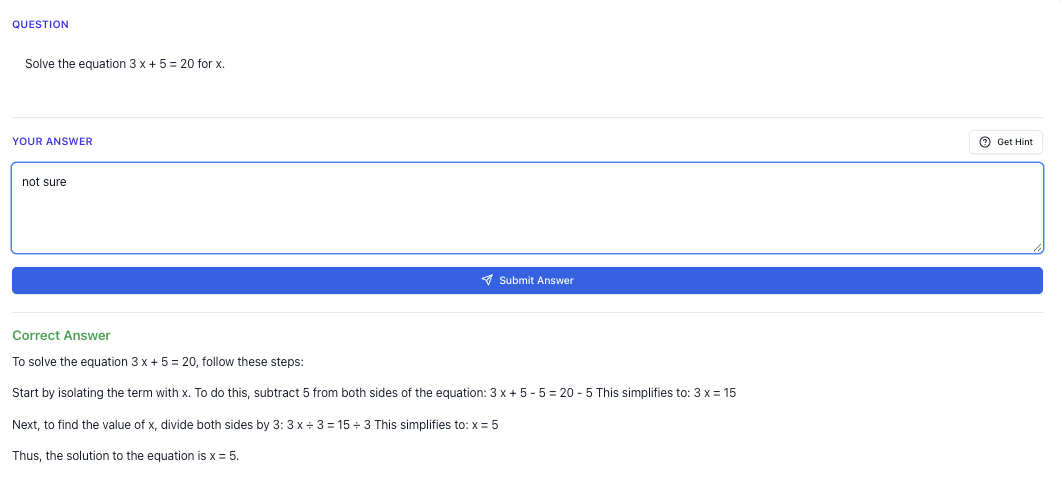
“Stuck on a question? See simple explanations that help you understand fast.”
👉 Give it a try and turn confusion into clarity in minutes.
Step-by-step tutorial
Let’s break O Level exam preparation into concrete stages, from now until your papers.
Step 1: Know your battlefield – MOE syllabus & exam format
Before you “study everything”, you need to know what exactly will be tested.
-
Download the MOE syllabus / SEAB documents
- Go to SEAB’s website and look up:
- GCE O-Level Mathematics / Additional Mathematics
- GCE O-Level English Language
- GCE O-Level Pure / Combined Sciences (Physics, Chemistry, Biology)
- Humanities (Social Studies, History, Geography, Literature), etc.
- For each subject, list down the main topics on a single page.
Example for E Math:- Numbers and Algebra
- Functions and Graphs
- Geometry and Measurement
- Trigonometry
- Statistics and Probability
- Go to SEAB’s website and look up:
-
Match topics to paper structure
- For each subject, write:
- Number of papers (e.g. E Math Paper 1 & 2)
- Duration (e.g. 2 hours)
- Marks and weightage
- Example (Combined Science Physics/Chemistry):
- Paper 1: MCQ (40 marks)
- Paper 2: Structured & Free Response (80 marks)
- Paper : Practical / Alternative to Practical
- For each subject, write:
-
Highlight high-yield topics
- Look at past-year papers from your school and Ten-Year Series (TYS).
- Circle topics that appear almost every year:
- E Math: algebraic manipulation, simultaneous equations, graphs, trigonometry, statistics.
- Pure Chem: chemical bonding, mole concept, acids/bases/salts, redox, qualitative analysis.
- Pure Physics: kinematics, forces, electricity, waves, thermal physics.
You don’t need to guess what might come out — the patterns are already there.
Step 2: Build a realistic long-term plan (6–8 months before O Levels)
If you’re reading this early in Sec 4 (or Sec 5), this is the ideal stage. If you’re later, you can compress the timeline but keep the structure.
1. Set subject-specific goals
Be honest about where you are now.
- Example:
- Current E Math grade: C 5
- Target for O Levels: A 2
- Then decide what that means:
- Secure all the “easy” marks (algebra, linear graphs, basic trig).
- Aim to be able to do at least 80–90% of TYS questions confidently.
2. Allocate weekly time per subject
Rough guideline for a typical Sec 4 O Level year (during school term):
- Core subjects (E Math, English, Mother Tongue, Pure/Combined Science):
~3–5 hours per week each (including school homework). - Humanities / Electives:
~2–3 hours per week each.
If you have tuition, include that inside the hours — don’t double-count.
3. Use a simple weekly template
Example weekly plan (school term):
- Monday–Thursday (weekdays)
- 1–1.5 hours per day of focused revision:
- Day 1: E Math + short English practice
- Day 2: Pure Chem
- Day 3: Pure Physics + Social Studies
- Day 4: E Math / A Math + Mother Tongue
- 1–1.5 hours per day of focused revision:
- Friday
- Lighter: finish school homework + 30–45 mins of quick revision.
- Weekend
- 2–4 hours each day:
- 1 full paper (timed) or 2–3 sections of different subjects.
- Review mistakes carefully (this is where you actually improve).
- 2–4 hours each day:
If you struggle to keep to a fixed schedule because of CCA or family commitments, this is where an on-demand tool helps. With Tutorly.sg, you can ask questions anytime (even at 11.30pm after training) and get instant, exam-style explanations without waiting for tuition day.
👉 CTA #1 (early): If you’re already feeling behind, don’t wait for the next tuition class. You can try Tutorly instantly at https://tutorly.sg/app and get help with any Sec 1–4 O Level topic on the spot.
Step 3: Topic-by-topic mastery (3–5 months before O Levels)
At this stage, your goal is to clear topics systematically, not jump randomly between chapters.
1. For each topic, follow this mini-process
Let’s use E Math Trigonometry as an example.
-
Review summary notes (max 30–40 mins)
- Key formulas:
- , etc.
- Sine rule, cosine rule, area of triangle .
- Conditions when each formula is used.
- Key formulas:
-
Do a small set of basic questions
- 5–10 straightforward textbook/school worksheet questions.
- Goal: make sure you remember formulas and basic application.
-
Immediately move to exam-style questions
- 10–15 TYS / school exam questions of varying difficulty.
- Time yourself lightly (e.g. 10–12 mins per long question).
-
Identify and fix errors
- Categorise mistakes:
- Conceptual (used wrong formula).
- Careless (sign error, unit missing).
- Misreading question (skipped key phrase like “hence” or “show that”).
- Categorise mistakes:
-
Ask targeted questions
- Instead of “I don’t understand trig”, ask:
- “Why is cosine rule used instead of sine rule here?”
- “How do I know which angle to use in this triangle question?”
- On Tutorly, you can paste the question, your final answer, and ask where the approach went wrong. It will show you a full worked solution from start to final answer, so you can compare.
- Instead of “I don’t understand trig”, ask:
Repeat this process topic by topic for each subject.
Step 4: Full-paper practice (1–3 months before O Levels)
Near the exam period, you must move beyond individual questions and practise full papers under exam conditions.
1. Simulate real exam conditions
- Sit at a table with:
- Only what SEAB allows (calculator, ruler, approved dictionary if relevant).
- No phone, no music, no notes.
- Set a timer:
- E Math Paper 1: 2 hours — finish the whole paper in one sitting.
- Combined Science Paper 2: follow the exact time limit.
- After each paper:
- Mark it using the answer scheme.
- Write down:
- Final score.
- Where you lost marks (topic + type of mistake).
2. Tighten your timing strategy
You should know your “time budget” per mark.
- Example for a 2-hour paper worth 80 marks:
- 120 minutes / 80 marks ≈ 1.5 minutes per mark.
- For a 5-mark question: aim for around 7–8 minutes.
- If you’re stuck at 5 minutes and haven’t made progress, circle it and move on first.
Doing this regularly trains you not to panic during the actual O Level paper.
Step 5: Final month – targeted revision, not panic
The last month should not be “chiong everything randomly”.
Focus on:
-
Weak topics only
- Look at your full-paper tracking.
- Pick the bottom 3–5 topics per subject.
- Do:
- 3–5 medium questions.
- 2–3 hard questions.
- Then move on. Don’t over-obsess one topic.
-
Exam techniques
- Memorise key templates:
- Social Studies PEEL / SEED paragraphs.
- Chemistry structured question formats (e.g. explaining rate of reaction, energy changes).
- English situational writing structure (salutation, purpose, tone).
- Memorise key templates:
-
Sleep and routine
- Try to keep your sleep schedule close to exam timing.
- Don’t suddenly change your breakfast or caffeine habits on exam day.
Exam strategy guide
Now that you have a timeline, let’s zoom into specific exam strategies for common O Level subjects in Singapore.
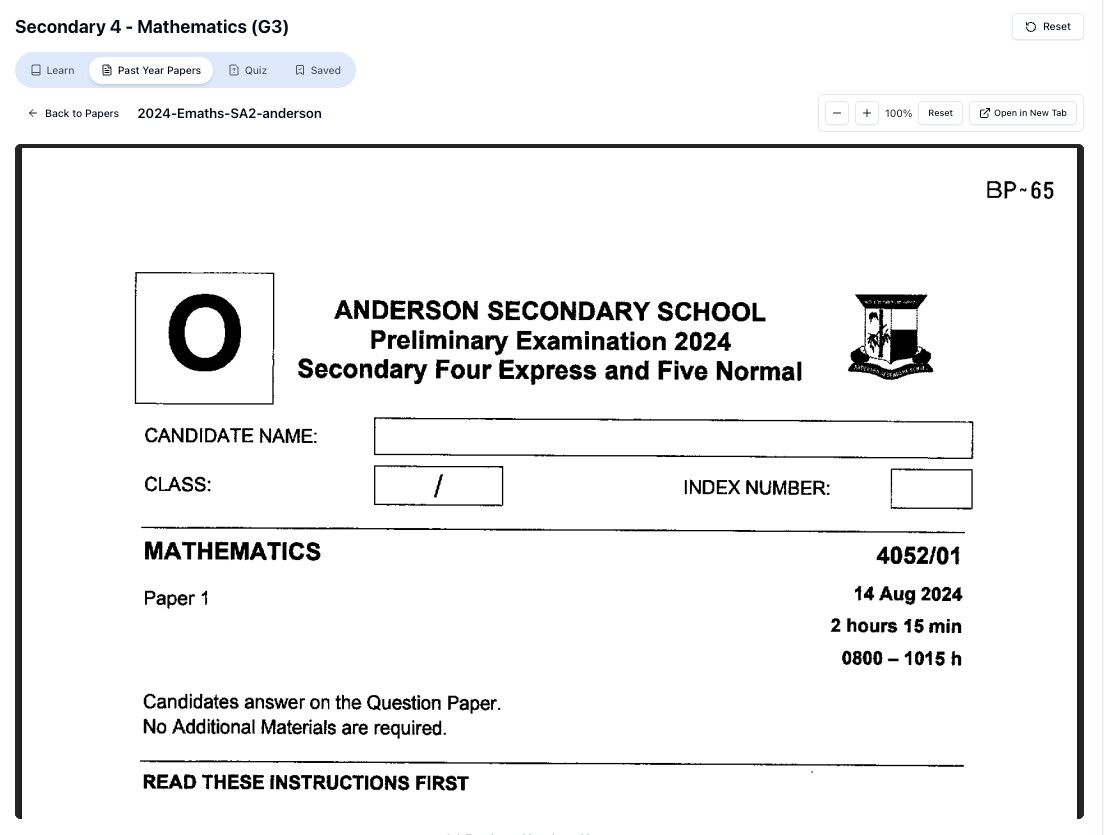
“Access more than 1000+ past year papers to practice”
👉 Start a paper today and test yourself like it’s the real exam.
1. O Level Mathematics (E Math / A Math)
During revision
- Drill core skills first
- E Math: algebra, equations, graphs, trig, statistics.
- A Math: quadratic functions, indices/surds, logarithms, differentiation, integration, binomial theorem.
- Do mixed-topic sections
- Don’t always practise chapter-by-chapter.
- Mix algebra, graphs, and trig in one session to mimic real papers.
During the exam
-
First 5 minutes: scan the paper
- Circle questions you find easy.
- Underline key words: “hence”, “exact value”, “nearest integer”.
-
Secure all easy marks first
- Finish all straightforward questions (algebra simplification, basic graphs, simple trig) before tackling long, unfamiliar ones.
-
Show clear working
- Even if you’re unsure, write steps clearly.
- In O Levels, method marks can save you from careless errors.
2. O Level Pure / Combined Sciences
During revision
-
Concept clusters
- Group related topics:
- Physics: kinematics + forces; electricity + EM spectrum.
- Chemistry: periodic table + bonding; acids/bases/salts; redox + electrolysis.
- Revise them together so you see connections.
- Group related topics:
-
Practise data-based questions
- Many O Level science questions involve interpreting graphs, tables, or experiments.
- Practise:
- Describing trends.
- Explaining using correct scientific terms.
During the exam
-
Underline command words
- “State”, “describe”, “explain”, “compare”, “calculate”.
- Adjust your answer length accordingly.
- “State”: short, direct.
- “Explain”: cause + effect, or idea + reason.
-
Use units and significant figures
- Always write units for physics calculations.
- Follow the question’s instruction for significant figures.
-
For qualitative analysis (Chem)
- Memorise:
- Test for common gases.
- Flame colours.
- Precipitate colours and solubility.
- Practise describing observations properly (e.g. “effervescence of a colourless, odourless gas that relights a glowing splint”).
- Memorise:
3. O Level English Language
During revision
-
Build a writing template
- For situational writing:
- Introduction: purpose + context.
- 2–3 body paragraphs: each with a clear point and elaboration.
- Conclusion: summarise and end with appropriate tone.
- For continuous writing:
- Plan for 5–6 paragraphs.
- Have 2–3 “go-to” story structures or argument structures.
- For situational writing:
-
Practise summary and comprehension
- Do timed practices:
- 15 minutes for summary.
- 35–40 minutes for full comprehension passage.
- Do timed practices:
During the exam
-
Plan before you write
- Spend 5–10 minutes planning your essay.
- Jot down:
- Main points in order.
- Examples you will use.
-
Keep language accurate
- It’s better to write a clear, simple sentence than a messy, over-ambitious one.
- Watch out for:
- Tense consistency.
- Subject-verb agreement.
- Punctuation.
4. Using AI wisely in your exam strategy
In Singapore, many students already use online tools, but the key is using them correctly.
With Tutorly.sg:
Free on Tutorly.sg
Practise with step-by-step help — free to start
On Tutorly.sg/app you can practise unlimited Singapore syllabus questions, get instant explanations when you are stuck, and use past-year papers — no sign-up needed to start.
- ✓ PSLE, O Level, A Level, and more
- ✓ Step-by-step working when you are stuck
- ✓ Works on phone and laptop
- You get explanations aligned to MOE and O Level format, not random overseas syllabuses.
- It’s been used by thousands of students in Singapore, and has even been mentioned on Channel NewsAsia (CNA), so it’s not some random overseas site.
- You can:
- Paste a question.
- See the final answer.
- Then view step-by-step working to learn the method.
Use it to:
- Clarify doubts right after school.
- Check how to structure full answers (e.g. science explanations, math proofs).
- Generate more practice questions on topics you’re weak in.
👉 CTA #2 (mid-article): If you’re stuck on a past-year question right now, open a new tab and get help now at https://tutorly.sg/app. Don’t let one confusing question block your whole revision session.
Worksheet practice
To prepare properly for O Levels, you need consistent worksheet practice — not just reading notes. Below are sample question types (with increasing difficulty) and how you should tackle them.
1. Mathematics practice (E Math focus)
Level 1: Core exam-style questions
-
Algebra (Medium)
Simplify:
-
Graphs (Medium)
The straight line 𝑙 has equation .
(a) Find the gradient of 𝑙.
(b) Find the coordinates of the point where 𝑙 cuts the 𝑦-axis. -
Trigonometry (Medium)
In , , cm and cm.
(a) Find BC.
(b) Find .
These are the types of questions you must be able to do without thinking too hard. Use them as warm-ups.
Level 2: Harder exam variants (what often differentiates A 1 from B 3)
-
Algebraic manipulation (Hard)
Solve the simultaneous equations:
\begin{cases} 3𝑥 + 2𝑦 = 7 \\ 2𝑥^2 - 𝑦 = 5 \end{cases}- This combines linear and quadratic equations — common in harder 𝑂 Level questions. 2. **Functions and inverse (Hard)** 𝐴 function 𝑓 is defined by 𝑓(𝑥) = \frac{2𝑥 - 1}{3} for 𝑥 \in \mathbb{𝑅}. (𝑎) Find 𝑓^{-1}(𝑥). (𝑏) Solve the equation 𝑓^{-1}(𝑥) = 5. 3. **Circle geometry (Hard)** In the figure, ABC is 𝑎 triangle inscribed in 𝑎 circle with centre 𝑂. AC is 𝑎 diameter of the circle. Given that \angle ABC = 32^\circ, (𝑎) Find \angle BAC. (𝑏) Find \angle BOC. These questions test whether you can combine multiple theorems and algebraic skills under time pressure. --- ### 2. Science practice (Pure / Combined) #### Level 1: Core exam-style questions 1. **Physics – Kinematics (Medium)** 𝐴 car starts from rest and accelerates uniformly at 2.0 \, \text{m s}^{-2} for 10 𝑠. (𝑎) Calculate its final velocity. (𝑏) Calculate the distance travelled in this time. 2. **Chemistry – Mole concept (Medium)** Calculate the number of moles of water in 36 𝑔 of water. (Relative molecular mass of water, 𝐻_2𝑂 = 18.) 3. **Chemistry – Acids, bases and salts (Medium)** State the ionic equation for the reaction between hydrochloric acid and sodium hydroxide solution. --- #### Level 2: Harder exam variants 1. **Physics – Graph interpretation (Hard)** The velocity-time graph of 𝑎 moving object is 𝑎 straight line decreasing from 20 \, \text{m s}^{-1} at 𝑡 = 0 to 0 \, \text{m s}^{-1} at 𝑡 = 8 𝑠. (𝑎) Determine the acceleration of the object. (𝑏) Calculate the total distance travelled. (𝑐) Suggest 𝑎 physical situation that could produce such 𝑎 graph. 2. **Chemistry – Titration reasoning (Hard)** 𝐴 student titrates 25.0 cm³ of sodium hydroxide solution with 0.100 mol/dm³ hydrochloric acid. The balanced equation is:\text{HCl} + \text{NaOH} \rightarrow \text{NaCl} + \text{H}_2\text{O}$$
(a) If 18.5 cm³ of HCl is required to reach the end-point, calculate the concentration of the NaOH solution in mol/dm³.
(b) The student repeats the experiment but overshoots the end-point. Explain how this affects the calculated concentration of NaOH. -
Chemistry – Qualitative analysis (Hard)
A colourless solution 𝑋 produces a white precipitate when aqueous sodium hydroxide is added. The precipitate dissolves in excess sodium hydroxide.
(a) Suggest the cation present in 𝑋.
(b) Describe one further test to confirm your answer.
When you practise, don’t just check if your final answer matches. Ask:
- Did I use the correct formula?
- Did I show all working clearly?
- Would this get method marks even if the final answer is wrong?
This is where a tool like Tutorly is powerful: you can input the question, see the correct final answer, and then follow the step-by-step working to compare with your own.
👉 CTA #3 (mid-late): If you want more hard variants like these tailored to your weak topics, you can generate and practise them directly at https://tutorly.sg/app, anytime you feel stuck.
“Doing Secondary Science? Pick a topic and practise like it’s a real exam — with clear answers right after.”
👉 Try Tutorly now and start a Science topic in seconds.

3. How many questions should you do?
For serious O Level exam preparation in Singapore, a rough target (over the whole Sec year):
- E Math:
- 10–15 full papers (school + TYS)
- Plus topic-specific drills (hundreds of short questions across the year)
- Each Pure Science:
- 8–12 full Paper 2-style practices
- Multiple MCQ sets (Paper 1)
- English:
- 8–10 full compositions (mixture of argumentative, narrative, expository)
- 8–10 situational writing pieces
- 10+ comprehension practices
You don’t need to do everything at once. Spread them across months and track your progress.
Common mistakes
Here are the most common mistakes I see from O Level students in Singapore — and how you can avoid them.
1. “I’ll start later” – underestimating Sec workload
Many students think they can start “proper revision” after Prelims. By then, it’s usually too late to fix deep conceptual gaps.
Fix:
- Start light but early:
- 30–60 mins per day of focused revision from Term 1.
- Use March and June holidays for:
- Clearing weak topics.
- Doing at least a few full papers.
2. Only doing easy questions
It feels good to do questions you already know how to solve, but this gives a false sense of security.
Fix:
- For every topic:
- Do 5–10 easy/medium questions to warm up.
- Then force yourself to attempt 3–5 harder questions (like the Level 2 variants above).
- Track:
- Which hard questions you cannot solve at all.
- Revisit them after learning from a model solution (e.g. from Tutorly).
3. Memorising without understanding
Especially common in:
- Chemistry (memorising equations without understanding why).
- Social Studies (memorising content without knowing how to answer the question).
- Math (memorising steps without understanding when to use which method).
Fix:
- After learning a concept, ask yourself:
- “Why do we use this formula here?”
- “What would happen if I changed this value?”
- Explain the concept out loud in simple language, as if teaching a Sec 2 student. If you can’t, you don’t properly understand it yet.
4. Not reviewing mistakes properly
Many students mark their papers, see a score, and move on. That wastes your practice.
Fix:
For every test / worksheet / paper, do a mistake analysis:
- Write down:
- Topic.
- Type of mistake (concept / careless / misread).
- Redo the question without looking at the solution.
- If still stuck, then look at a worked solution (from school, TYS, or Tutorly).
- Summarise the “lesson learnt” in 1–2 lines in a notebook.
Over time, this notebook becomes your personal “exam mistakes guide” to reread before O Levels.
5. Depending only on tuition timing
Real-life scenario:
It’s 10.45pm, three days before your E Math paper. You’re doing a TYS question on quadratic inequalities and you just can’t get the answer your school gave. Your tuition session was yesterday. The next one is only after your paper. Your parents are asleep, your friends are also stuck. You feel like giving up on that whole topic for the exam.
This situation is extremely common in Singapore, especially near exams when everyone is stressed and busy.
Having something like Tutorly.sg means you don’t have to wait:
- You can paste the exact question.
- See the final answer.
- Then follow step-by-step working to see where your method differed.
This way, a 30–40 minute “stuck” situation can become a 5–10 minute learning moment.
6. Not choosing the right kind of help
In Singapore, you basically have three main options for extra support: private tutor, tuition centre, and online tools like Tutorly.sg.
Here’s a quick comparison:
| Option | Price (rough SG range) | Flexibility | Availability (time slots / urgency) |
|---|---|---|---|
| Private tutor | About $40–$120/hour depending on level & experience | Can customise timing, but fixed weekly slot usually | Limited by tutor’s schedule; hard to get last-minute help |
| Tuition centre | About $150–$400/month per subject (group classes) | Fixed class times; harder to reschedule | Specific days/times only; no help outside |
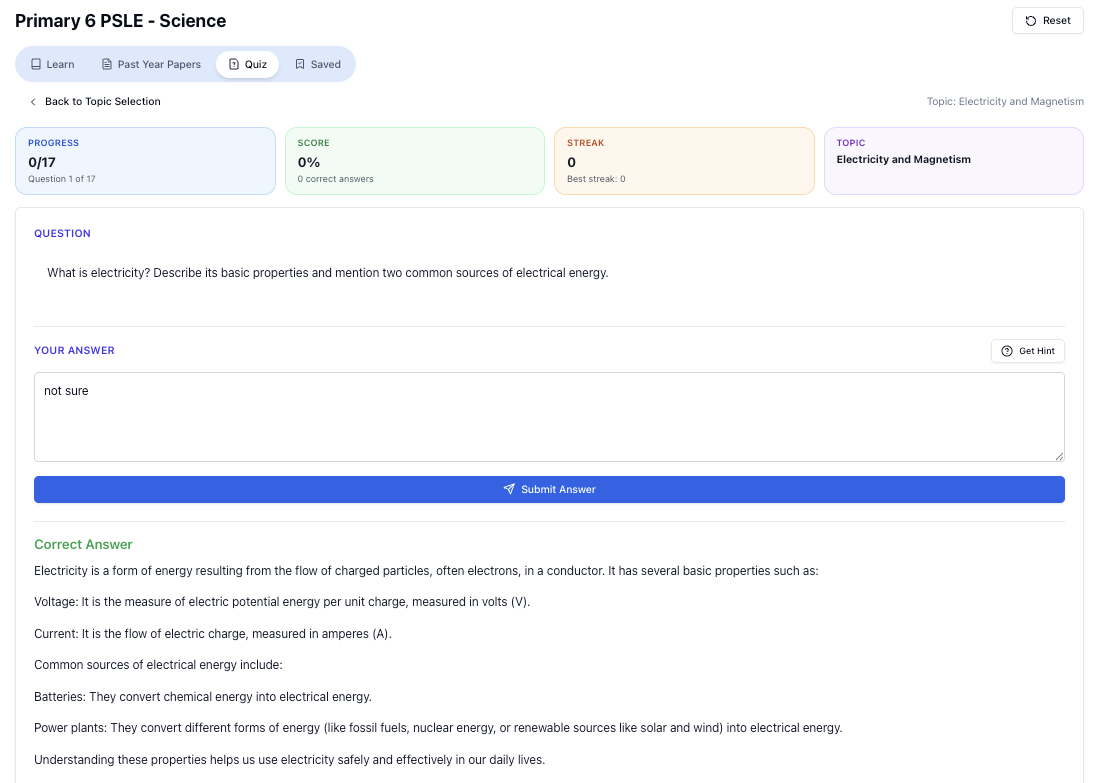
“Practice PSLE Science questions and get clear, step-by-step answers instantly.”
👉 Try a question now and see how fast you can improve.
Ready to practise?
If you want a Singapore-focused AI tutor you can use immediately (website, no sign-up), try Tutorly here:
Related Articles
Free on Tutorly.sg
Practise with step-by-step help — free to start
On Tutorly.sg/app you can practise unlimited Singapore syllabus questions, get instant explanations when you are stuck, and use past-year papers — no sign-up needed to start.
- ✓ PSLE, O Level, A Level, and more
- ✓ Step-by-step working when you are stuck
- ✓ Works on phone and laptop