

Free on Tutorly.sg
Practise Electricity and magnetism with step-by-step help — free to start
On Tutorly.sg/app you can practise unlimited Singapore syllabus questions, get instant explanations when you are stuck, and use past-year papers — no sign-up needed to start.
- ✓ PSLE, O Level, A Level, and more
- ✓ Step-by-step working when you are stuck
- ✓ Works on phone and laptop
Quick answer
Ever felt your heart sink when you see an electricity question in the exam and you know the answer but still lose marks? It's a common issue, especially when you're cramming the night before. Let's focus on the key areas you need to understand and what to prioritize in your revision.
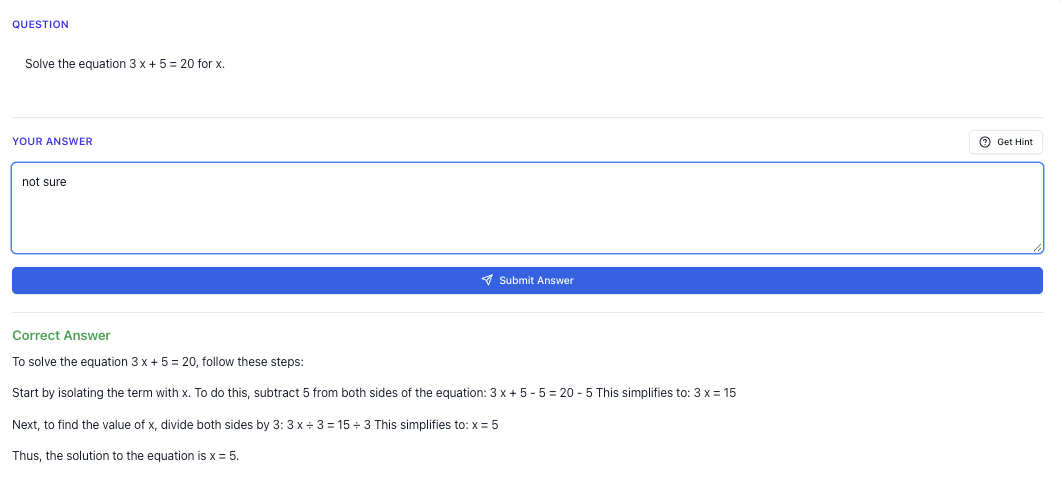
“Stuck on a question? See simple explanations that help you understand fast.”
👉 Give it a try and turn confusion into clarity in minutes.
What you need to know
Electricity and magnetism in O Level Physics cover how electric charges interact and how magnetic fields behave. It's not just about memorizing formulas but understanding how they apply to real-life situations, like the MRT's electric trains or your phone's battery.
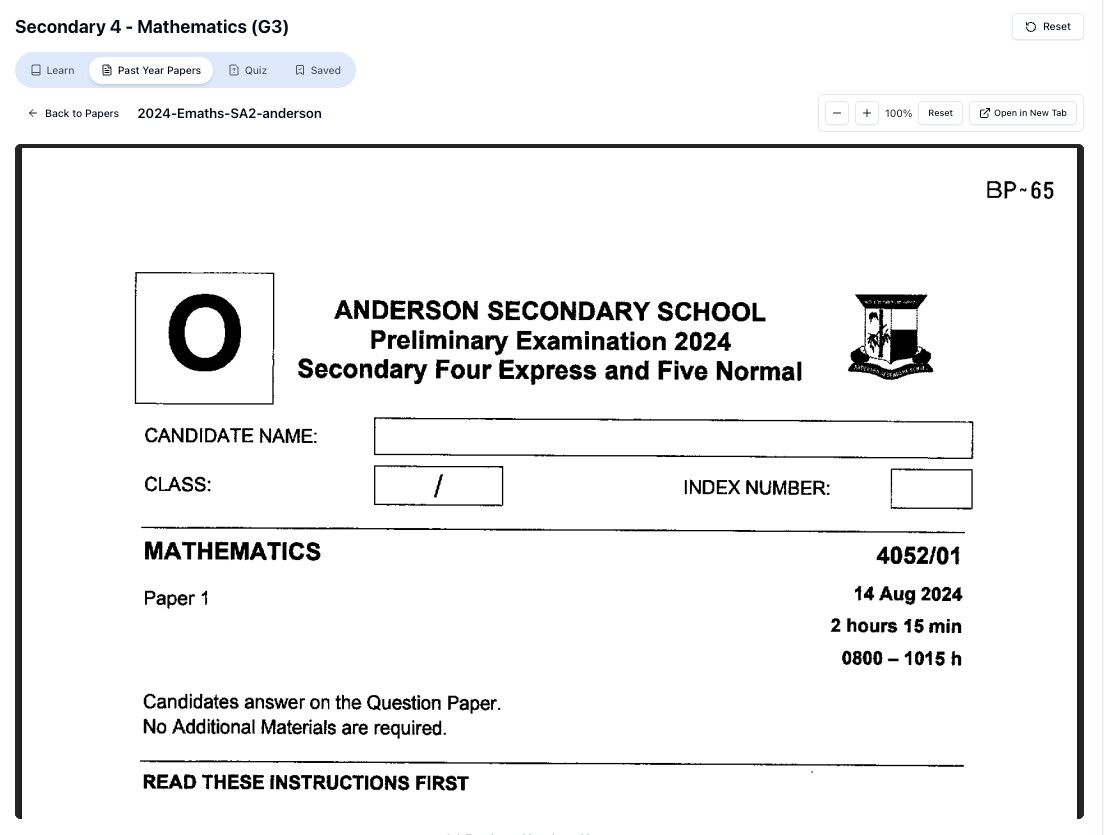
“Access more than 1000+ past year papers to practice”
👉 Start a paper today and test yourself like it’s the real exam.
Common Mistakes in Electricity and Magnetism
Misunderstanding Current and Voltage
One mistake I repeatedly see among my Sec 4 students is confusing current with voltage. Current is the flow of electric charge, while voltage is the potential difference that pushes the current through the circuit. Imagine current as the number of people crowding onto an MRT train, and voltage as the force pushing them into the train.
Application Questions Panic
Students usually panic when they see application questions like this. The examiner is testing whether you truly understand the process, not just whether you can recite definitions. For instance, knowing Ohm's Law () is useful, but you need to apply it to solve for unknowns in a circuit.
Lack of Precision
Many students in Singapore memorize keywords without understanding what they mean. Precision matters more than length in O-Level questions. For example, if a question asks for the direction of the magnetic field, saying "north" is too general. Specify "north to south" along the field lines.
Revision checklist — specific slips + how to fix (Singapore papers)
- Confusing Current and Voltage: Practice differentiating them in circuit diagrams.
- Application Questions: Break down questions into parts and identify which formula applies.
- Precision in Answers: Use specific terms from the syllabus, not general words.
- Misreading Units: Always double-check the unit conversions — e.g., milliampere to ampere.
- Formula Confusion: Create a formula sheet with definitions and when to use each formula.
Exam tip — marks, presentation, time, question types
- Marks Allocation: Pay attention to the marks per question. A 3-mark question needs more detail than a 1-mark one.
- Presentation: Clear, labeled diagrams can gain marks, especially in magnetism.
- Time Management: Don't spend too long on one question. If stuck, move on and return if time allows.
- Question Types: Be ready for both calculation and explanation questions. They often test the same concept in different ways.
Question
A circuit contains a 12 V battery and a resistor of 4 ohms. Find the current flowing through the circuit.
Solution
Step 1: Use Ohm’s Law, .
Why: We need to find the current (I), so we rearrange the formula to .
Step 2: Substitute and into the formula: .
Why: By substituting the values, we can directly calculate the current.
Step 3: Calculate the current: .
Why: This gives us the current in amperes, which is the standard unit.
“Doing Secondary Science? Pick a topic and practise like it’s a real exam — with clear answers right after.”
👉 Try Tutorly now and start a Science topic in seconds.

Quick summary
- Understand the difference between current and voltage.
- Precision is crucial; use specific terms from the syllabus.
- Practice application questions to reduce panic.
- Manage your time well during the exam.
- Use clear diagrams to support your answers.
FAQ
1. How do I differentiate between series and parallel circuits?
In a series circuit, components are connected end-to-end, so the same current flows through each. In a parallel circuit, components are connected across the same voltage source, so the voltage is the same across each.
2. Why do I keep losing marks on explanation questions?
You might be too general. Use specific terms and link them to the concept being tested. Explain the "why" behind each step.
3. How do I remember all the formulas?
Create a formula sheet with the formula, what it represents, and a simple example. Review it regularly, especially before the exam.
4. What's the best way to revise electricity and magnetism?
Focus on understanding concepts, not just memorizing. Practice past questions and identify where you commonly make mistakes.
Free on Tutorly.sg
Practise Electricity and magnetism with step-by-step help — free to start
On Tutorly.sg/app you can practise unlimited Singapore syllabus questions, get instant explanations when you are stuck, and use past-year papers — no sign-up needed to start.
- ✓ PSLE, O Level, A Level, and more
- ✓ Step-by-step working when you are stuck
- ✓ Works on phone and laptop
Free practice
Try it yourself
Practise similar questions with step-by-step help on Tutorly. This interactive approach helps reinforce what you've learned.
- ✓ Unlimited similar questions
- ✓ Step-by-step help when you are stuck
- ✓ No sign-up needed to start
Related Topics You Should Learn Next
- O Level Physics: Mastering Electricity and Magnetism Exam Techniques
- O Level Electricity and magnetism common mistakes Singapore Physics
- O Level Electricity and magnetism explained simply Singapore Physics
- O Level Physics: Electricity and Magnetism Made Simple
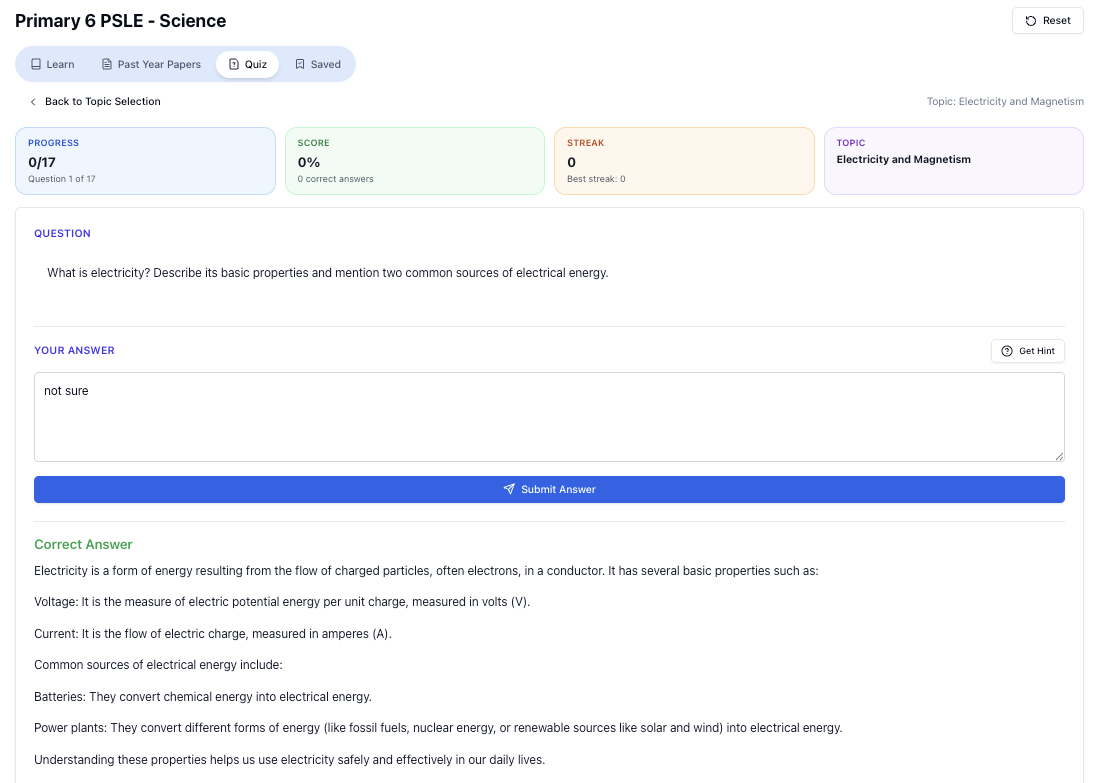
“Practice PSLE Science questions and get clear, step-by-step answers instantly.”
👉 Try a question now and see how fast you can improve.
Free on Tutorly.sg
Practise Electricity and magnetism with step-by-step help — free to start
On Tutorly.sg/app you can practise unlimited Singapore syllabus questions, get instant explanations when you are stuck, and use past-year papers — no sign-up needed to start.
- ✓ PSLE, O Level, A Level, and more
- ✓ Step-by-step working when you are stuck
- ✓ Works on phone and laptop