

Free on Tutorly.sg
Practise with step-by-step help — free to start
On Tutorly.sg/app you can practise unlimited Singapore syllabus questions, get instant explanations when you are stuck, and use past-year papers — no sign-up needed to start.
- ✓ PSLE, O Level, A Level, and more
- ✓ Step-by-step working when you are stuck
- ✓ Works on phone and laptop
If you’re using an AI tutor in Singapore for O-Level Chemistry, the fastest gains usually come from fixing misconceptions and learning the exact phrasing that earns marks.
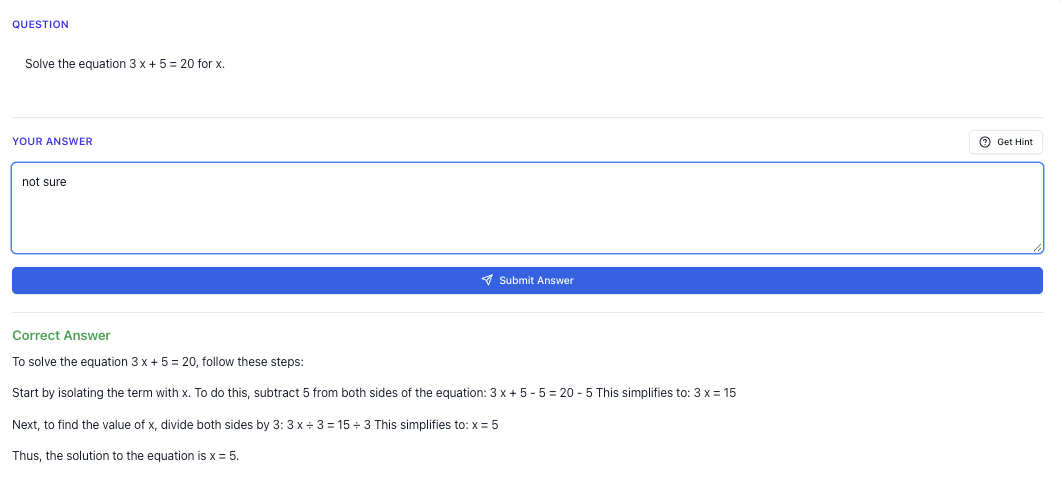
“Stuck on a question? See simple explanations that help you understand fast.”
👉 Give it a try and turn confusion into clarity in minutes.
This guide is a practical loop: find the misconception → drill the pattern → lock in the wording.
Why Chemistry feels “studied” but marks don’t move
Chemistry is unforgiving in a specific way:
- you can kind of understand the concept,
- but still lose marks because your explanation misses keywords or the logic jumps.
That’s why random practice is slow. You need:
- targeted misconception fixing,
- and answer phrasing that matches marking points.
If you want Tutorly’s Singapore AI tutor landing page, start here:
AI Tutor Singapore
Step 1: Build your misconception list (15 minutes)
Start with the 4 most common:
- ionic vs covalent bonding explanations
- balancing equations vs writing formulae
- acids/bases and salt preparation steps
- redox and electron transfer wording
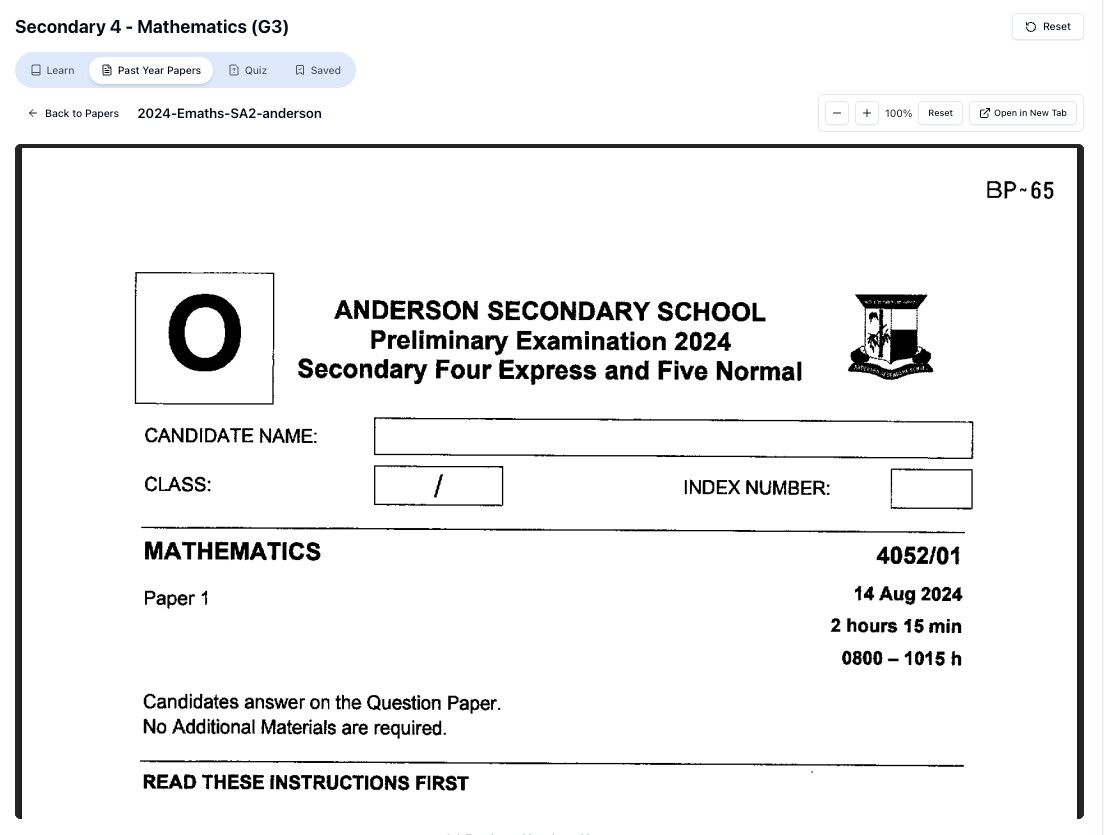
“Access more than 1000+ past year papers to practice”
👉 Start a paper today and test yourself like it’s the real exam.
Write it like this:
- “I lose marks on ______ because I confuse ______ with ______.”
Example:
- “I lose marks on bonding because I describe ionic bonding like covalent bonding.”
Step 2: Drill one misconception at a time (20–30 minutes)
Pick one misconception and do:
- 6 questions of the same pattern
- redo any wrong question immediately after the explanation
- then do 2 similar questions (slightly harder)
The goal is not variety. The goal is automatic recall of the correct reasoning and keywords.
Step 3: Lock in the marking-point wording (this is where marks are)
After each question, ask for:
- the 2–4 marking points in short bullet form
- the keywords you must include
Example keywords:
- “electrons transferred”
- “oxidation state increases/decreases”
- “ions in a lattice”
- “shared pair of electrons”
The “keyword notebook” trick (takes 3 minutes, pays off big)
Create a simple list on your phone or notebook:
- Topic: Redox
- Keywords: electrons transferred; oxidation state increases/decreases; oxidising agent reduced
Every time you lose marks due to wording, add the missing keyword once. You’ll be surprised how fast your answers tighten up.
Step 4: Weekly mixed set + review (30 minutes)
Once a week:
- 12 mixed questions (timed)
- update your misconception list with the top 3 mistakes you repeated
How to use an AI tutor when you’re not sure your explanation is “markable”
When your answer is long and messy, ask for:
- “Rewrite my answer into a 3–4 line O-Level marking-point answer.”
- “List the missing keywords needed for full marks.”
- “Which sentence is irrelevant and should be removed?”
AI tutor prompts that work for O-Level Chemistry (copy/paste)
- “I’m taking O-Level Chemistry in Singapore. Give me 6 questions on redox focused on oxidation state changes. One at a time. Wait for my answer.”
- “Mark my answer and list the missing keywords I need for full marks.”
- “Explain ionic vs covalent bonding in O-Level marking-point style, then give me 3 quick test questions.”
Sample questions + step-by-step solutions (O-Level Chemistry style)
Question 1 (Bonding: ionic vs covalent)
Magnesium oxide, MgO, has a high melting point. Explain why, in terms of its structure and bonding.
Solution (step-by-step)
Step 1: Identify the bonding type.
MgO is made from a metal (Mg) and a non-metal (O), so it forms an ionic compound.
Why: Metals tend to lose electrons to form positive ions; non-metals gain electrons to form negative ions.
Step 2: Describe the structure.
MgO has a giant ionic lattice of and ions.
Why: Ionic compounds form repeating 3 D lattices, not discrete molecules.
Step 3: Link bonding to melting point.
There are strong electrostatic attractions between the oppositely charged ions in the lattice.
Why: Opposite charges attract strongly across the whole lattice.
Step 4: Explain what happens when melting.
A lot of energy is needed to overcome these strong attractions, so the melting point is high.
Final answer (marking-point style):
MgO has a giant ionic lattice of and ions. Strong electrostatic attraction between oppositely charged ions requires a large amount of energy to overcome, giving MgO a high melting point.
Answer check (common wrong answers + why)
- Weak answer: “It has strong bonds”: too vague; you must mention giant ionic lattice and electrostatic attraction between ions.
- Wrong idea: “because it has covalent bonds”: MgO is ionic (metal + non-metal).
Question 2 (Redox: oxidation states)
In the reaction:
State whether iron is oxidised or reduced, and explain why.
Solution (step-by-step)
Step 1: Look at the charge change / electrons.
Iron goes from to and produces an electron.
Free on Tutorly.sg
Practise with step-by-step help — free to start
On Tutorly.sg/app you can practise unlimited Singapore syllabus questions, get instant explanations when you are stuck, and use past-year papers — no sign-up needed to start.
- ✓ PSLE, O Level, A Level, and more
- ✓ Step-by-step working when you are stuck
- ✓ Works on phone and laptop
Why: Producing an electron means it loses an electron.
Step 2: Use the definition.
Oxidation is loss of electrons (OIL).
Why: This is the simplest, most reliable redox rule at O-Level.
Step 3: Conclude.
Iron is oxidised because it loses one electron.
Final answer: Iron is oxidised (loss of electron / oxidation state increases from +2 to +3).
Answer check (common wrong answers + why)
- Wrong: “reduced because it becomes +3”: reduction is gain of electrons / oxidation state decreases. Here, electron is produced (lost).
- Incomplete: “oxidised” only: add the reason (loss of electron / oxidation state increases).
Question 3 (Acids and bases)
Hydrochloric acid reacts with sodium hydroxide.
- Write the balanced chemical equation.
- State the type of reaction.
- Name the salt formed.
Solution (step-by-step)
Part 1: Write the equation
“Doing Secondary Science? Pick a topic and practise like it’s a real exam — with clear answers right after.”
👉 Try Tutorly now and start a Science topic in seconds.

Why: Acid + alkali produces salt + water.
Part 2: Check balancing
Count atoms:
- Left: H (2: one in HCl, one in NaOH), Cl (1), Na (1), O (1)
- Right: Na (1), Cl (1), H (2 in water), O (1)
So it’s already balanced.
Why: Balanced equations conserve atoms (mass).
Part 3: Type of reaction
This is a neutralisation reaction.
Why: Acid + base → salt + water is neutralisation.
Part 4: Salt formed
The salt is sodium chloride ().
Answer check (common wrong answers + why)
- Wrong equation: (no reaction shown) — you must form salt + water.
- Wrong salt: “sodium hydroxide” — NaOH is the alkali, not the salt. The salt is NaCl.
Question 4 (Moles / reacting masses)
Magnesium reacts with oxygen to form magnesium oxide.
If 4.8 g of magnesium is burned in excess oxygen, calculate the mass of magnesium oxide formed.
(Relative atomic mass: Mg = 24, 𝑂 = 16)
Solution (step-by-step)
Step 1: Find moles of magnesium used.
Why: Moles convert a mass into “number of particles amount”, which lets us use the chemical equation ratios.
Step 2: Use the mole ratio from the balanced equation.
From:
the ratio .
So:
Why: The coefficients show the reacting proportions. Here, Mg and MgO have the same coefficient, so 1 mol Mg gives 1 mol MgO.
Step 3: Convert moles of MgO to mass.
First find :
Then:
Final answer: 8.0 g of MgO
Answer check (common wrong answers + why)
- Wrong answer: 4.0 g: using or mixing up atomic masses (MgO is 24+16=40).
- Wrong ratio step: using 2:1 incorrectly — Mg : MgO is 1:1 in the balanced equation.
If you want a Singapore-focused AI tutor for O-Level revision
Tutorly.sg supports Secondary levels with exam-style practice and explanations.
Start here: AI Tutor Singapore
Try Tutorly immediately (no sign-up):
https://tutorly.sg/app
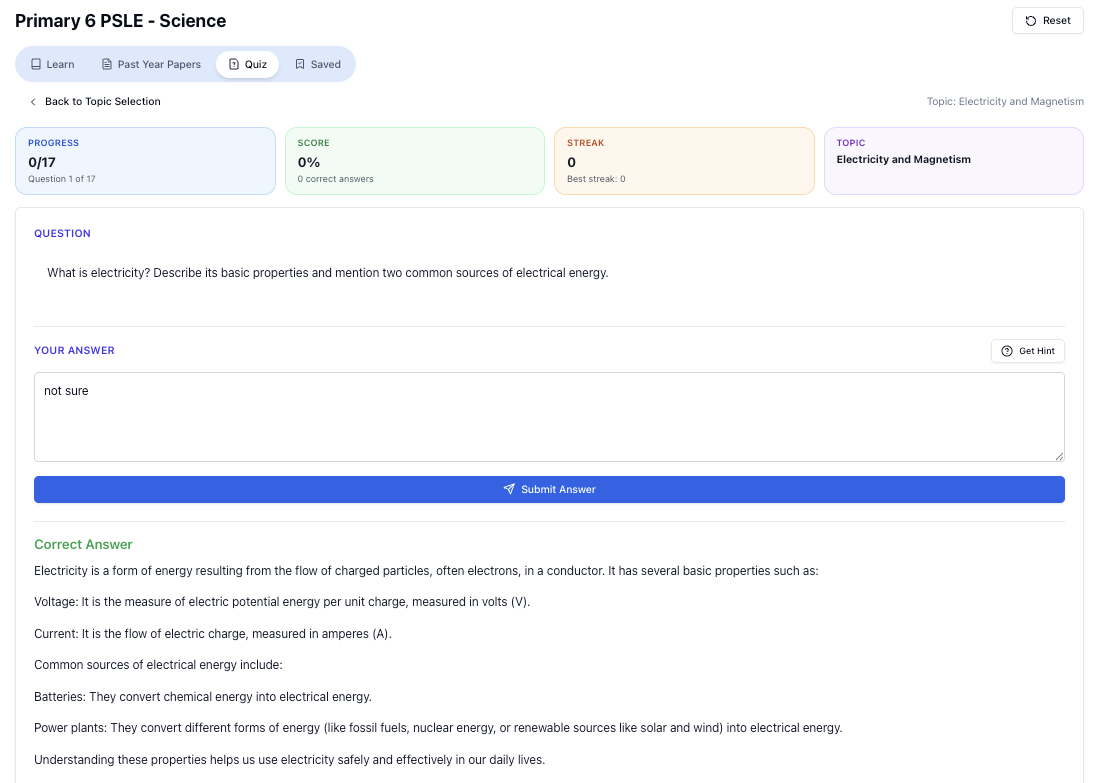
“Practice PSLE Science questions and get clear, step-by-step answers instantly.”
👉 Try a question now and see how fast you can improve.
Free on Tutorly.sg
Practise with step-by-step help — free to start
On Tutorly.sg/app you can practise unlimited Singapore syllabus questions, get instant explanations when you are stuck, and use past-year papers — no sign-up needed to start.
- ✓ PSLE, O Level, A Level, and more
- ✓ Step-by-step working when you are stuck
- ✓ Works on phone and laptop