

Free on Tutorly.sg
Practise with step-by-step help — free to start
On Tutorly.sg/app you can practise unlimited Singapore syllabus questions, get instant explanations when you are stuck, and use past-year papers — no sign-up needed to start.
- ✓ PSLE, O Level, A Level, and more
- ✓ Step-by-step working when you are stuck
- ✓ Works on phone and laptop
If you’re in JC, you already know: A-Level Math is no joke.
Whether you’re doing H 1 or H 2, the jump from Sec 4 to JC is huge. Suddenly there’s vectors in 3 D, complex numbers, binomial expansions with weird conditions, and statistics that feels like a different language. On top of that, you’ve got CCAs, PW (in JC 1), and maybe other demanding subjects like Chem and Econs.
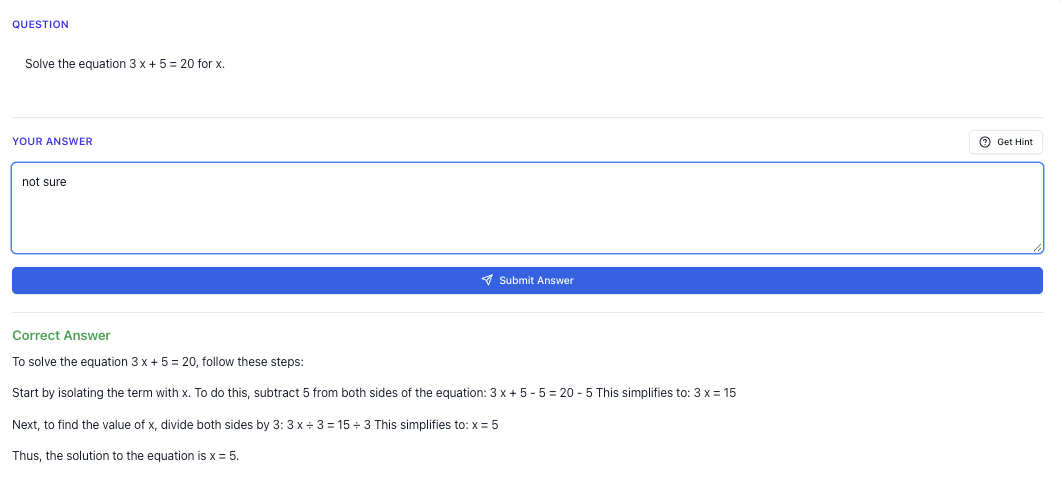
“Stuck on a question? See simple explanations that help you understand fast.”
👉 Give it a try and turn confusion into clarity in minutes.
So it’s natural to ask:
Does JC math tuition really help, or is it just more time and money?
Short answer: it helps a lot — if you use it the right way. And “tuition” today doesn’t only mean sitting in a physical class. Online tools like Tutorly.sg can give you support that works together with (or even replaces) traditional tuition.
Tutorly.sg is a AI tutor website built specifically for Singapore students, aligned to the MOE syllabus. It’s been mentioned on Channel NewsAsia (CNA) and used by thousands of students in Singapore, including many JC students preparing for A-Levels.
In this guide, I’ll walk you through:
- How JC math tuition (and AI support) actually boosts A-Level performance
- A step-by-step tutorial for tackling common A-Level style questions
- An exam strategy guide tailored to H 1/H 2 Math
- Worksheet-style practice (with hard variants) you can try now
- Common mistakes JC students make — and how to fix them
Throughout, I’ll show you how to use Tutorly.sg alongside your school work and/or tuition so you’re not just “studying more”, but studying smarter.
Why JC Math Feels So Hard (And How Tuition Helps)
Before we jump into techniques, it helps to understand why so many JC students struggle with math, even if they did fine for O-Levels / IP.
1. The content is deeper, not just more
In JC, topics don’t just add on; they go deeper:
- Functions → transformations, inverse, modulus, inequalities
- Calculus → chain rule, product rule, integration by parts, differential equations
- Vectors → 3 D geometry, lines and planes, shortest distance
- Probability & Statistics → distributions, hypothesis testing, regression
JC math tuition (or a good online tutor like Tutorly.sg) helps by breaking down these topics into smaller, logical steps so you don’t feel lost halfway through a question.
2. A-Level questions test thinking, not just formula
You already know the formula for quadratic equations. But at A-Levels, the question might look like:
“Given that the roots of the equation are real and distinct, find the range of values of 𝑘.”
Same chapter (quadratics), but now you need to:
- Recognise it’s a discriminant question
- Apply
- Rearrange to find a range of 𝑘
Tuition and step-by-step explanations help you see patterns in questions so you know what to do, instead of staring at the paper thinking, “What is this even asking?”
3. You don’t have time to be stuck
In JC, time is your biggest enemy. If you spend 2 hours stuck on one tutorial question, that’s time you’re not revising other topics.
This is where having on-demand help is powerful:
- In physical tuition, you can ask your tutor during class or via WhatsApp (if they allow).
- With Tutorly.sg, you can ask any time, even at 1am before a math test, and get:
- Instant answers
- Step-by-step solutions aligned to the A-Level style
- Explanations in simple language
You don’t waste hours stuck; you get unstuck fast, then move on and practise more.
Step-by-step tutorial
Let’s go through some A-Level style questions step by step, and I’ll show you the kind of thinking process a good tutor (or AI tutor like Tutorly.sg) will guide you through.
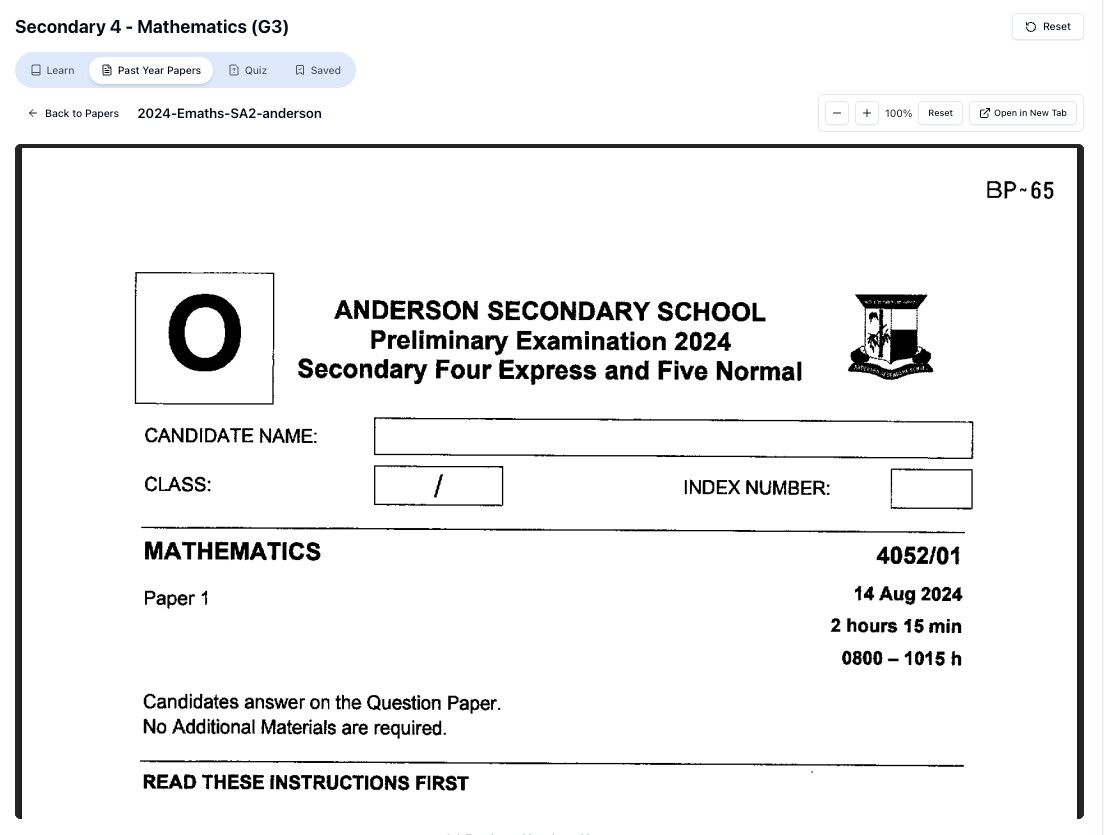
“Access more than 1000+ past year papers to practice”
👉 Start a paper today and test yourself like it’s the real exam.
We’ll cover:
- Differentiation (H 2 style, but useful even if you’re H 1)
- Vectors in 3 D
- Probability / Statistics (hypothesis testing flavour)
1. Calculus: Differentiation with chain rule & product rule
Question 1 (H 2-style):
The function 𝑓 is defined by
(a) Find 𝑓'(𝑥).
(b) Hence, find the stationary points of the curve .
Step-by-step solution
(a) Find 𝑓'(𝑥)
We have where
We’ll use product rule:
-
Differentiate 𝑢:
-
Differentiate 𝑣:
- By chain rule,
-
Apply product rule:
-
Factorise if possible (this is often useful for part (b)):
- Factor out :
- Factor out :
So,
(b) Find stationary points
Stationary points occur when .
We have
Note: for all real 𝑥, and , so the only way this product is zero is when:
Solve the quadratic:
Use quadratic formula:
So the x-coordinates of the stationary points are
To find the y-coordinates, substitute back into 𝑓(𝑥):
(For exam, you can leave answers in exact form.)
How tuition / Tutorly helps here
Many students know product rule and chain rule, but:
- They forget to factorise 𝑓'(𝑥) properly, making part (b) harder.
- They panic when they see and forget it’s always positive.
- They mess up the algebra in the quadratic.
With a tutor or Tutorly.sg, you can:
- Ask for the next step only if you’re stuck at product rule.
- Check your final derivative and then see the full working.
- Practise similar questions until the pattern becomes natural.
2. Vectors: Line and plane in 3 D
Question 2 (H 2-style):
The line 𝑙 has equation
and the plane has equation
(a) Show that the line 𝑙 intersects the plane , and find the point of intersection.
(b) Find the acute angle between the line 𝑙 and the plane .
Step-by-step solution
(a) Point of intersection
A point on 𝑙 is given by
This point lies on if it satisfies the plane equation:
Compute the dot product:
Set equal to 9:
3 + 6\lambda = 9 \Rightarrow 6\lambda = 6 \Rightarrow \lambda = 1.
Substitute back into the line:
So the line intersects the plane at (3, 1, 2).
(b) Acute angle between line and plane
-
Direction vector of line 𝑙:
-
Normal vector of plane :
The angle between the line and the plane is related to the angle between the line and the normal by:
\theta = 90^\circ - \phi.
First, find using the dot product:
Compute:
So
Hence
Then
\theta = 90^\circ - \phi.
In exam, it’s fine to leave it as
Some schools prefer you to write directly the angle between line and plane using formula, but this method is conceptually clear.
3. Statistics: Hypothesis testing flavour (H 1/H 2)
Question 3 (H 1/H 2-style, conceptual):
Free on Tutorly.sg
Practise with step-by-step help — free to start
On Tutorly.sg/app you can practise unlimited Singapore syllabus questions, get instant explanations when you are stuck, and use past-year papers — no sign-up needed to start.
- ✓ PSLE, O Level, A Level, and more
- ✓ Step-by-step working when you are stuck
- ✓ Works on phone and laptop
A JC claims that the average score for its J 2 cohort in a recent internal math test is 65. A teacher believes the average is lower. A random sample of 40 students has a mean score of 62, with a known population standard deviation of 10. Test, at the 5% significance level, whether there is evidence that the average score is lower than 65.
(Assume normal distribution.)
Step-by-step solution (outline)
- Define hypotheses
Let be the true mean score.
- : (school’s claim)
- : (teacher believes mean is lower)
- Identify test statistic
Population standard deviation is known, .
Use 𝑍-test:
Given: , , , .
- Find critical value for 5% level (one-tailed, lower)
For 5% lower-tail test, critical value is approximately .
- Decision
- If 𝑍 < -1.645, reject .
- Our .
So, reject .
- Conclusion (in context)
At the 5% significance level, there is sufficient evidence to conclude that the average score is lower than 65.
How a tutor / Tutorly helps here
Many JC students:
- Mix up and
- Forget to state the conclusion in context
- Don’t know when to use one-tailed vs two-tailed tests
With Tutorly.sg, you can:
- Type in a hypothesis testing question
- Get the final answer
- Then read the full step-by-step reasoning, including how to phrase the conclusion — very helpful for exam-style wording.
“Doing Secondary Science? Pick a topic and practise like it’s a real exam — with clear answers right after.”
👉 Try Tutorly now and start a Science topic in seconds.

Exam strategy guide
Tuition isn’t just about content; it’s also about strategy. Here’s how you can approach A-Level Math more effectively.
1. Know the paper structure (H 1 vs H 2)
Check your syllabus (H 1 or H 2), but in general:
- H 1 Math: 1 paper, heavy on statistics and applications.
- H 2 Math: 2 papers (pure + statistics), more rigorous and deeper.
A good tutor or AI tutor aligns practice to your paper structure. For example:
- If you’re weak in stats and taking H 1, you can’t just avoid it — it’s a big chunk of your paper.
- If you’re H 2, you need to manage time across two papers and handle longer, multi-part questions.
2. Use a 3-phase study approach
Instead of “just doing more questions”, structure your revision:
Phase 1 – Concept clarity
- Go through your lecture notes/tutorials.
- For each topic, make a 1-page summary: key formulas, typical question types, common tricks.
- Use Tutorly.sg when you’re stuck on a concept: ask it to “explain binomial expansion with conditions” or “show me a worked example of integration by parts”.
Phase 2 – Targeted practice
- Do topical questions (e.g. only vectors, only differentiation).
- When you get something wrong, don’t just look at the answer — understand why you got it wrong.
- Use Tutorly to:
- Check your final answer
- Compare with step-by-step solutions
- Ask follow-up questions like “why did they use chain rule here instead of product rule?”
Phase 3 – Exam conditions
- Do full exam papers under timed conditions.
- After each paper, do a post-mortem:
- Which topics took the most time?
- Where did you lose marks (careless, concept, or time)?
- Focus your tuition / online practice on these weak spots.
3. Time management during the paper
Some practical tips:
- Don’t get stuck more than 3–4 minutes on a single part. Circle it, move on, come back later.
- For long questions, scan all parts (i), (ii), (iii) first. Sometimes later parts give hints for earlier parts.
- Show working clearly. Even if your final answer is wrong, method marks can save you.
A good JC math tutor will drill this into you; if you’re using Tutorly.sg regularly, you’ll also start to recognise familiar question structures faster, which saves time in the exam.
4. Use school tests and promos as “mini A-Levels”
Don’t treat CTs, mid-years, or promos as “just tests”. Use them as practice A-Levels:
-
Before the test:
- Revise using your summaries and a few timed questions.
- Use Tutorly to clarify any last-minute doubts (e.g. “I don’t get how to find angle between line and plane”).
-
After the test:
- Go through every mistake.
- Re-do the question without looking at the solution.
- If still stuck, ask Tutorly to walk you through a similar question.
Over time, this is what actually boosts your final A-Level grade — not just cramming in J 2 Oct.
Worksheet practice
Let’s simulate a mini “tuition worksheet” here, with a mix of standard and harder variants. Try them on your own first, then you can use Tutorly.sg to:
- Check your final answers
- Get full step-by-step workings
- Ask for more similar questions
Section A: Standard practice
Q 1 (Functions, H 1/H 2):
Given ,
(a) Find the inverse function .
(b) State the domain of .
Q 2 (Differentiation, H 1/H 2):
Differentiate with respect to 𝑥:
(Hint: simplify before differentiating.)
Q 3 (Binomial, H 2):
Expand in ascending powers of 𝑥.
Q 4 (Probability, H 1/H 2):
A fair die is thrown twice. Find the probability that the sum of the scores is at least 10.
Section B: Hard exam variants (A-Level style)
These are closer to what you’ll see in tougher promo / Prelim / A-Level questions.
Q 5 (Hard – Calculus, H 2):
The curve 𝐶 has equation
(a) Find .
(b) Find the coordinates of the stationary points of 𝐶.
(c) Determine the nature (maximum/minimum) of each stationary point.
(d) Hence, sketch the general shape of the curve, indicating the stationary points clearly.
(You do not need to plot accurately.)
How tuition / Tutorly helps:
Parts (b) and (c) are classic. Many students can differentiate but struggle with interpreting the stationary points. After you attempt this, you can go to Tutorly, type the question, check your answers, and compare with the full reasoning.
Q 6 (Hard – Vectors, H 2):
Points 𝐴, 𝐵 and 𝐶 have position vectors, relative to an origin 𝑂,
\overrightarrow{OA} = \begin{pmatrix}1 \ 0 \ 2\end{pmatrix}, \quad \overrightarrow{OB} = \begin{pmatrix}3 \ 1 \ -1\end{pmatrix}, \quad \overrightarrow{OC} = \begin{pmatrix}-1 \ 2 \ 1\end{pmatrix}.
(a) Show that 𝐴, 𝐵 and 𝐶 are not collinear.
(b) Find the vector equation of the plane containing 𝐴, 𝐵 and 𝐶.
(c) A point 𝑃 lies in the plane such that \overrightarrow{OP} = \overrightarrow{OA} + s\overrightarrow{AB} + t\overrightarrow{AC}, where 𝑠 and 𝑡 are scalars. Given that 𝑃 lies on the line through 𝑂 and parallel to the vector \begin{pmatrix}1 \ 1 \ 1\end{pmatrix}, find the values of 𝑠 and 𝑡.
This is the kind of multi-part vector question that appears in A-Levels: checking collinearity, finding a plane, then solving a system with parameters.
Q 7 (Hard – Statistics, H 1/H 2):
The masses of packets of rice produced by a machine are normally distributed with mean grams and standard deviation grams.
A random sample of 50 packets has a mean mass of 998 g. A supermarket claims that the mean mass is at least 1000 g.
(a) Formulate suitable null and alternative hypotheses to test the supermarket’s claim.
(b) Test, at the 1% significance level, whether there is evidence that the supermarket’s claim is not true.
(c) Comment on your conclusion in the context of the question.
Here you must:
- Set up the hypotheses correctly (pay attention to “at least”).
- Use 𝑍-test with
Try Tutorly.sg (Singapore)
Start here: AI Tutor Singapore
Try Tutorly on the website (no sign-up): https://tutorly.sg/app
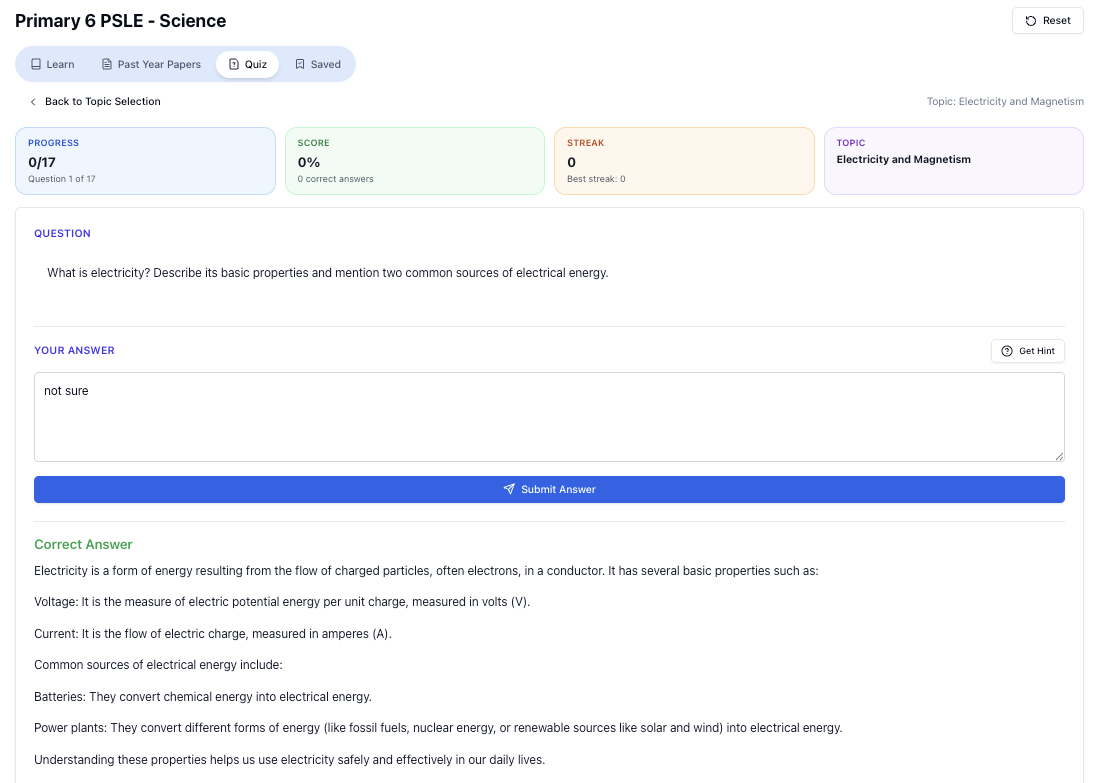
“Practice PSLE Science questions and get clear, step-by-step answers instantly.”
👉 Try a question now and see how fast you can improve.
Ready to practise?
If you want a Singapore-focused AI tutor you can use immediately (website, no sign-up), try Tutorly here:
Related Articles
Free on Tutorly.sg
Practise with step-by-step help — free to start
On Tutorly.sg/app you can practise unlimited Singapore syllabus questions, get instant explanations when you are stuck, and use past-year papers — no sign-up needed to start.
- ✓ PSLE, O Level, A Level, and more
- ✓ Step-by-step working when you are stuck
- ✓ Works on phone and laptop