

Free on Tutorly.sg
Practise with step-by-step help — free to start
On Tutorly.sg/app you can practise unlimited Singapore syllabus questions, get instant explanations when you are stuck, and use past-year papers — no sign-up needed to start.
- ✓ PSLE, O Level, A Level, and more
- ✓ Step-by-step working when you are stuck
- ✓ Works on phone and laptop
If you’re taking H 2 Math in JC, you already know this: it’s not just “harder Additional Math”. It’s a different game.
Suddenly you’re dealing with vectors in 3 D, sigma notation, maclaurin series, and statistics that actually look like what you see in real-world data. On top of that, you have CCAs, PW, and maybe other demanding subjects like H 2 Physics or Chemistry.
“Stuck on a question? See simple explanations that help you understand fast.”
👉 Give it a try and turn confusion into clarity in minutes.
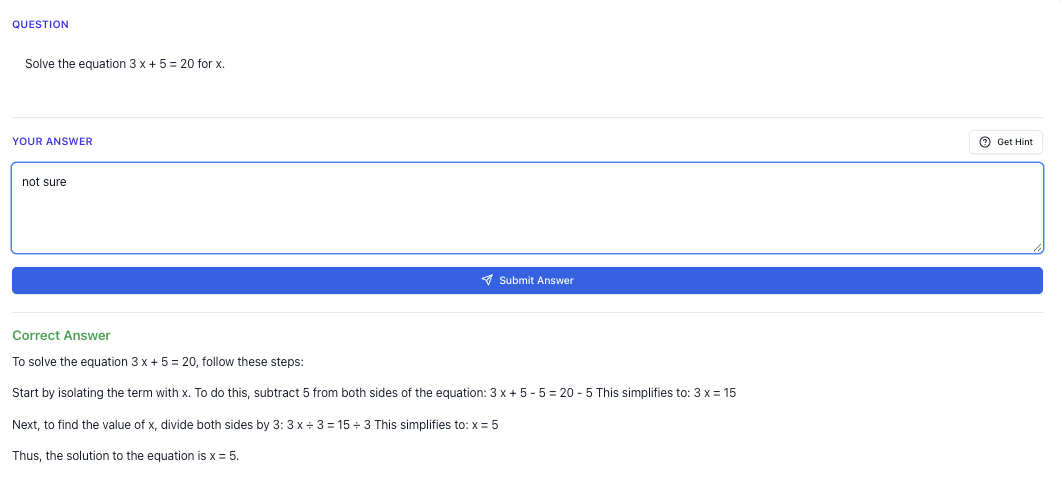
This is exactly where targeted JC H 2 Math tuition can make a big difference — not just in understanding content, but in how you approach A-Level style questions under time pressure.
In this guide, I’ll walk you through:
- How targeted help in H 2 Math actually boosts A-Level performance
- A step-by-step tutorial style walkthrough for a few core topics
- An exam strategy guide tailored to the A-Level H 2 Math paper
- How to use worksheet practice (including hard variants) effectively
- Common mistakes Singapore JC students keep making — and how to avoid them
- How to use Tutorly.sg, a AI tutor website built around the MOE syllabus, to support your H 2 Math journey
Tutorly.sg has already been used by thousands of students in Singapore, and has even been mentioned on Channel NewsAsia (CNA) — so you’re not experimenting with some random tool. You’re using something your seniors are already relying on.
You can try it anytime here:
AI tutor for Singapore students: https://tutorly.sg/ai-tutor-singapore
Go straight to the web app: https://tutorly.sg/app
Why JC H 2 Math Feels So Hard (And Why Tuition Helps)
H 2 Math is designed for students who may go into STEM, business, or data-related fields. That’s why the syllabus expects you to:
- Apply concepts to unfamiliar contexts
- Link topics together (e.g. calculus + graphs + inequalities)
- Justify your steps logically, not just “do and see”
The jump from O-Level A Math to JC H 2 Math is big because:
-
Speed and depth
In JC, you might learn something like differentiation rules in a few weeks, then immediately jump into applications (rates of change, optimisation, kinematics). There’s no time to slowly “get used to it”. -
Question style
H 2 Math questions are often multi-part:- (i) Show some expression or prove a result
- (ii) Use that result in a new context
- (iii) Interpret the answer in a real-world scenario
-
Concept linking
Example: A probability question might suddenly involve a normal distribution, then ask you to approximate a binomial distribution using normal, and then interpret the result in context.
Targeted tuition (whether with a human tutor, school consults, or an AI tutor like Tutorly.sg) helps because it:
- Focuses on what you personally are weak at, not just going through the syllabus in order
- Gives you exam-style questions that mirror A-Level difficulty
- Shows you step-by-step solutions so you don’t just memorise answers, but understand the method
Tutorly is especially useful here because you can ask questions anytime, even at 1am before your promo paper, and still get a clear explanation aligned to the Singapore A-Level H 2 Math syllabus.
Step-by-step tutorial
Let’s go through a few core H 2 Math areas where students usually struggle, and break them down in a step-by-step way. You can use this as a model for how to study any topic.
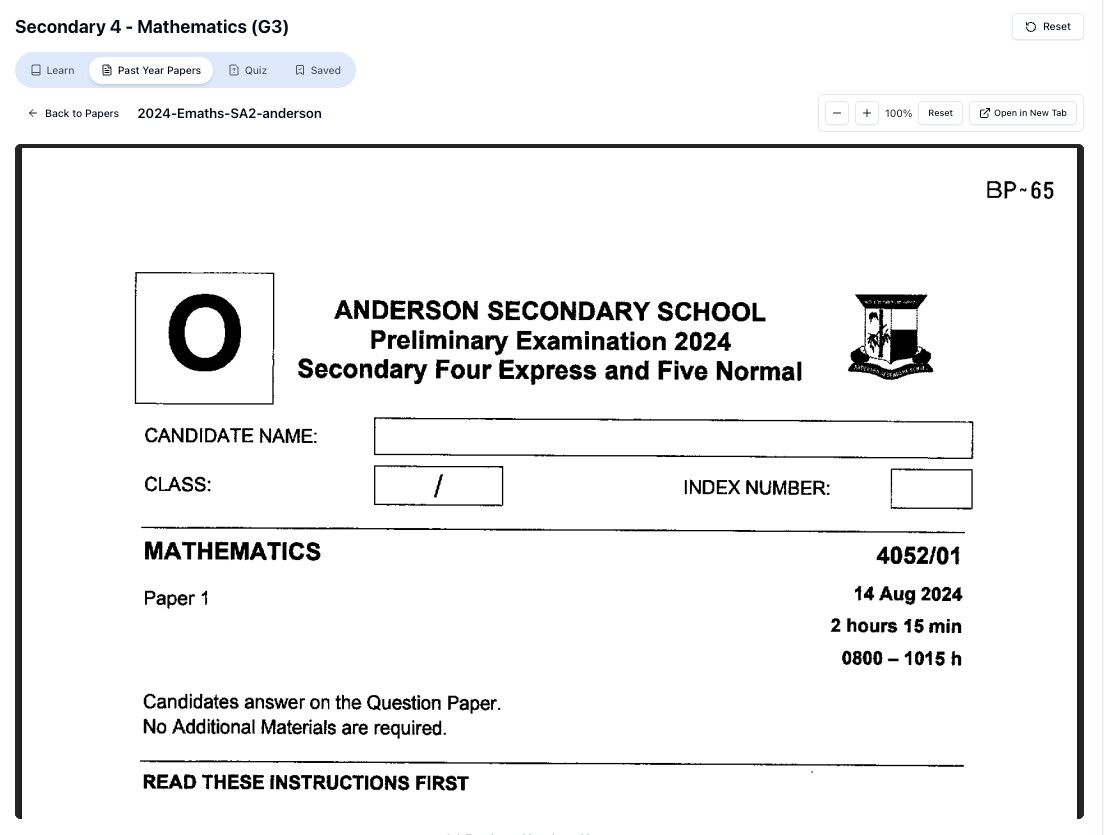
“Access more than 1000+ past year papers to practice”
👉 Start a paper today and test yourself like it’s the real exam.
We’ll cover:
- Differentiation – optimisation question
- Vectors – line and plane intersection
- Statistics – normal distribution and probability
1. Differentiation: Optimisation Question
Typical A-Level style question:
A rectangle has a fixed perimeter of 40 cm. Its length is 𝑥 cm and its breadth is 𝑦 cm.
- Express 𝑦 in terms of 𝑥.
- Show that the area 𝐴 of the rectangle can be written as .
- Find the value of 𝑥 for which 𝐴 is maximum, and find this maximum area.
Step-by-step approach
Step 1: Use the perimeter condition
Perimeter:
Step 2: Express area in terms of 𝑥
Area:
(That answers part 2.)
Step 3: Differentiate and find stationary point
Differentiate w.r.t. 𝑥:
Set derivative to 0 for stationary point:
Step 4: Confirm maximum
Second derivative:
So 𝐴 is maximum when .
Step 5: Find maximum area
This kind of question is “basic” for H 2, but the same structure appears in harder forms with more variables or constraints. When you practise with Tutorly.sg, you can ask it to:
- Generate similar optimisation questions
- Show you the full working from the expression to the derivative to the conclusion
You see the pattern enough times, the method becomes automatic.
2. Vectors: Line and Plane Intersection
Typical exam-style question:
A line 𝑙 is given by
A plane is given by
Find the point of intersection of 𝑙 and .
Step-by-step approach
Step 1: Express coordinates of a general point on the line
From the line equation:
Step 2: Substitute into the plane equation
Plane: .
Substitute:
2(1 + 2\lambda) - (2 - \lambda) + (-1 + 3\lambda) = 5
Simplify:
2 + 4\lambda - 2 + \lambda - 1 + 3\lambda = 5
Combine like terms:
(2 - 2 - 1) + (4\lambda + \lambda + 3\lambda) = 5 \Rightarrow -1 + 8\lambda = 5
Solve for :
Step 3: Substitute back to find coordinates
So the point of intersection is:
When you practise vectors, don’t just memorise formulas. Always think:
- Write parametric form
- Substitute into plane / another line
- Solve for parameter
- Get the point
On Tutorly.sg, you can paste a full vector question from your tutorial worksheet and ask it to explain the method from start to end. It won’t mark every step you type, but it will:
- Check your final answer
- Show you a clean, exam-style solution so you can compare your approach
3. Statistics: Normal Distribution
Typical question:
The heights of a group of JC 2 students are normally distributed with mean cm and standard deviation cm.
- Find the probability that a randomly chosen student is taller than cm.
- Find the height above which the tallest of students lie.
Step-by-step approach
Let 𝑋 be the height of a student.
Part 1: 𝑃(𝑋 > 180)
Step 1: Standardise
When :
So:
Step 2: Use normal tables / calculator
Using GC (as in A-Level exams), you’ll get something like:
So probability is about (to 3 s.f.).
Part 2: Top 10% height
We want such that:
Step 1: Find corresponding 𝑧-value
From normal distribution tables / GC, .
So:
So the tallest 10% of students are taller than about cm (to nearest cm).
The exam trick here is:
- Recognise whether they’re giving you an 𝑋-value or a probability
- Convert between 𝑋 and 𝑍 correctly
- Use the right tail (top 10% vs bottom 10% vs middle 90%, etc.)
Tutorly.sg can generate extra normal distribution questions, including tricky ones with “at least one”, “between”, or “top/bottom k%” phrasing, and then walk you through the solution.
Exam strategy guide
H 2 Math isn’t just about knowing content; it’s about performing in a 3-hour paper with a mix of topics.
Here’s a strategy tuned to the A-Level exam format.
1. Know the paper structure
For the current syllabus (check your year’s exact details, but generally):
- Paper 1 & Paper 2, each about 3 hours
- Mix of pure math and statistics
- Mostly long structured questions (not MCQ), often with multiple parts (i), (ii), (iii)
You need to:
- Manage time across questions
- Decide when to move on and come back later
- Avoid getting stuck on one part and losing marks on easier parts later
2. Use the “triage” method
In the first 5–10 minutes:
- Flip through the paper.
- Mark questions mentally as:
- A: “I can do this”
- B: “Can do most parts, but maybe one tricky step”
- C: “No idea / very unsure”
Tackle in this order:
- All A questions
- Then B questions
- Only then attempt C questions with remaining time
This prevents you from spending 25 minutes on one killer statistics question and then rushing through 3 easy calculus ones.
3. Don’t chase perfection in every part
Free on Tutorly.sg
Practise with step-by-step help — free to start
On Tutorly.sg/app you can practise unlimited Singapore syllabus questions, get instant explanations when you are stuck, and use past-year papers — no sign-up needed to start.
- ✓ PSLE, O Level, A Level, and more
- ✓ Step-by-step working when you are stuck
- ✓ Works on phone and laptop
Some students try to get full marks for every question and end up:
- Over-checking early questions
- Leaving the last 1–2 questions half-done
A more realistic approach:
- Aim to secure all the easy marks in every question
- If you’re stuck on a harder part (like proving an identity), move on and come back later
- Even if you can’t do part (i), still attempt part (ii) if possible — sometimes the question gives you a result to use
4. Show clear working (especially for methods-based marks)
H 2 Math marking schemes give method marks even if the final answer is wrong. To earn them:
- Write key equations clearly (not just scribbles)
- State formulas you’re using when it’s not obvious (e.g. )
- For proof/“show that” questions, make logical steps, not jumps
When you practise with Tutorly.sg, pay attention not only to the final answer but also the structure of the solution:
- How is the working laid out?
- Which lines are “big steps” vs simple arithmetic?
- How are assumptions or conditions stated?
Copy that style into your own exam practice.
5. Use the GC efficiently
You’re allowed a graphing calculator. But many students:
- Waste time typing everything twice
- Forget to set the right mode or bounds
- Don’t know how to interpret GC graphs
Before A-Levels:
- Practise using GC for:
- Solving equations
- Finding intersections
- Normal distribution probabilities
- Regression / correlation
- Develop a standard routine: write the equation → enter into GC → verify mode → interpret answer properly with units/context
Worksheet practice
Tuition (human or AI) is only effective if you practise exam-style questions regularly. Here’s how to structure your own “tuition-style” practice, even when you’re self-studying.
1. How to design your own worksheet practice
For each topic (e.g. Differentiation):
-
Start with 3–5 basic questions
- Straightforward application of formula or concept
- E.g. differentiate given functions, simple stationary points
-
Move to 3–5 intermediate questions
- Mix two ideas (e.g. differentiation + chain rule + product rule)
- Include word problems
-
End with 1–2 hard variants
- Longer, multi-step questions
- Require linking to other topics (e.g. differentiation + inequalities)
You can ask Tutorly.sg to:
- Generate a set of questions on a specific topic (e.g. “Give me some H 2 Math differentiation exam questions, including hard variants”)
- Then show you step-by-step solutions after you attempt them
Because it’s available on the web at https://tutorly.sg/app, you can fit this into your schedule whenever you have 20–30 minutes.
2. Sample worksheet: Differentiation (with hard variants)
Try these, then check your answers with an AI tutor or your teacher.
“Doing Secondary Science? Pick a topic and practise like it’s a real exam — with clear answers right after.”
👉 Try Tutorly now and start a Science topic in seconds.

Q 1 (Basic)
Differentiate the following with respect to 𝑥:
a)
b)
c)
Focus: product rule, chain rule, basic rules.
Q 2 (Intermediate – stationary points)
A curve has equation .
- Find .
- Find the coordinates of the stationary points.
- Determine the nature (max/min) of each stationary point.
Focus: differentiation, solving simultaneous equations, second derivative test.
Q 3 (Hard variant – optimisation with constraint)
A rectangular piece of card measures cm by cm. Squares of side 𝑥 cm are cut from each corner, and the sides are folded up to form an open box.
- Show that the volume 𝑉 of the box is given by .
- Find the value of 𝑥 which gives the maximum volume of the box.
- Find this maximum volume.
This is the kind of question that appears in promos/prelims — messy algebra, but standard method.
You can ask Tutorly.sg to walk you through:
- Expressing volume in terms of 𝑥
- Differentiating and solving
- Checking the second derivative for maximum
3. Sample worksheet: Vectors (with hard variant)
Q 4 (Basic)
Given vectors and :
- Find .
- Find .
- Find the magnitude .
Q 5 (Intermediate – angle between vectors)
Find the angle between vectors and .
Use the formula:
Q 6 (Hard variant – shortest distance from point to line)
The line 𝑙 is given by
A point 𝐴 has position vector \begin{pmatrix}5\-1\3\end{pmatrix}.
- Show that the foot of the perpendicular from 𝐴 to the line 𝑙 lies on 𝑙.
- Find the shortest distance from 𝐴 to the line 𝑙.
This is a classic “harder” vectors question. The method involves:
- Letting the foot of perpendicular be a point 𝑃 on 𝑙
- Using the condition is perpendicular to direction vector of 𝑙
- Solving for
- Finding |AP|
Tutorly.sg is very good at questions like this because it can:
- Show you the algebra cleanly
- Explain why each step is done (e.g. “dot product = 0 for perpendicular vectors”)
4. Sample worksheet: Statistics (with hard variants)
Q 7 (Basic – binomial)
A biased coin has probability of landing heads. It is tossed times.
- Find the probability of getting exactly heads.
- Find the probability of getting at least heads.
Q 8 (Intermediate – normal approximation to binomial)
The number of defective bulbs in a batch of has distribution .
- State the mean and variance of 𝑋.
- Using a suitable normal approximation, find the probability that there are at most defective bulbs.
Focus: continuity correction, mean/variance, normal approximation conditions.
Q 9 (Hard variant – conditional probability with normal)
The weights of packets of rice are normally distributed with mean kg and standard deviation kg.
Packets that weigh less than kg are considered underweight and rejected.
- Find the proportion of packets that are rejected.
- Given that a packet is not rejected, find the probability that it weighs more than kg.
This is the kind of statistics question that can appear near the end of a paper. It involves:
- Normal distribution
- Conditional probability
- Interpreting context carefully
Again, you can answer it yourself, then use Tutorly.sg to check your final answer and see a full, step-by-step solution.
Common mistakes
Here are some of the most common H 2 Math mistakes I see from JC students in Singapore — including those who are already in tuition.
1. Memorising methods without understanding
You might know:
- “For optimisation, differentiate and set to zero.”
- “For normal distribution, standardise then use GC.”
But if you don’t understand why you’re doing each step, you’ll get stuck when the question is phrased slightly differently.
Fix:
- After each solution, ask yourself: “Why did we choose this method?”
- Use Tutorly.sg not just to get the answer, but to read the explanation of the method and logic.
2. Weak algebra and manipulation
Many students “know” calculus, but lose marks because:
- They expand brackets wrongly
- They mis-handle negative signs or fractions
- They can’t rearrange equations cleanly
This is painful because all your hard conceptual understanding is wasted by small algebra errors.
Fix:
- Spend some time on pure algebra drills (especially before J 1 promos).
- When using an AI tutor, ask it to give you algebra-only practice questions and go fast.
- Check your working line-by-line for sign errors.
3. Not stating assumptions or conditions
In statistics especially, marks can be lost for:
- Not stating the distribution clearly, e.g. “Let ”
- Not writing down continuity correction properly
- Not interpreting the final answer in context (e.g. “probability that the machine produces at least 3 defective items in a day”)
Fix:
- Train yourself to always start with “Let 𝑋 be …” and write the distribution.
- Check if the question asks for a probability, a number of items, or a proportion.
4. Over-relying on final answers
Many students practise by checking only if their final answer matches the solution. If it doesn’t, they just “see how they did it” and move on.
This doesn’t help you fix your thinking.
Fix:
- Compare your method to the model solution.
- Ask: “Where did I start to differ? Why did I choose a less efficient method?”
- With Tutorly.sg, you can try the same question again later and see if you remember the approach, not just the numbers.
5. Ignoring time pressure
You can do the question in 25 minutes at home, but in the exam you only have maybe 12–15 minutes for a big question.
Fix:
- Do timed practice: 1 or 2 questions under strict timing.
- Use Tutorly.sg to generate a small set of questions, set a timer for 30–40 minutes, and attempt them as if it’s an exam section.
- Afterwards, check solutions and see where you spent too long.
How Tutorly.sg fits into your JC
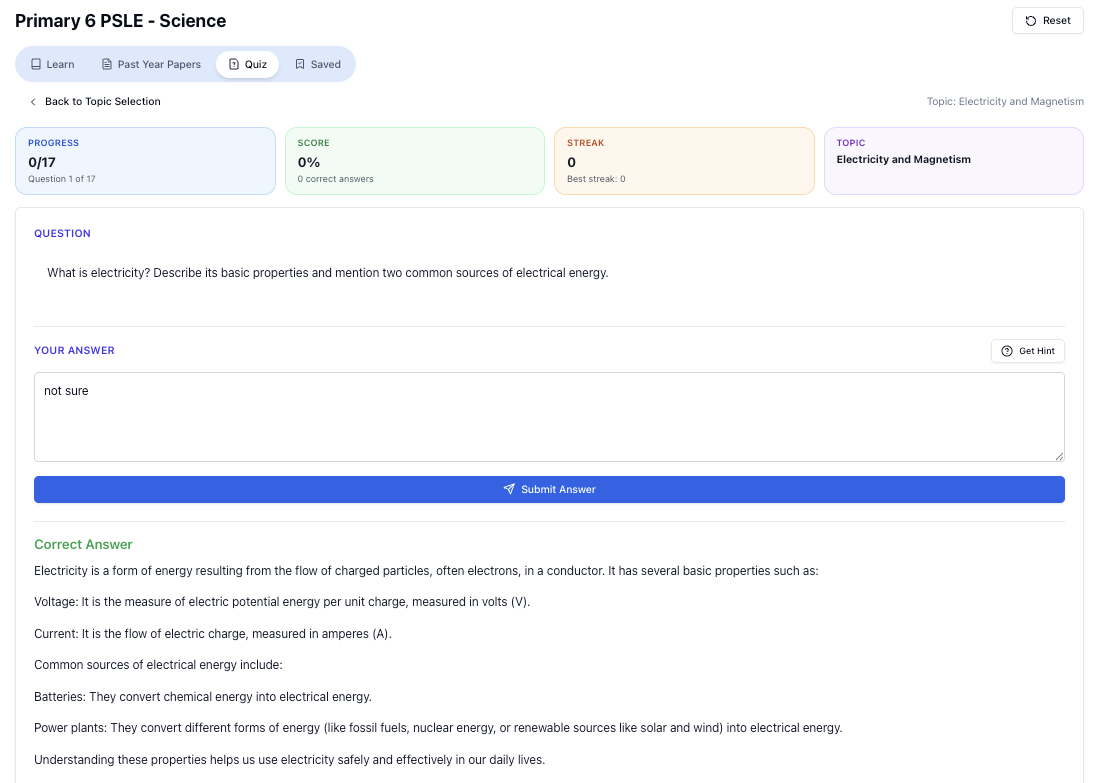
“Practice PSLE Science questions and get clear, step-by-step answers instantly.”
👉 Try a question now and see how fast you can improve.
Ready to practise?
If you want a Singapore-focused AI tutor you can use immediately (website, no sign-up), try Tutorly here:
Related Articles
Free on Tutorly.sg
Practise with step-by-step help — free to start
On Tutorly.sg/app you can practise unlimited Singapore syllabus questions, get instant explanations when you are stuck, and use past-year papers — no sign-up needed to start.
- ✓ PSLE, O Level, A Level, and more
- ✓ Step-by-step working when you are stuck
- ✓ Works on phone and laptop