

Free on Tutorly.sg
Practise with step-by-step help — free to start
On Tutorly.sg/app you can practise unlimited Singapore syllabus questions, get instant explanations when you are stuck, and use past-year papers — no sign-up needed to start.
- ✓ PSLE, O Level, A Level, and more
- ✓ Step-by-step working when you are stuck
- ✓ Works on phone and laptop
For JC students, an AI tutor in Singapore is most useful when it helps you practise specific A-Level question types and clean up your working fast.
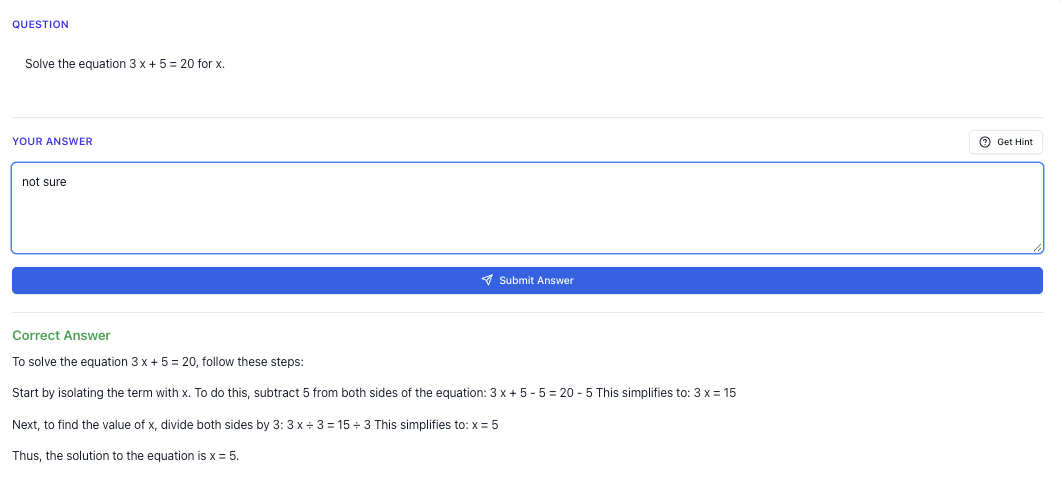
“Stuck on a question? See simple explanations that help you understand fast.”
👉 Give it a try and turn confusion into clarity in minutes.
If you’re not improving, it’s usually one of these:
- you practise topics too broadly (no repetition of the same pattern)
- you don’t diagnose the first wrong step
- you don’t do timed sets after accuracy stabilises
The JC reality: you don’t have time to “revise everything”
JC revision gets stressful because the syllabus is big and the questions are layered.
If you’re feeling stuck, it often looks like:
- you “understand” during review, but can’t reproduce under pressure,
- you lose method marks because your working is messy,
- you keep doing different questions but never stabilise a pattern.
An AI tutor helps when it gives you focused repetition and fast marking of your working.
If you want Tutorly’s Singapore AI tutor page, start here:
AI Tutor Singapore
The H 2 Math workflow (pattern → steps → timed)
Step 1: Pick one high-impact topic (5 minutes)
Start with topics that often leak marks:
- Functions & graphs
- Calculus techniques
- Sequences & series
- Probability & distributions
- Vectors
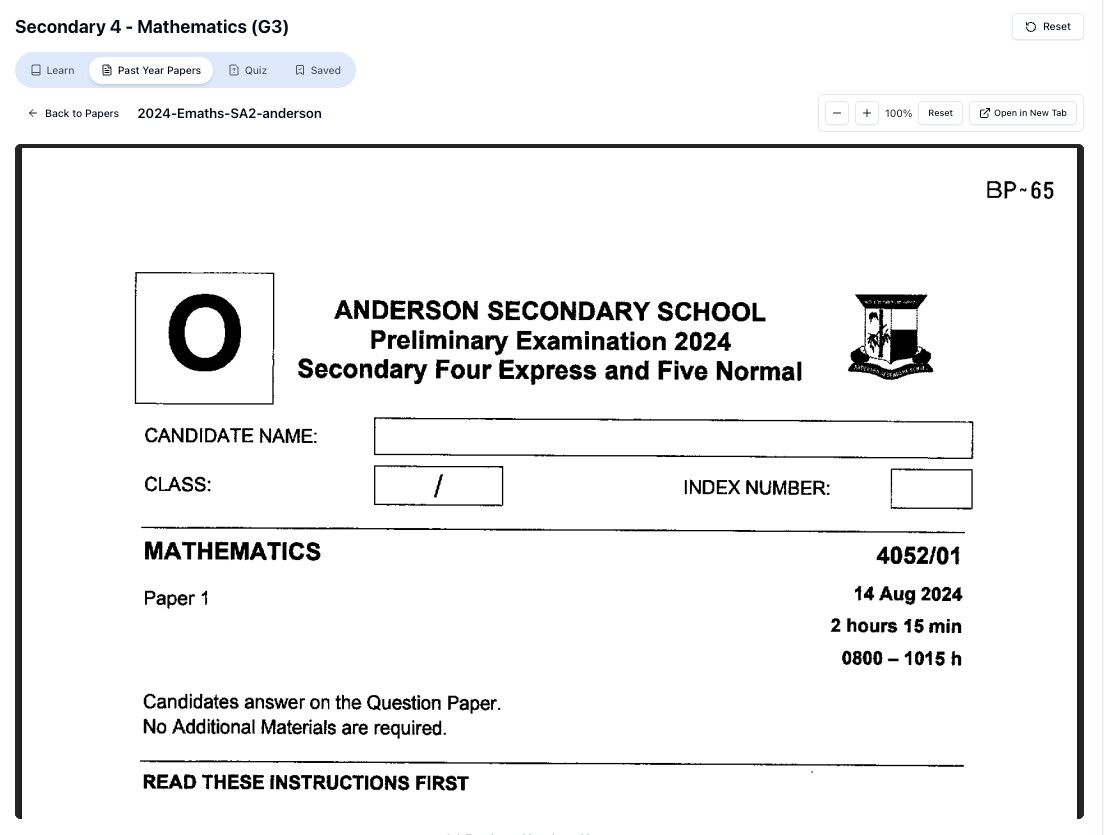
“Access more than 1000+ past year papers to practice”
👉 Start a paper today and test yourself like it’s the real exam.
Pick the topic where you lose marks most consistently — not the one you like.
Step 2: Break it into question types (this is the key)
Example: “integration” is too broad. Break it into:
- substitution recognition
- integration by parts selection
- algebra rearrangement before integrating
- bounds / constants handling
Then drill one question type at a time.
If you can’t name the question type, you can’t practise it properly.
Step 3: Mark your steps (method marks matter)
After each attempt:
- highlight the first wrong line
- ask for the corrected line + the reason your line fails
- redo immediately
Step 4: Add timed sets (2–3 times/week)
Once accuracy is stable:
- do 10–14 questions mixed (timed)
- review only the questions you lost marks on
The “first wrong line” rule (this fixes 80% of slow progress)
Most JC students review like this:
- “I got it wrong, so I’ll read the full solution.”
That feels safe but it’s slow. Instead:
- find the first wrong line
- fix only that
- redo the question
This turns every mistake into a targeted correction instead of a long reading session.
Prompts that are useful for H 2 Math (copy/paste)
- “I’m a JC 2 student in Singapore. Give me 6 H 2 Math questions on vectors focused on one pattern (e.g., line intersection). One at a time. Wait for my answer.”
- “Here is my working. Identify the first wrong line and give a corrected line. Then give 2 similar questions.”
- “Create a 30-minute timed mixed set across calculus + probability. Provide marking-scheme style answers.”
A 2-week plan if your exam is near
This is realistic for most students.
Week 1: Stabilise 2 weak patterns
- pick 2 topics
- for each topic, pick 2 question types
- drill 6 questions per session, 4 sessions/week
Week 2: Timed mixed sets + targeted correction
- 2 timed mixed sets
- 2 topical drills (based on mistakes from timed sets)
- 1 final mixed set
What to ask for if you want marking-scheme style answers
Use these:
- “Give answers in marking scheme style (short, method marks).”
- “Don’t skip algebra steps; show method-mark lines only.”
Sample questions + step-by-step solutions (JC H 2 Math style)
Question 1 (Differentiation: stationary points)
Given ,
- find
- find the 𝑥-coordinates of the stationary points.
Solution (step-by-step)
Part 1: Differentiate
Step 1: Differentiate term-by-term.
Why: Differentiation is linear: we can differentiate each term separately and add the results.
So:
Part 2: Stationary points
Step 2: Set .
Stationary points occur when the gradient is zero.
Step 3: Factorise.
Factor out 3 first:
Why: Factoring simplifies the equation and makes solving faster.
Now factor the quadratic:
So:
Step 4: Solve each factor.
Final answers:
Stationary points at and
Answer check (common wrong answers + why)
- Wrong derivative: : differentiating incorrectly (it becomes -6𝑥, not -3𝑥).
- Wrong stationary points: setting instead of (stationary points are about gradient).
Question 2 (Integration: substitution)
Evaluate .
Free on Tutorly.sg
Practise with step-by-step help — free to start
On Tutorly.sg/app you can practise unlimited Singapore syllabus questions, get instant explanations when you are stuck, and use past-year papers — no sign-up needed to start.
- ✓ PSLE, O Level, A Level, and more
- ✓ Step-by-step working when you are stuck
- ✓ Works on phone and laptop
Solution (step-by-step)
Step 1: Choose a substitution.
Let .
Why: We see and also 2𝑥. That’s a strong hint for substitution.
Step 2: Differentiate 𝑢 with respect to 𝑥.
Step 3: Replace in the integral.
Step 4: Integrate.
Why: Use the power rule: for .
Step 5: Substitute back .
Final answer:
Answer check (common wrong answers + why)
- Wrong answer: : forgetting to increase the power (it must be , not ).
- Wrong answer: : missing the factor (from integrating ).
Question 3 (Probability)
A fair coin is tossed 5 times. Find the probability of getting exactly 3 heads.
“Doing Secondary Science? Pick a topic and practise like it’s a real exam — with clear answers right after.”
👉 Try Tutorly now and start a Science topic in seconds.

Solution (step-by-step)
Step 1: Identify the distribution.
This is a binomial situation: each toss has two outcomes (H/T), and the probability of head is constant.
So:
- want
Why: Binomial applies when trials are independent and identical.
Step 2: Use the binomial formula.
Why: counts how many ways to place 3 heads in 5 tosses.
Step 3: Simplify.
So:
Final answer:
Answer check (common wrong answers + why)
- Wrong answer: : forgetting the combinations .
- Wrong answer: : treating probability like “3 out of 5” (binomial requires counting outcomes).
Question 4 (Sequences and series)
The sequence is defined by .
- Find , , and .
- Find the sum of the first 10 terms, .
Solution (step-by-step)
Part 1: Substitute values of 𝑛.
Step 1: Find .
Why: The formula gives the term directly once you plug in 𝑛.
Step 2: Find .
Step 3: Find .
Part 2: Sum of first 10 terms
This is an arithmetic sequence because the difference between terms is constant:
Why: Constant difference means arithmetic progression (AP), so we can use AP sum formulas.
So:
- first term
- common difference
- number of terms
Step 4: Find the 10th term .
Step 5: Use the AP sum formula.
Why: AP sum is the average of first and last term multiplied by number of terms.
Final answers:
and
Answer check (common wrong answers + why)
- Wrong : 3: forgetting the “-1” in 3𝑛-1.
- Wrong sum: 150: using the wrong last term (you need , not or ).
If you want an AI tutor built for Singapore JC revision
Tutorly.sg supports JC levels with Singapore-focused practice and step-by-step explanations.
Start here: AI Tutor Singapore
Try Tutorly immediately (no sign-up):
https://tutorly.sg/app
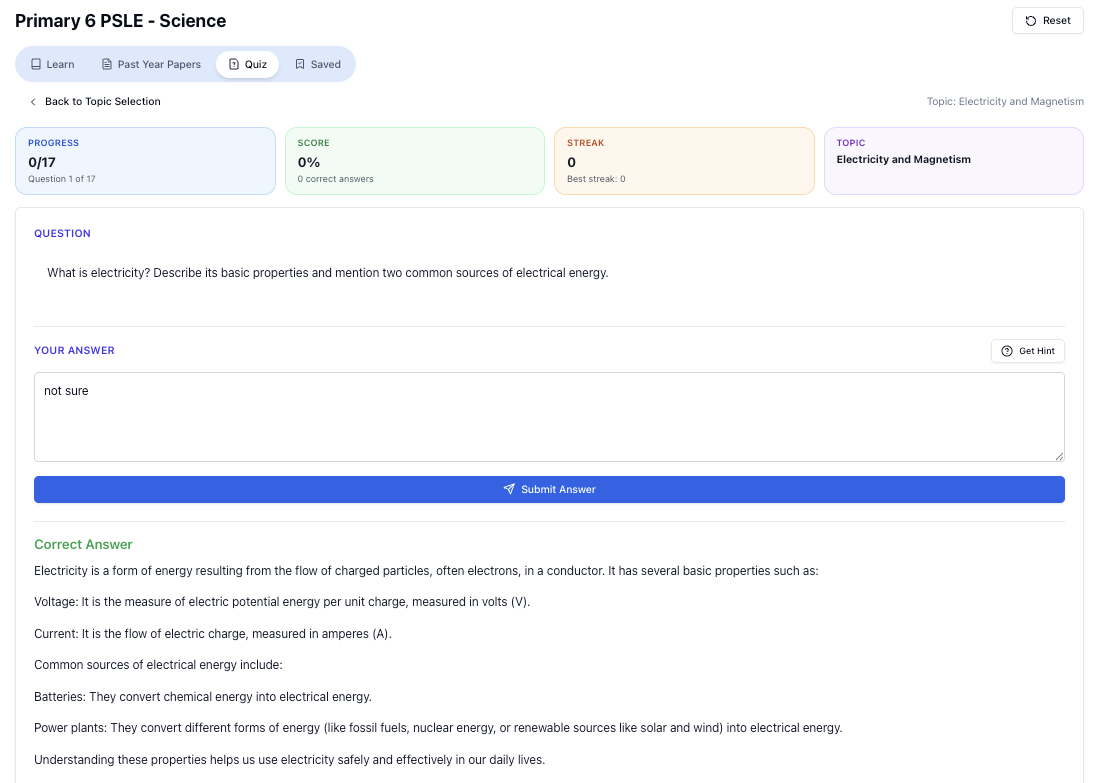
“Practice PSLE Science questions and get clear, step-by-step answers instantly.”
👉 Try a question now and see how fast you can improve.
Free on Tutorly.sg
Practise with step-by-step help — free to start
On Tutorly.sg/app you can practise unlimited Singapore syllabus questions, get instant explanations when you are stuck, and use past-year papers — no sign-up needed to start.
- ✓ PSLE, O Level, A Level, and more
- ✓ Step-by-step working when you are stuck
- ✓ Works on phone and laptop