

Free on Tutorly.sg
Practise with step-by-step help — free to start
On Tutorly.sg/app you can practise unlimited Singapore syllabus questions, get instant explanations when you are stuck, and use past-year papers — no sign-up needed to start.
- ✓ PSLE, O Level, A Level, and more
- ✓ Step-by-step working when you are stuck
- ✓ Works on phone and laptop
If you’ve ever walked out of an exam thinking, “I knew the content, but my marks don’t show it,” this guide is for you.
In Singapore, especially at lower secondary and O-Level, how you write your answers matters almost as much as what you know. Marking schemes for MOE exams are very structured. If your answer doesn’t match that structure, you lose marks even if your idea is correct.
“Stuck on a question? See simple explanations that help you understand fast.”
👉 Give it a try and turn confusion into clarity in minutes.
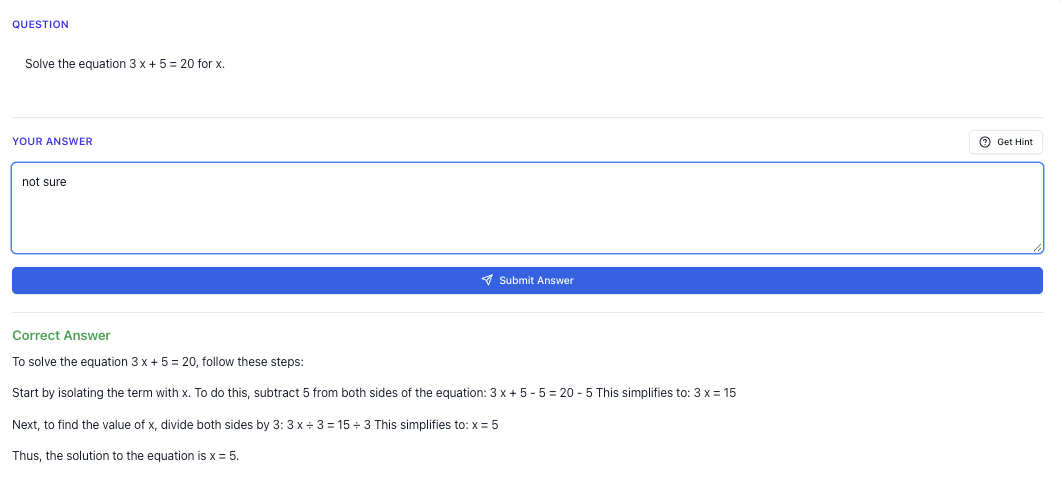
This article will walk you through exact, step-by-step answering techniques that fit MOE-style marking for common Secondary and O-Level subjects, and show you how to practise them properly.
I’ll also show you how to use Tutorly.sg, a AI tutor website built specifically for Singapore students, to drill these techniques anytime you need. Tutorly.sg has already been used by thousands of students in Singapore and has even been mentioned on Channel NewsAsia (CNA), so you’re not experimenting with something random from overseas.
Useful links for later:
- Main site & guide: https://tutorly.sg/ai-tutor-singapore
- Direct web app: https://tutorly.sg/app
Step-by-step tutorial
Let’s go through concrete answer structures for key Secondary / O-Level subjects:
- English (Paper 2 and 1)
- Mathematics
- Science (Physics / Chemistry / Biology style)
- Humanities (Social Studies / History / Geography style)
You don’t have to use every technique at once. Start with the subjects you’re struggling with most.
1. English: How to write exam-style answers (Secondary & O-Level)
1.1 Comprehension short-answer questions (Paper 2)
Most questions fall into a few patterns:
- Own words
- Inference / “What does this suggest?”
- Language use / effect
- Vocabulary in context
Let’s take them one by one.
(A) “Use your own words” questions
Goal: Show you understand the idea, not just copy.
Basic structure:
- Identify the key idea(s) in the relevant lines.
- Replace important words with simple synonyms.
- Keep the same meaning, but short and clear.
Example type:
In your own words, explain why the writer felt relieved. [2]
Step-by-step:
- Underline the phrases that show why the writer felt relieved.
- Change:
- “anxious” → “worried”
- “results were out” → “the marks were released”
- “finally over” → “ended at last”
- Answer in a full sentence, not point form.
Sample answer:
He felt relieved because he had been very worried about his marks, and now that the exam results were finally released, his anxiety ended.
(B) Inference questions
Clues: “What can you tell about…?”, “What does this show/suggest about…?”
Simple structure:
- State the trait / conclusion
- Give evidence from the text (paraphrased or short quote)
- Link with “This shows that…”
Example type:
What does the writer’s reaction show about his attitude towards failure? [2]
Sample structure:
The writer is determined and reflective.
This is shown when he carefully analysed what went wrong and planned how to improve, instead of giving up. This shows that he treats failure as a chance to learn.
Markers love this: trait → evidence → explanation.
(C) Language use / effect questions
Clues: “What is the effect of this phrase?”, “How does this metaphor help you understand…?”
Structure (PEE):
- Point – What is the effect?
- Evidence – Quote the phrase.
- Explain – How does it create that effect?
Example type:
What is the effect of the phrase “a storm of emotions”? [2]
Sample answer:
The phrase “a storm of emotions” shows that his feelings were very intense and chaotic.
Just like a storm is wild and hard to control, his emotions were overwhelming and confusing, suggesting he was deeply affected by the situation.
(D) Situational writing (Secondary / O-Level English Paper 1)
For emails, letters, reports, speeches, etc., a simple 4-part structure works:
- Purpose – Why are you writing?
- Context – What happened / background?
- Points – Each bullet point in the question = at least one paragraph.
- Tone & audience – Formal / informal, school / friend / principal.
Quick checklist:
- Have you addressed every bullet point clearly?
- Is your tone appropriate? (No slang to principal, please.)
- Is there a clear beginning and ending?
2. Mathematics: Answering to match MOE/O-Level marking
In Maths, you don’t get marks for “I almost got it”. You must:
- Show key steps
- Give a clear final answer, often with units / correct form
Even though markers don’t need full essays, a consistent structure keeps you safe.
2.1 Short questions (1–3 marks)
Structure:
- Write the relevant formula (if needed).
- Substitute values.
- Simplify clearly.
- Box or underline the final answer with units.
Example:
Find the value of 𝑥 if .
Good working:
Final:
Simple, clear, no skipping big jumps.
2.2 Long structured questions (4–8 marks)
Use this universal structure:
- Identify the topic (e.g. similar triangles, simultaneous equations, kinematics).
- Write the principle (e.g. “Using Pythagoras’ Theorem”, “Using ”).
- Show logical steps in order.
- State conclusion clearly (with reason if needed).
Example (Algebra / functions):
The graph of passes through (3, 7). Find the value of 𝑐.
Structured answer:
- Since the point (3, 7) lies on the line, substitute , into .
Final:
You don’t need essays, but sentence starters like “Since…”, “Therefore…” help make your logic clear.
3. Science: How to write full-mark explanation answers
For Secondary and O-Level Science, explanations usually follow:
Cause → Scientific concept → Effect
Let’s go by type.
3.1 “Explain why…” questions
Structure:
- State the concept (e.g. diffusion, pressure, Newton’s law)
- Apply to the situation (link to the question)
- State the result / effect
Example (Chem / diffusion):
Explain why perfume sprayed at one corner of the room can be smelt at the other end after some time. [3]
Full structure answer:
- Perfume particles diffuse from a region of higher concentration to a region of lower concentration.
- When perfume is sprayed, the concentration of perfume particles is higher near the source and lower further away.
- The particles move randomly and spread out to fill the room, so after some time, they reach the other end and can be smelt there.
See the pattern: concept → link → outcome.
3.2 “Describe and explain” questions
“Describe” = What you observe.
“Explain” = Why it happens.
Structure:
- Describe – state what will happen (trend / observation).
- Explain – use the correct concept to justify.
Example (Physics / heating a metal rod):
Describe and explain what happens when one end of a metal rod is heated. [4]
Sample answer:
Describe:
When one end of the metal rod is heated, after some time the other end also becomes hot.Explain:
Heat is transferred through the metal by conduction. The particles at the hot end gain kinetic energy and vibrate more vigorously, passing energy to neighbouring particles. This process continues along the rod, so the other end becomes hot too.
4. Humanities: Structured answering (Social Studies / History / Geography)
For source-based and structured essay questions, PEEL is your best friend:
Point → Evidence → Explanation → Link
4.1 Social Studies: “Explain” questions (e.g. 6–8 marks)
Question type:
Explain how Factor A and Factor B contribute to social cohesion in Singapore. [8]
Structure per paragraph (per factor):
- Point – State how the factor contributes.
- Evidence – Give example (policy, data, case).
- Explanation – Why this leads to cohesion.
- Link – Tie back to the question.
Sample paragraph (Factor A: Education):
Point:
Education contributes to social cohesion by providing shared experiences and values for students from different backgrounds.Evidence:
For example, in Singapore, schools follow a common national curriculum set by MOE, which includes National Education and CCE lessons.Explanation:
These lessons emphasise common values such as respect and responsibility, and help students understand Singapore’s history and challenges. By learning the same content and participating in school activities together, students from different races and religions can build mutual understanding and a shared identity.Link:
Therefore, education helps to strengthen social cohesion by uniting students through common experiences and values.
Repeat this structure for each factor.
4.2 History / Geography essays
Same PEEL, but with more content:
- Point – Your argument sentence
- Evidence – Specific names, dates, places, statistics
- Explanation – Why this proves your point
- Link – Back to question (e.g. “This shows that…”, “Therefore, this was a significant cause of…”)
Once you get used to PEEL, writing becomes a lot more predictable and less stressful.
Exam strategy guide
Now that you know how to structure answers, here’s how to use these structures during exams under time pressure.
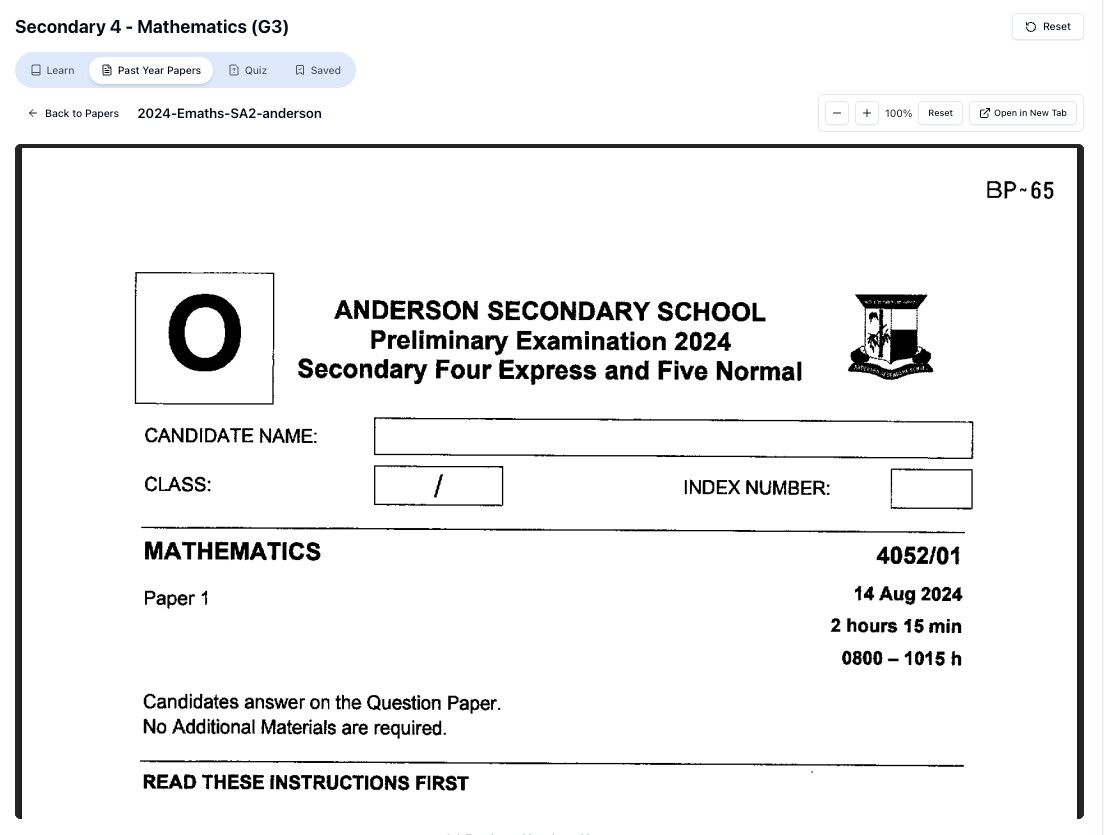
“Access more than 1000+ past year papers to practice”
👉 Start a paper today and test yourself like it’s the real exam.
1. Before the exam: build “answering muscle memory”
Free on Tutorly.sg
Practise with step-by-step help — free to start
On Tutorly.sg/app you can practise unlimited Singapore syllabus questions, get instant explanations when you are stuck, and use past-year papers — no sign-up needed to start.
- ✓ PSLE, O Level, A Level, and more
- ✓ Step-by-step working when you are stuck
- ✓ Works on phone and laptop
You want to reach the point where your brain automatically goes:
- English inference → “trait + evidence + explanation”
- Science explanation → “concept + apply + outcome”
- SS / History → “PEEL paragraph”
To do that:
-
Practise by type, not by chapter only
E.g. do 10 “Explain why” questions in Science back-to-back, focusing on structure. -
Use timed mini-drills
- 5 minutes: write one PEEL paragraph.
- 3 minutes: write one Science explanation.
This trains you for exam speed.
-
Use Tutorly.sg to generate more question types:
- Go to: https://tutorly.sg/app
- Select your level and subject (e.g. Sec 3, Pure Chemistry).
- Ask for:
“Give me 5 ‘Explain why’ questions on diffusion with answers, in O-Level style.”
- Then practise writing your own answers before checking Tutorly’s explanation.
Because Tutorly.sg is built specifically for the MOE syllabus, the style of questions and answers will feel familiar to what you see in school prelims and national exams.
2. During the exam: a simple answering routine
Use this 3-step routine for each question:
-
Decode the command word
- “State / list” → short, direct answers.
- “Explain / why / how” → full structure.
- “Compare / contrast” → similarities and differences.
- “To what extent / how far do you agree” → balanced argument + judgement.
-
Plan 10–30 seconds
- Jot down quick keywords on the question paper.
- For essays, outline 3 points and the order.
-
Write using your structure
- English: trait → evidence → explanation.
- Science: concept → apply → outcome.
- Humanities: PEEL.
- Maths: formula → substitute → solve → conclude.
This short pause to plan actually saves time later because you won’t get stuck halfway.
3. Time management by section
For most Secondary and O-Level papers:
- Do the easier questions first to secure marks.
- Watch the marks:
- 2 marks → ~2–3 minutes
- 4 marks → ~5–6 minutes
- 8 marks → ~10–12 minutes
If you find yourself explaining for too long for a 2-mark question, you’re probably overwriting. Use your structure, then stop.
4. After the exam: learn from your scripts
When you get your paper back:
- Look at questions where you lost 1–2 marks.
- Ask: was it:
- Wrong content?
- Or incomplete structure (e.g. no explanation, no link, no units)?
- Rewrite just those answers using proper structure.
You can also copy those questions into Tutorly.sg and ask:
“This is the question: [paste]. This is my answer: [paste]. Show me a full-mark answer and explain what I missed.”
Tutorly will not grade your script like a teacher, but it will show you a model solution step-by-step, so you can compare and see which parts your answer lacked.
Worksheet practice
Here are some practice questions with hard variants you can try now. I’ll include suggested structures and sample answers so you can compare.
You can also paste these into https://tutorly.sg/app to generate more similar questions once you’re done.
1. English practice (Comprehension & Situational Writing)
Q 1 (Inference – medium)
From the passage: “When the results were released, Mei Lin stared at the paper in silence, her hands trembling slightly. She folded it carefully and placed it in her bag without a word.”
What can you tell about Mei Lin’s feelings at that moment? [2]
Structure to use:
- Trait / conclusion
- Evidence
- Explanation
Sample answer:
Mei Lin was shocked and disappointed by her results.
This is shown when her hands were trembling and she said nothing, instead folding the paper carefully and keeping it away. This suggests she was trying to control her emotions and hide how upset she was.
Q 2 (Situational writing – harder)
You are the Chairperson of your school’s Environmental Club. Write an email to the Principal to propose a new school-wide recycling initiative. Your email should:
- Explain the purpose of the initiative
- Describe at least two activities
- Explain how the initiative will benefit the school community
Write your email.
Suggested structure:
- Opening – Purpose & context
- Body 1 – Activity 1 (description + why)
- Body 2 – Activity 2 (description + why)
- Body 3 – Benefits to school community
- Closing – Polite request / thanks
You can write your own version, then go to Tutorly and ask:
“Mark this like an O-Level English teacher and show me a stronger version.”
Tutorly won’t give you an official grade, but it will generate a more polished answer you can compare with.
2. Mathematics practice (with hard variants)
Q 3 (Algebra – medium)
Solve the equation .
Structure:
- Expand brackets.
- Collect like terms.
- Solve.
Answer:
Q 4 (Harder variant – simultaneous equations)
Solve the simultaneous equations:
\begin{cases} 2𝑥 + 3𝑦 = 13 \\ 5𝑥 - 𝑦 = 9 \end{cases}$$
Suggested structure:
- Make coefficients of 𝑦 (or 𝑥) match.
- Add / subtract equations.
- Solve for first variable.
- Substitute back to find second variable.
Answer:
- From , express .
- Substitute into :
Final:
Even for harder questions, the same structure applies.
3. Science practice (with hard variants)
Q 5 (Chemistry – medium)
Explain why increasing the temperature increases the rate of reaction between magnesium and dilute hydrochloric acid. [3]
Structure:
- Concept – particle collision theory
- Apply – what happens when temperature increases
- Outcome – effect on rate
Sample answer:
“Doing Secondary Science? Pick a topic and practise like it’s a real exam — with clear answers right after.”
👉 Try Tutorly now and start a Science topic in seconds.

When temperature increases, the particles gain kinetic energy and move faster.
This causes more frequent and more energetic collisions between the magnesium particles and acid particles.
Therefore, the rate of reaction increases because there are more effective collisions per unit time.
Q 6 (Harder variant – Physics / pressure)
A student stands on soft, wet soil wearing shoes with very thin heels. She notices her heels sink into the ground. Explain, in terms of pressure, why this happens. Suggest one way she could reduce the sinking. [4]
Structure:
- Concept – pressure formula
- Apply – small area → high pressure
- Effect – soil cannot support
- Suggestion – change area
Sample answer:
Pressure is given by .
The student’s weight is acting on a very small area due to the thin heels, so the pressure on the soil is very high.
The soft, wet soil cannot withstand this high pressure and gives way, causing her heels to sink.
She can reduce the sinking by increasing the area in contact with the ground, for example by wearing shoes with wider, flatter soles, which lowers the pressure.
4. Social Studies / Humanities practice (with hard variants)
Q 7 (Social Studies – medium)
Explain how the government’s housing policy helps to promote social cohesion in Singapore. [4]
Use PEEL:
Sample paragraph:
Point:
Housing policy promotes social cohesion by encouraging people of different races to live together.Evidence:
For instance, the Ethnic Integration Policy (EIP) sets limits on the proportion of each ethnic group in HDB blocks and neighbourhoods.Explanation:
This prevents racial enclaves from forming and ensures that residents from different ethnic backgrounds are mixed. As a result, they have more opportunities to interact in everyday situations, such as at void decks or nearby shops. Over time, this can reduce prejudice and increase understanding.Link:
Therefore, the housing policy helps build stronger social cohesion by promoting regular interaction among different ethnic groups.
Q 8 (Harder variant – “How far do you agree?”)
How far do you agree that individual responsibility is the most important factor in maintaining racial harmony in Singapore? Explain your answer. [8]
Suggested structure:
- Introduction – Brief stand (e.g. “I mostly agree, but other factors are also important.”)
- Paragraph 1 (Agree) – Individual responsibility (PEEL)
- Paragraph 2 (Other factor) – Government policies / education (PEEL)
- Paragraph 3 (Another factor) – Community efforts (PEEL)
- Conclusion – Weigh and restate stand
You don’t need a super long essay; focus on clear, well-structured PEEL paragraphs.
Common mistakes
Here are the mistakes I see most often from Secondary and O-Level students in Singapore, and how you can fix them.
1. Writing “half” an explanation
Example in Science:
“Because temperature increase.”
This will almost always get 0 marks for an explanation question.
Fix: Train yourself to always follow:
Concept → apply → outcome
E.g. “When temperature increases, particles gain kinetic energy and move faster, so they collide more frequently and with more energy, increasing the rate of reaction.”
2. Ignoring the command word
- “State” → you write a whole paragraph (waste time).
- “Explain” → you give one-word answers (lose marks).
- “Compare” → you only describe one item.
Fix: Underline the command word in the exam, and mentally pair it with a structure:
- State / list → keyword only
- Describe → what you see / what happens
- Explain / why / how → full structure
- Compare → similarities and differences
- To what extent / how far → balanced answer + judgement
3. Copying too much from the passage (English)
If the question says “in your own words”, lifting entire phrases will lose marks.
Fix: Practise paraphrasing with Tutorly.sg:
- Go to https://tutorly.sg/app
- Ask:
“Give me 5 O-Level style ‘in your own words’ questions with short passages to practise paraphrasing.”
- Try your own paraphrase before checking Tutorly’s suggested answer.
Focus on changing key words, not just adding or removing “very”.
4. No clear final answer in Maths
Common issues:
- No units (e.g. “5” instead of “5 cm”).
- Not simplifying (e.g. leaving 20/40).
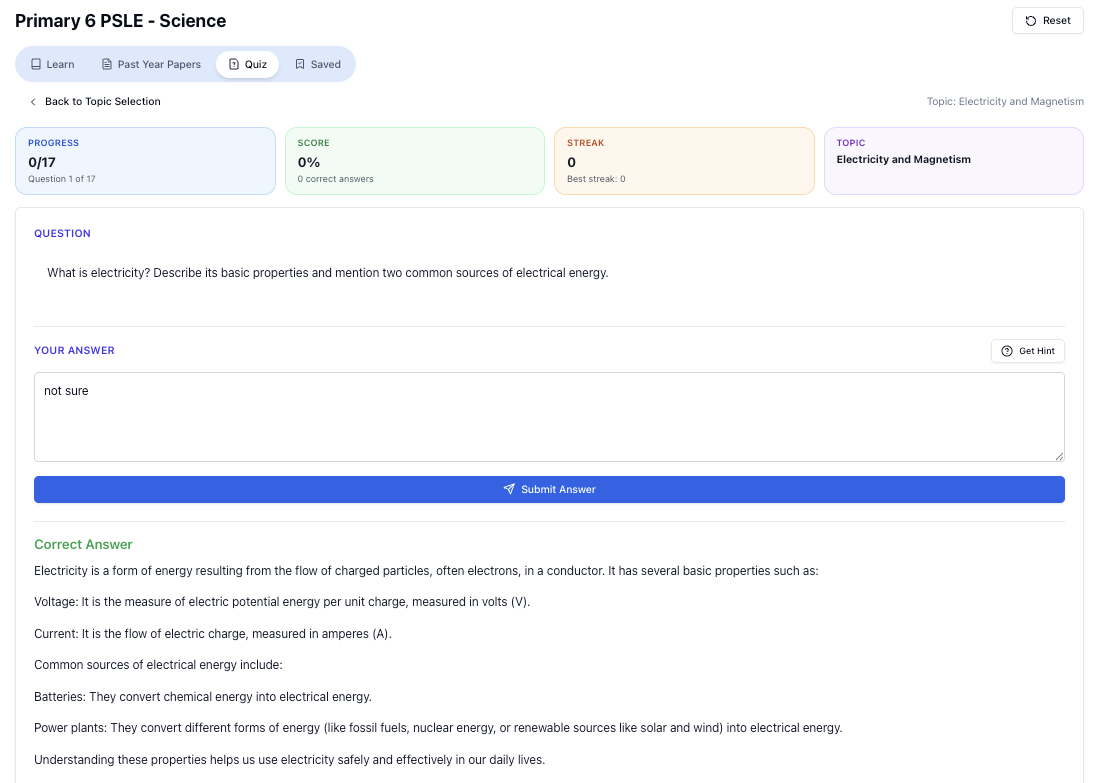
“Practice PSLE Science questions and get clear, step-by-step answers instantly.”
👉 Try a question now and see how fast you can improve.
Ready to practise?
If you want a Singapore-focused AI tutor you can use immediately (website, no sign-up), try Tutorly here:
Related Articles
Free on Tutorly.sg
Practise with step-by-step help — free to start
On Tutorly.sg/app you can practise unlimited Singapore syllabus questions, get instant explanations when you are stuck, and use past-year papers — no sign-up needed to start.
- ✓ PSLE, O Level, A Level, and more
- ✓ Step-by-step working when you are stuck
- ✓ Works on phone and laptop