

Free on Tutorly.sg
Practise with step-by-step help — free to start
On Tutorly.sg/app you can practise unlimited Singapore syllabus questions, get instant explanations when you are stuck, and use past-year papers — no sign-up needed to start.
- ✓ PSLE, O Level, A Level, and more
- ✓ Step-by-step working when you are stuck
- ✓ Works on phone and laptop
If you’ve ever walked out of an exam thinking, “I knew the content, but my marks don’t show it,” this guide is for you.
In Singapore, especially at secondary level and O Levels, the difference between a B 3 and an A 1 is usually not how much you studied, but how well you optimise your answers for the way marks are awarded in MOE exams.
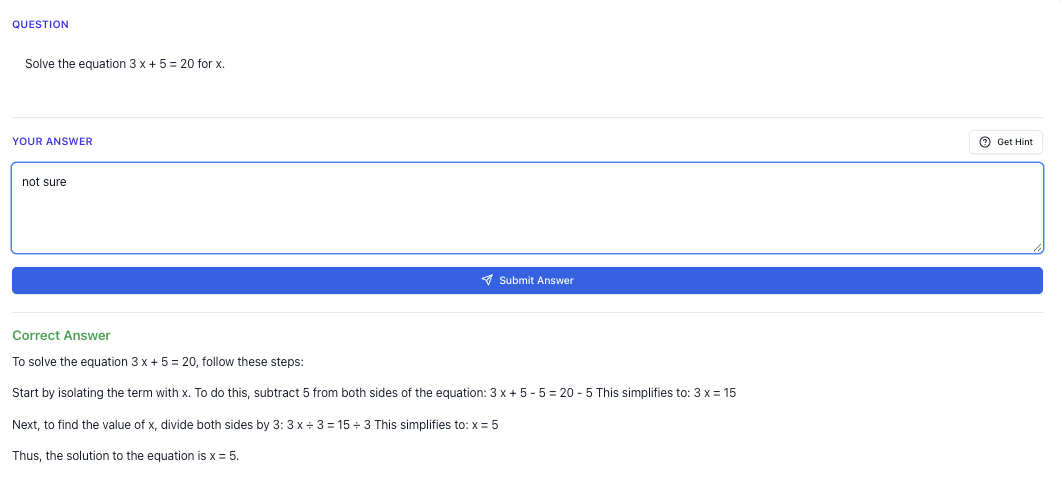
“Stuck on a question? See simple explanations that help you understand fast.”
👉 Give it a try and turn confusion into clarity in minutes.
You don’t just need knowledge. You need exam technique.
This article will focus on Secondary and O-Level style questions, and show you:
- How to turn your rough ideas into full-mark answers
- How to read and respond to command words properly
- How to practise with worksheet-style questions, including harder variants
- How to use Tutorly.sg, a AI tutor built for Singapore students, to get constant practice and feedback
Tutorly.sg has already been used by thousands of students in Singapore and even mentioned on Channel NewsAsia (CNA), so you’re not experimenting with something random — it’s a tool that’s already helping local students improve their exam answers every day.
Useful links to keep open:
- Learn more about the AI tutor: https://tutorly.sg/ai-tutor-singapore
- Go straight to the web app: https://tutorly.sg/app
Step-by-step tutorial: Turning “I roughly know” into full-mark answers
Let’s walk through a clear method you can apply to almost any structured question in subjects like English, Math, Science, and Humanities.
Step 1: Decode the command word (this decides your structure)
In Singapore exams, command words are not just decoration. They decide how marks are allocated.
Common ones you’ll see in secondary / O-Level papers:
- State / Identify / List – Short, direct, no explanation needed
- Describe – Say what you see / what happens, in sequence or detail
- Explain / Account for / Why – Give cause + effect, or reason + result
- Compare / Contrast – Talk about similarities and/or differences explicitly
- Discuss / Evaluate / To what extent – Consider both sides, then give a judgement
- Show that / Prove (Math) – Use clear, logical steps to reach the given result
Before you even pick up your pen, underline the command word and ask yourself:
“What kind of answer structure is this question asking for?”
Example (Chemistry, O-Level style):
“Explain why the rate of reaction increases when the temperature is raised.” (3 m)
Command word: Explain
So you know you must give reasons, not just repeat the fact.
Step 2: Identify how many marks = how many key points
In MOE-style marking schemes, the number of marks gives you a strong hint about how many distinct ideas you need.
- 1 mark → usually 1 key point
- 2–3 marks → 2–3 key points, or 1 point explained in 2–3 parts
- 4–6 marks → multiple points, often with explanation and/or examples
Look again at the Chemistry example:
3 marks → likely 3 linked ideas.
A possible mark breakdown:
- Particles gain kinetic energy
- More frequent effective collisions
- Hence, rate of reaction increases
So your job is to make sure your answer covers all three clearly.
Step 3: Use a simple template for each subject
You don’t need to memorise fancy frameworks. Just use simple, repeatable structures.
For Science “Explain” questions (Sec 3–4 / O Level)
Use a Cause → Particle/Mechanism → Outcome structure:
- State the change
- Describe what happens at particle/ mechanism level
- Link to the observable outcome
Example answer (Chemistry):
When temperature increases, the particles gain kinetic energy.
They move faster and collide more frequently and with greater energy.
Therefore, there are more frequent effective collisions per unit time, increasing the rate of reaction.
Notice:
- 3 clear ideas
- Linked logically
- Uses keywords examiners expect: kinetic energy, effective collisions, per unit time
For Humanities “Explain / Why” questions (SS, History, Geography)
Use PEEL:
- Point – Direct answer to the question
- Evidence – Example, fact, case study, data
- Explain – How your evidence supports your point
- Link – Tie back to the question
Example (Social Studies, 4 m):
Question: Explain why some Singaporeans may support government policies to attract foreign talent. (4 m)
Sample PEEL paragraph:
Point: Some Singaporeans support these policies because they believe foreign talent helps grow Singapore’s economy.
Evidence: For example, foreign professionals in finance and technology help fill skills gaps and attract multinational companies to set up regional headquarters in Singapore.
Explain: This creates more business activity and can lead to more job opportunities and higher wages for locals in the long term.
Link: Therefore, they support such policies as they see them as beneficial for Singapore’s overall economic development.
For English Language (Paper 1 & 2)
-
Summary / Comprehension Short Questions:
- Identify the focus (e.g. “reasons why…”, “effects of…”)
- Turn the relevant parts of the passage into your own words as far as possible
- For 2–3 mark questions, give 2–3 distinct points, not the same idea repeated
-
Situational / Continuous Writing:
- Always link back to the question requirement (e.g. “Write about a time you learnt the importance of honesty…”)
- Use clear topic sentences and logical flow
- End with a conclusion that answers the question directly
Step 4: Write in “markable” sentences
Examiners are marking fast. Your job is to make it easy for them to award marks.
- One idea per sentence (especially for Science/Humanities)
- Use keywords from the syllabus (e.g. “diffusion”, “opportunity cost”, “photosynthesis”, “demand curve”)
- Avoid vague language like “stuff”, “things happen”, “it goes up a lot”
Try this mini-upgrade:
Weak Science answer:
The line goes up quickly because of heat.
Improved answer:
The rate of reaction increases because a higher temperature gives particles more kinetic energy, causing more frequent effective collisions per unit time.
Same idea, but the second one is markable in an O-Level context.
Step 5: Check against the question at the end
Before you move on:
- Re-read the question
- Ask: “Did I actually answer what they asked, or did I just write everything I know?”
- If it’s a “Compare” question, check that you have both sides
- If it’s “To what extent / Evaluate”, check that you have a judgement, not just description
This last 10–20 seconds can easily save 1–2 marks per question.
Exam strategy guide: How to optimise answers under time pressure
Knowing how to write a perfect answer is one thing. Doing it in an exam hall with the clock ticking is another.
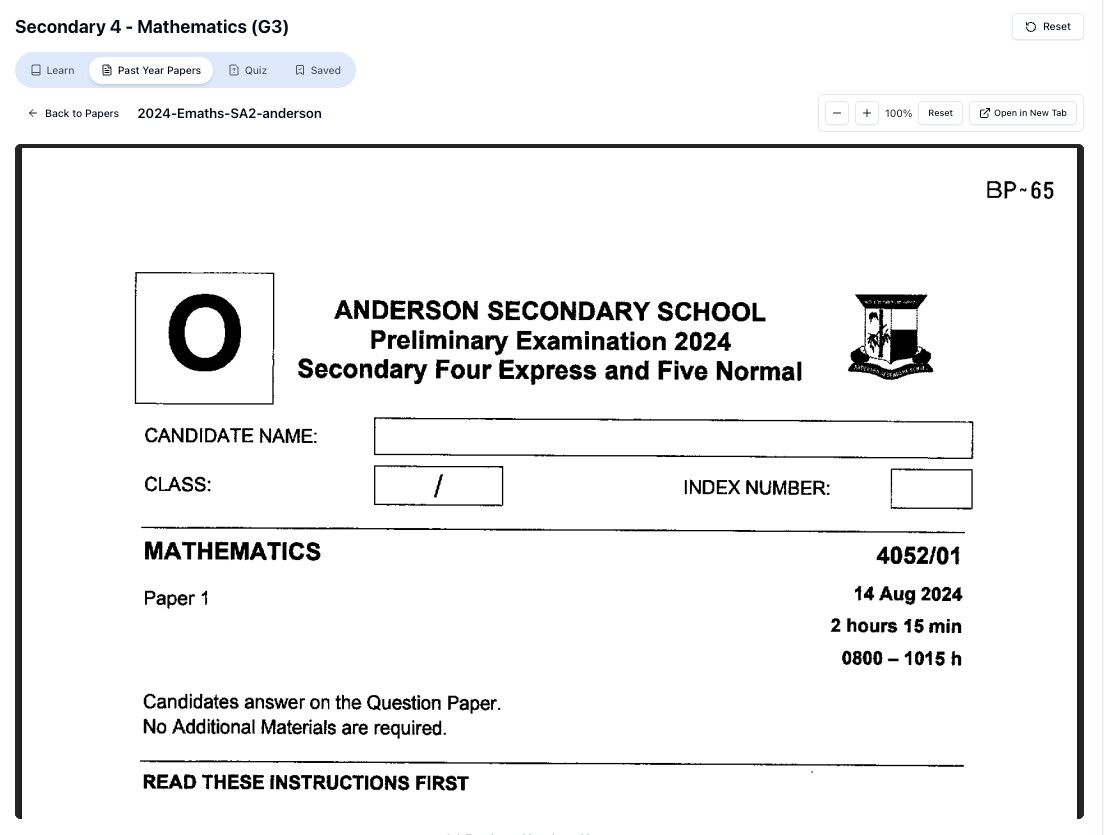
“Access more than 1000+ past year papers to practice”
👉 Start a paper today and test yourself like it’s the real exam.
Here’s how to apply all that under PSLE-style timing but at Secondary/O-Level difficulty.
1. Spend the first 3–5 minutes scanning and planning
Don’t dive straight into writing full answers. Instead:
- Flip through the paper quickly
- Circle or underline command words: Explain, Describe, Compare, Evaluate
- Star the questions that look easiest for you
Why? You want to:
- Warm up with questions you can score quickly
- Avoid getting stuck early on a 6–8 mark question and panicking
2. Use “time per mark” as your pacing guide
For most secondary / O-Level papers, a good rule of thumb:
- 1 mark ≈ 1 minute (including reading and thinking time)
So for a 5-mark question, you should aim to:
- Spend about 5 minutes
- If you’re still stuck after 6–7 minutes, write your best attempt and move on
This prevents you from sacrificing easy marks later just because you were stubborn with one question.
3. Start with skeleton answers, then flesh out
Especially for long-structured questions:
- Quickly jot down bullet-point ideas first (in the space beside or below the question)
- Then turn them into full sentences
Example (Geography 6 m):
“Explain how human activities can lead to water pollution.” (6 m)
Skeleton:
- Industrial waste into rivers → chemicals → toxic
- Domestic sewage → eutrophication
- Agricultural fertilisers → runoff → algae bloom
Then expand each into 2–3 sentence PEEL-style mini-paragraphs.
This method stops you from forgetting points halfway through and helps you stay organised.
4. Prioritise high-yield questions
Not all questions are equal. Some give more marks for the same amount of writing.
- In English Paper 2, summary is high-yield if you’ve practised
- In Science, long structured questions (4–8 marks) often test core concepts
- In Math, some 3–4 mark questions are straightforward if you’ve seen similar types
Your strategy:
- Secure all the certain marks first
- Then come back for the “maybe can, maybe cannot” questions
5. Train exam conditions before the real exam
You can’t suddenly become fast and accurate in September if you’ve been doing only untimed practice since March.
Use a simple weekly routine:
- Once a week: pick 1–2 exam papers or sections
- Set a timer according to the paper’s actual duration
- Do it under no distractions, like a real exam
- Mark it against the scheme (or use Tutorly.sg to check answers and see model solutions)
This builds your answering stamina and helps you figure out:
- Which types of questions you’re slow at
- Which topics you keep losing marks on
Worksheet practice: Try these, then level up with hard variants
Let’s walk through some practice questions you can try right now. I’ll show:
- How to think about them
- What a high-mark answer should roughly look like
- A harder variant of each type
You can then create similar questions on Tutorly.sg and see how your answers compare to model solutions.
1. Science (Chemistry, O-Level style)
Q 1 (Standard):
A student increases the surface area of a solid reactant by crushing it into powder. Explain how this affects the rate of reaction. (3 m)
How to think:
- Command word: Explain
- 3 marks → likely 3 linked ideas: surface area → collision frequency → rate
Sample high-mark answer:
Crushing the solid increases its surface area.
This exposes more particles of the solid to the other reactant.
Hence, there are more frequent effective collisions per unit time, increasing the rate of reaction.
Q 1 (Hard variant):
A student investigates the decomposition of hydrogen peroxide using manganese(IV) oxide as a catalyst. He repeats the experiment with the same volume and concentration of hydrogen peroxide but uses a greater mass of manganese(IV) oxide. Explain why the volume of oxygen gas produced after 5 minutes remains the same, even though the rate of reaction changes. (4 m)
Key ideas:
- Catalyst affects rate, not amount of product
- Same amount of reactants = same final volume of gas
- More catalyst → faster reaction, but same total gas
Sample high-mark answer (4 points):
The manganese(IV) oxide acts as a catalyst, so increasing its mass increases the rate of reaction.
This is because more catalyst provides more active sites, leading to more frequent effective collisions.
However, the total amount of hydrogen peroxide remains the same in both experiments.
Therefore, the final volume of oxygen gas produced is the same, even though it is produced faster when more catalyst is used.
Try creating your own similar questions on Tutorly.sg by asking for “O-Level Chemistry structured questions on rate of reaction” and then comparing your answers to the explanations given.
Free on Tutorly.sg
Practise with step-by-step help — free to start
On Tutorly.sg/app you can practise unlimited Singapore syllabus questions, get instant explanations when you are stuck, and use past-year papers — no sign-up needed to start.
- ✓ PSLE, O Level, A Level, and more
- ✓ Step-by-step working when you are stuck
- ✓ Works on phone and laptop
2. Math (E-Math, O-Level style)
Q 2 (Standard):
Solve . (2 m)
Thinking:
- Simple linear equation
- Show clear steps
Sample answer:
\begin{aligned} 3 x - 5 &= 16 \ 3 x &= 21 \ x &= 7 \end{aligned}
Q 2 (Hard variant):
Solve the simultaneous equations:
\begin{cases} 2𝑥 + 3𝑦 = 13 \\ 3 x - 2 y = 4 \end{cases}(4 m)
Approach:
- Decide elimination or substitution
- Show neat working
- Final answers should be exact
Sample answer (elimination):
Multiply first equation by 2, second by 3:\begin{aligned} (1)\quad 2 x + 3 y &= 13 \ (2)\quad 3 x - 2 y &= 4 \end{aligned}
13 x = 38 \Rightarrow = = \approx 2.923(\text{but keep exact}) \Rightarrow
Oops — that looks messy and suggests a miscalculation. Let’s do it more cleanly (this is exactly the kind of thing you want to avoid in an exam).
Correct method:
Multiply (1) by 2 and (2) by 3:\begin{aligned} (1')\quad 4 x + 6 y &= 26 \ (2')\quad 9 x - 6 y &= 12 \end{aligned}$$
Add:
Actually, that simplifies to 𝑥 = \frac{38}{13}, which is 𝑎 bit unusual but still valid. Let’𝑠 check quickly: Substitute into (1):$$
2 + 3 y = 13 \ + 3 y = 13 \ 3 y = 13 - = = \ =
Free on Tutorly.sg
Practise with step-by-step help — free to start
On Tutorly.sg/app you can practise unlimited Singapore syllabus questions, get instant explanations when you are stuck, and use past-year papers — no sign-up needed to start.
- ✓ PSLE, O Level, A Level, and more
- ✓ Step-by-step working when you are stuck
- ✓ Works on phone and laptop