

Free on Tutorly.sg
Practise with step-by-step help — free to start
On Tutorly.sg/app you can practise unlimited Singapore syllabus questions, get instant explanations when you are stuck, and use past-year papers — no sign-up needed to start.
- ✓ PSLE, O Level, A Level, and more
- ✓ Step-by-step working when you are stuck
- ✓ Works on phone and laptop
If you want to improve your grades fast in Singapore, you need a clear weekly study system: focus on exam-weighted topics, drill exam-style questions, fix your common mistakes quickly, and get instant feedback instead of waiting for the next tuition class or school test.
In this guide, I’ll walk you through a practical, Singapore-specific system that Secondary and O-Level students can start using this week, plus how to use an AI tutor like Tutorly.sg to speed things up without paying $80/hour for more tuition.
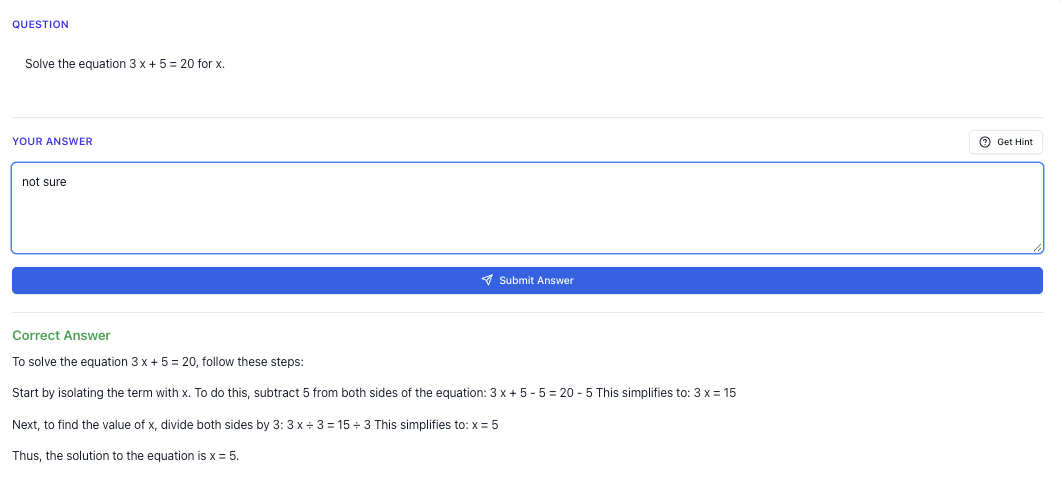
“Stuck on a question? See simple explanations that help you understand fast.”
👉 Give it a try and turn confusion into clarity in minutes.
Why “Studying Harder” Isn’t Enough (Especially In Singapore)
You’re in Secondary school or preparing for O Levels. You’ve probably heard this:
“Just study harder.”
But in Singapore, “harder” isn’t the issue. You already have:
- CCA
- School homework
- Projects
- Remedial
- Maybe tuition
The problem is inefficient studying.
To improve grades fast, especially for mid-years, end-of-years, or O Levels, you need to:
- Target the right topics (based on MOE syllabus & past papers).
- Practise the right type of questions (exam-style, not just textbook).
- Get feedback immediately so you don’t repeat the same mistake for 3 months.
That’s what we’ll build step by step.
Step-by-step tutorial: A 2-week system to boost your grades
This is a simple, realistic plan you can follow even with CCA. I’ll assume you’re a Secondary 3–4 / O-Level student, but Sec 1–2 can adapt it too.
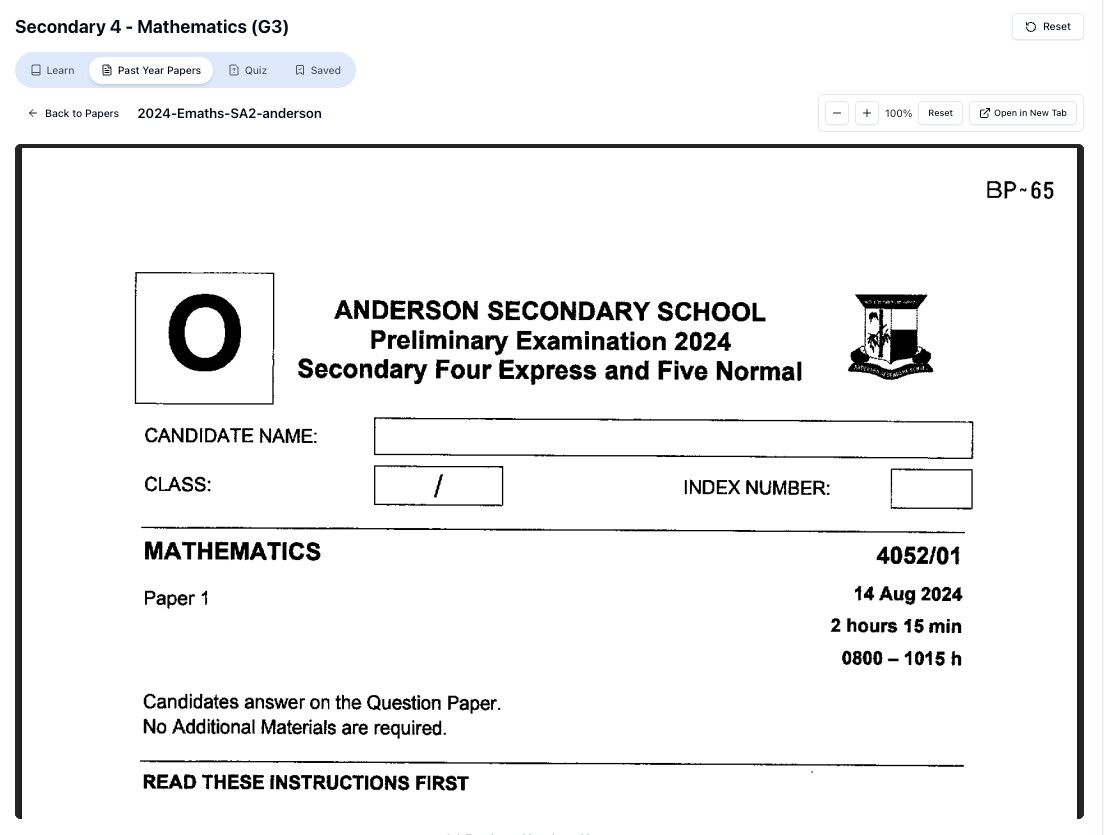
“Access more than 1000+ past year papers to practice”
👉 Start a paper today and test yourself like it’s the real exam.
Step 1: Pick 2 “high-impact” subjects first
Don’t try to “fix everything” at once.
Choose:
- 1 science or maths subject (e.g. E-Maths, A-Maths, Pure Physics, Chemistry)
- 1 humanities / language (e.g. English, Social Studies, Geography, History)
Why? These are heavily tested in O Levels and usually have clear structures for improvement.
Look at your last exam or weighted assessment:
- Which subjects are borderline? (e.g. C 6, D 7, E 8)
- Which ones can jump fastest with technique? (usually Maths / Science / SS source-based / English Paper 2)
Start with those 2.
Step 2: Identify your “killer topics” using your past papers
Take out:
- Your latest weighted assessment / mid-year / end-of-year paper
- Any topical tests (e.g. Algebra test, Kinematics test)
For each subject, do this:
-
Circle every question you lost more than 2 marks on.
-
For each circled question, write the topic name beside it.
- E-Maths: Algebraic manipulation, Quadratic equations, Trigonometry, Similarity & Congruency
- A-Maths: Indices & Surds, Quadratic functions, Differentiation, Integration
- Physics: Kinematics, Dynamics, Electricity, Light, Waves
- Chemistry: Atomic structure, Chemical bonding, Mole concept, Acids & Bases, Redox
- English: Comprehension inference, summary, situational writing format, editing
- Humanities: SBQ skills (inference, reliability, comparison), structured essay skills
-
Count how many times each topic appears.
Your “killer topics” are the ones where:
- You lost marks repeatedly
- They are major O-Level topics (you can check your school’s scheme of work or MOE syllabus)
These are your priority topics.
Step 3: Build a realistic weekly schedule (that you can actually follow)
You don’t need 5 extra hours a day. You need consistent, focused blocks.
A realistic Secondary school schedule:
Weekdays (Mon–Fri):
- 30–45 mins after dinner (3–4 days a week)
Weekends:
- 2 × 60–75 min blocks (Sat/Sun)
That’s roughly 5–7 focused hours a week, which is enough to see real improvement if used properly.
Break it down like this:
Example weekly plan (for 2 subjects):
- Mon (45 mins): E-Maths – Algebra (killer topic)
- Tue (45 mins): English – Comprehension Paper 2 (inference questions)
- Thu (45 mins): E-Maths – Trigonometry exam questions
- Sat (60–75 mins): Physics – Kinematics & graphs (mixed questions)
- Sun (60–75 mins): Review mistakes from the week + 1 timed practice (e.g. 30 mins of Paper 2 section)
During each block, you focus on one topic only. No multitasking, no half-maths-half-phone.
Step 4: Use a structured “question-first” approach
For fast improvement, content revision alone is too slow. You must work question-first:
- Start with 1–2 exam-style questions on the topic.
- Try them without notes first (like a mini test).
- Check your answer immediately.
- Only then, revise the concept that you got wrong.
You can do this using:
- School worksheets / TYS / Ten-Year Series / assessment books
- Or an AI tutor like Tutorly.sg that generates fresh, MOE-aligned questions on the exact topic you’re weak at
With Tutorly, you can:
- Select your level (e.g. Sec 4 Express)
- Choose subject (e.g. A-Maths)
- Ask for “5 hard differentiation exam questions with step-by-step solutions”
Then:
- Attempt each question on paper
- Key in your final answer
- If wrong, Tutorly shows you a full worked solution so you can compare approach
You don’t waste time flipping answer keys or waiting till the next tuition class.
👉 If you want to try this style right now, you can open Tutorly in your browser here:
Try Tutorly instantly
Step 5: Use a simple “error log” to stop repeating mistakes
Fast improvement comes from not repeating the same mistake 10 times.
Create a simple “Error Log” in a notebook or Google Doc. For every question you get wrong, record:
- Topic: (e.g. E-Maths – Trigonometry, Physics – Kinematics graphs)
- Question type: (e.g. “find angle using sine rule”, “distance-time graph interpretation”)
- What went wrong:
- Misread question
- Formula wrong
- Careless (sign error / unit)
- Concept misunderstanding
- Correct method (1–2 lines, in your own words)
Once a week (e.g. Sunday), review your error log for 20–30 mins:
- You’ll start to see patterns (e.g. always forget to convert units, always mess up negative signs, always skip context words like “hence” or “give your answer in 3 s.f.”).
- These patterns are where your fastest marks are hiding.
Step 6: Add timed practice to simulate exam pressure
For O Levels and school exams, you don’t just need knowledge—you need speed and stamina.
Once you’re comfortable with a topic:
-
Set a timer (e.g. 20–30 mins).
-
Do a small section under exam conditions:
- E-Maths: 10 MCQ or 3–4 structured questions
- English: 1 comprehension passage or 1 situational writing task outline
- SS/History/Geography: 2–3 SBQ + 1 short essay outline
-
Mark immediately and add mistakes to your error log.
You should do at least one timed practice every weekend.
Exam strategy guide: Subject-specific tactics for fast gains
Here’s how to get the quickest grade boost for common O-Level subjects.
Maths (E-Maths & A-Maths)
1. Memorise core formulas + when to use them
Don’t just memorise formulas blindly. For each formula, write:
- What it’s for
- What typical question words look like
Example (E-Maths Trigonometry):
- Formula:
- Used for: Right-angled triangle side/angle questions
- Keywords: “right-angled triangle”, “find the length of…”, “height of building”, “angle of elevation/depression”
2. Focus on high-frequency topics
For fast improvement, drill:
- E-Maths: Algebra, Quadratics, Trigonometry, Coordinate Geometry, Statistics (cumulative frequency & histograms)
- A-Maths: Indices & Surds, Quadratic functions, AP/GP, Differentiation, Integration, Trigonometric identities
3. Train “working presentation”
Markers give method marks for:
- Clear steps
- Correct equations
- Logical flow
You can practise by:
- Writing every step neatly
- Comparing your solution with a full worked solution (from school, TYS, or Tutorly) and checking:
- Did you skip any key step?
- Is your method efficient?
Sciences (Physics / Chemistry / Combined Science)
1. Master definitions and standard explanations
For fast marks:
- Memorise key definitions word-for-word (MOE-approved style).
- Practise 3–4 lines model answers for common questions.
Example (Physics: Newton’s First Law):
A body will remain at rest or continue to move with constant velocity in a straight line unless a resultant force acts on it.
Example (Chemistry: Oxidation):
Oxidation is the loss of electrons or an increase in oxidation state.
These are easy marks if you know the exact phrasing.
2. Use a 3-step approach for calculation questions
For Physics/Chemistry calculations:
- Write the formula.
- Substitute with units.
- Show the final answer with correct units and significant figures.
Example (Physics: ):
You’ll pick up method marks even if arithmetic slips slightly.
English (Paper 1 & 2)
Fast gains usually come from Paper 2 and situational writing.
1. Situational writing: Use a fixed template
Learn a clear format for:
- Formal letter
- Proposal
- Report
For each, know:
- Where to put addresses
- How to open and close
- Tone (formal vs informal)
Practise writing just the first and last paragraphs for different question types. This alone can bump your content/format marks.
2. Comprehension: Answer using “CLUE + OWN WORDS”
For inference questions:
- Find the clue in the passage
- Paraphrase using your own words
- Link to the question
For summary:
- Underline key points
- Combine them into 1–2 points per sentence
- Avoid lifting long chunks
You can ask Tutorly to:
- Generate practice passages
- Mark your answers
- Show you model answers for comparison
Humanities (Social Studies, History, Geography)
1. SBQ: Use PEEL or PEE(L) structure
For Source-Based Questions, structure is everything.
Example (inference question):
- Point: What can you infer?
- Evidence: Quote from source.
- Explain: How the evidence supports your inference.
- Link: Back to the question.
2. Essay questions: Memorise 2–3 strong examples per theme
You don’t need to memorise entire essays. Focus on:
- Clear topic sentences
- 2–3 strong examples with explanation
- A short, clear judgement in conclusion
Free on Tutorly.sg
Practise with step-by-step help — free to start
On Tutorly.sg/app you can practise unlimited Singapore syllabus questions, get instant explanations when you are stuck, and use past-year papers — no sign-up needed to start.
- ✓ PSLE, O Level, A Level, and more
- ✓ Step-by-step working when you are stuck
- ✓ Works on phone and laptop
If you want help generating exam-style questions and model answers for any of these subjects, you can use Tutorly’s MOE-aligned AI tutor here:
Get help now on Tutorly
Tutorly.sg has already been used by thousands of students in Singapore, and it’s even been mentioned on Channel NewsAsia (CNA), so it’s not some random overseas tool that doesn’t follow our syllabus.
Tuition vs self-study vs AI tutor: What’s fastest for you?
Most Secondary students in Singapore use some mix of:
- School consultations
- Private tuition
- Tuition centres
- Self-study with assessment books
- Now, AI tutors like Tutorly.sg
Here’s a quick comparison:
| Private tutor | Tuition centre | Tutorly (website) | |
|---|---|---|---|
| Price (rough) | ~$40–$120/hour (Sec–O Level) | ~$150–$350/month for 1 subject | Low cost / free to try; pay only when you need more usage |
| Flexibility | Fixed weekly slot, hard to reschedule | Fixed timetable, replacement classes limited | On-demand, , use anytime from laptop/phone browser |
| Availability | Need to book in advance, peak periods full | Limited slots near exams | Instant—great for last-minute questions before tests |
Private tutors and centres can be very helpful, but they’re expensive and not always there when you’re stuck at 11.30pm before a test.
Tutorly fills this gap:
- You get instant explanations and practice questions.
- You don’t need to travel or commit to a long-term package.
- It’s available , from anywhere with internet.
You can explore how it works here:
Explore Tutorly’s AI tutor for Singapore students
Worksheet practice: From basic to hard exam variants
To improve fast, you need deliberate practice with increasing difficulty.
Here’s how to structure your practice for any topic, plus some example question types (you can recreate similar ones in your own worksheets or ask Tutorly to generate them).
1. Start with basic skill questions (warm-up)
Example (E-Maths – Algebra, basic):
- Simplify: 3𝑥 - 5 + 2𝑥 + 7
- Solve:
- Factorise:
Goal: Make sure you’re not losing marks to simple manipulation.
2. Move to standard exam questions
Example (E-Maths – Algebra, exam-style):
- Solve for 𝑥:
- Given that , find the value of 𝑦 when .
- The length of a rectangle is (3𝑥 + 2) cm and the breadth is (𝑥 - 1) cm.
(a) Express the area in terms of 𝑥.
(b) If the area is , find the value of 𝑥.
“Doing Secondary Science? Pick a topic and practise like it’s a real exam — with clear answers right after.”
👉 Try Tutorly now and start a Science topic in seconds.

Do these untimed first, then repeat a smaller set under timed conditions.
3. Add hard exam variants (where many students lose marks)
Hard variants usually:
- Combine multiple topics
- Include tricky wording
- Require more than 3 steps
Example (A-Maths – Differentiation, hard variant):
A particle moves in a straight line such that its displacement 𝑠 metres from a fixed point after 𝑡 seconds is given by
- Find the velocity 𝑣 in terms of 𝑡.
- Find the acceleration 𝑎 in terms of 𝑡.
- Hence, find the time when the particle is momentarily at rest.
- Determine whether the particle is accelerating or decelerating at .
This tests:
- Differentiation
- Solving equations
- Understanding of velocity vs acceleration
Example (Physics – Kinematics graph, hard variant):
The velocity-time graph of a car’s journey is described as follows:
- From to s, the velocity increases uniformly from to .
- From to s, the car travels at a constant velocity.
- From to s, the car decelerates uniformly to rest.
- Sketch the velocity-time graph.
- Find the acceleration during the first 5 seconds.
- Calculate the total distance travelled in 20 seconds.
- State during which interval the car experiences zero resultant force, and explain your answer.
This tests:
- Graph interpretation
- Area under graph
- Concept of resultant force
Example (English – Summary, harder variant):
You’re given a passage about social media use among teenagers in Singapore. The question:
“In no more than 80 words, summarise the reasons why some teenagers in Singapore find it difficult to reduce their social media usage.”
You need to:
- Identify reasons only (not effects or solutions)
- Paraphrase points
- Stay within word limit
You can ask Tutorly to:
- Generate a passage
- Let you attempt the summary
- Then show you a model summary to compare structure and vocabulary
4. Mix topics for “mock paper” practice
Once you’re more confident, create mini “mock sections”:
- Maths: 5 mixed questions (Algebra, Trigo, Geometry, Statistics)
- Science: 2 calculation questions + 2 explanation questions + 1 data-based question
- English: 1 editing + 1 visual text + 1 comprehension passage
- Humanities: 2 SBQ + 1 short essay outline
Do them under timed conditions and mark immediately.
If you’re short on time or don’t have enough worksheets, you can get Tutorly to generate:
- “10 mixed E-Maths questions, Sec 4 Express, exam-level, with full solutions”
- “3 hard SS SBQ about governance in Singapore, O-Level style”
Then use those as your practice set.
👉 You can start generating such questions now here:
Practise with Tutorly question sets
Common mistakes that slow down grade improvement
Improving fast is not just about what you do—it’s also about what you stop doing.
Here are some common mistakes I see from Secondary and O-Level students in Singapore.
1. “I’ll start after CCA season / after this busy week”
There is always another busy week:
- CCA competitions
- School events
- Group projects
- Family commitments
If you wait for a “free period”, it may never come.
Instead:
- Commit to just 30 mins a day, 3–4 days a week.
- Even during peak CCA season, short, focused sessions can keep your grades moving up.
2. Only re-reading notes, not doing questions
Re-reading makes you feel productive but doesn’t prepare you for exam questions.
Signs you’re stuck in this trap:
- You can explain the concept to yourself
- But when you see a question, you don’t know where to start
Fix:
- Use the question-first approach: attempt questions, then refer to notes only when you’re stuck.
- For each topic, aim for at least 20–30 questions spread over a few days, not just 3–4.
3. Not checking answers immediately
If you do a whole worksheet and only mark it next week:
- You forget your thought process
- You don’t learn from your mistakes properly
- You may keep repeating the same error
Instead:
- Mark after every 3–5 questions.
- For each wrong question, immediately:
- Record it in your error log
- Re-do it correctly (don’t just read the solution)
This is where having instant solutions (e.g. from Tutorly) helps a lot.
4. Over-relying on tuition without self-practice
Tuition can guide you, but:
- Improvement happens when you do the practice.
- Many students attend tuition, but don’t revise the tuition worksheet again.
Fix:
- After tuition, spend at least 20–30 mins re-doing the questions you got wrong in class.
- Try similar questions from other sources (school, assessment books, Tutorly).
5. Ignoring weak topics because they feel “too hard”
Common ones:
- A-Maths: Trigonometric identities, integration
- Physics: Electricity, forces and moments
- Chemistry: Mole concept, redox
- English: Summary, inference questions
- SS: Reliability/comparison SBQ
If you avoid them:
- They keep appearing in exams
- You keep losing the same big chunk of marks
Fix:
- Break the topic into micro-skills.
- E.g. “Mole concept” → converting mass to moles, using mole ratio, finding unknown mass/volume
- Practise one micro-skill at a time until it feels manageable.
6. Not using tools that are already available
You’re in 2020 s Singapore. You have:
- School notes
- Past year papers
- Friends’ help
- Teachers’ consults
- Online resources
- AI tutors like Tutorly
If you’re stuck and just stare at the question for 40 mins, that’s wasted time.
Instead:
- Struggle for 5–10 mins.
- If still stuck, get help:
- Ask a friend
- Ask a teacher (if available)
- Or get an instant explanation from Tutorly and move on
This keeps your momentum and confidence up.
A quick real-life scenario: Last-minute panic before mid-years
Imagine this:
You’re Sec 4, mid-years in 5 days. You just did your school revision paper for E-Maths and realised:
- You still mess up Trigonometry word problems.
- You keep mixing up sine rule and cosine rule.
- You lost 15 marks in that section alone.
Your tuition is only once a week, and the next lesson is after the paper. Your teacher is busy with other classes.
What you can do in 2–3 days:
- That same night:
- List out all the Trigo question types you got wrong.
- Use Tutorly to generate:
- “10 E-Maths Trigonometry exam questions (Sec 4 Express, O-Level style) with full solutions.”
- Attempt 5 questions on Day 1, 5 more on Day 2.
- After each question:
- Check your final answer on Tutorly.
- If wrong, read the step-by-step solution.
- Add common mistakes to your error log (e.g. wrong angle, wrong formula, forgot to convert degrees/radians).
- On Day 3:
- Do a timed 30-min Trigo section from a past paper.
You might not become perfect in 3 days, but you can easily recover 5–10 marks just by:
- Stopping repeated mistakes
- Getting familiar with the typical wording
- Building speed and confidence
This is how “fast improvement” actually looks like in real life—targeted, focused, and supported by instant feedback.
Final thoughts: Build a system, then let tools speed it up
To improve your grades fast in Singapore, especially for Secondary and O Levels, you don’t need miracle tips. You need:
- Clear priorities (which subjects and topics first).
- A weekly schedule you can stick to (5–7 focused hours).
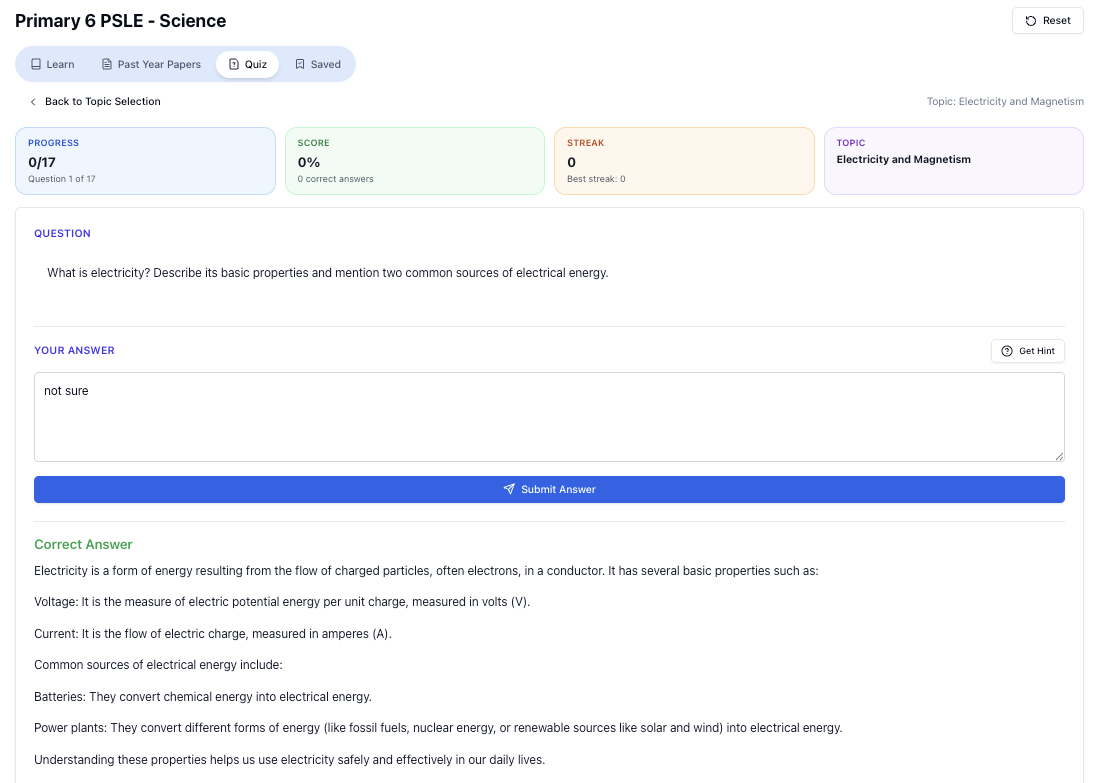
“Practice PSLE Science questions and get clear, step-by-step answers instantly.”
👉 Try a question now and see how fast you can improve.
Ready to practise?
If you want a Singapore-focused AI tutor you can use immediately (website, no sign-up), try Tutorly here:
Related Articles
Free on Tutorly.sg
Practise with step-by-step help — free to start
On Tutorly.sg/app you can practise unlimited Singapore syllabus questions, get instant explanations when you are stuck, and use past-year papers — no sign-up needed to start.
- ✓ PSLE, O Level, A Level, and more
- ✓ Step-by-step working when you are stuck
- ✓ Works on phone and laptop