

Free on Tutorly.sg
Practise with step-by-step help — free to start
On Tutorly.sg/app you can practise unlimited Singapore syllabus questions, get instant explanations when you are stuck, and use past-year papers — no sign-up needed to start.
- ✓ PSLE, O Level, A Level, and more
- ✓ Step-by-step working when you are stuck
- ✓ Works on phone and laptop
If you’ve ever stared at the clock in an exam and thought, “How on earth am I going to finish this?”, you’re not alone.
In Singapore, Secondary and O Level papers are tight on time. It’s not just about whether you know the content; it’s whether you can get to the answer quickly and accurately under exam pressure.
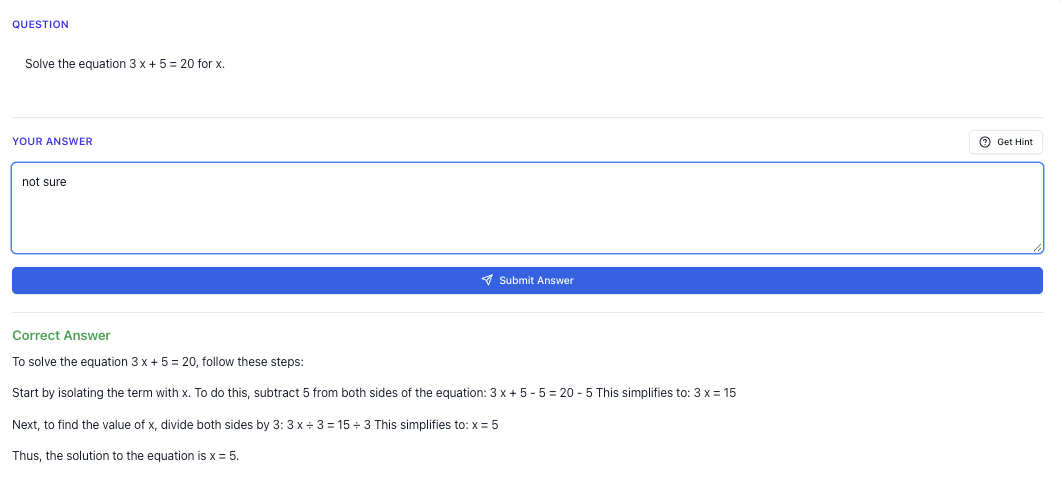
“Stuck on a question? See simple explanations that help you understand fast.”
👉 Give it a try and turn confusion into clarity in minutes.
This guide is for you if:
- You know your stuff, but still can’t finish papers.
- You lose marks because you rush the last few questions.
- You freeze on harder questions and waste 10–15 minutes stuck on one part.
I’ll walk you through practical, exam-specific answering techniques that help you speed up without becoming careless, plus how to practise them using tools like Tutorly.sg – a AI tutor website built for Singapore students following the MOE syllabus.
Tutorly.sg has already been used by thousands of students in Singapore and has even been mentioned on Channel NewsAsia (CNA), so you’re not experimenting with something random off the internet.
Useful links (you’ll see me refer to them later too):
- About the AI tutor: https://tutorly.sg/ai-tutor-singapore
- Go straight to the web app: https://tutorly.sg/app
Step-by-step tutorial: A faster way to tackle exam questions
Let’s start with a clear, repeatable system you can use in almost any Secondary or O Level paper (Math, Science, Humanities, even English).
Think of this as your “fast-answer routine”.
Step 1: Read the question like a lawyer, not a storybook
Most students read the question once, think they “got it”, then realise halfway they missed something.
Instead, train yourself to read in layers:
-
First read – gist
Just understand roughly what the question is about. -
Second read – highlight keywords
Underline or circle:- Command words: state, explain, compare, show that, calculate, hence, deduce
- Scope: in terms of, with reference to, from the graph, using the data given
- Units and conditions: cm³, at room temperature, between 2010 and 2015, assuming no air resistance
-
Third read – rephrase in your head
Tell yourself in simple words:- “They want me to compare these two trends using numbers from the graph.”
- “They want a chemical explanation, not just ‘it increases’.”
- “They want me to show that this formula is true using algebra.”
This sounds slow, but it saves time because:
- You won’t write irrelevant things.
- You won’t miss parts of the question.
- You know exactly what kind of answer the marker expects.
Step 2: Use “answer templates” for common question types
Markers don’t just look for correct content; they look for clear structure.
If you already have templates in your head, you answer faster because you’re not inventing your style from scratch.
Example: O Level Math – “Show that” questions
Question type: “Show that is a solution of …” or “Show that the gradient is 4”.
Template:
- Start with what is given (substitute the value or expression).
- Work step by step until you reach the target expression.
- Conclude with the exact line the question wants.
For example:
Show that is a solution of .
Your working:
\begin{aligned} \text{Substitute } 𝑥 &= 3 \\ 2(3)^2 - 5(3) - 3 &= 18 - 15 - 3 \ &= 0 \end{aligned}Final line: “Therefore, 𝑥 = 3 is 𝑎 solution of 2𝑥^2 - 5𝑥 - 3 = 0.” When you’ve practised this template enough, you don’𝑡 have to think “how do 𝐼 start?” in the exam. You just plug and go. #### Example: Science (Chemistry) – “Explain” questions Common pattern: state + because + link to concept. Template: 1. **Statement** – what happens. 2. **Reason** – cause. 3. **Concept** – link to syllabus idea (𝑒.𝑔. collision theory, diffusion, neutralisation). For example: > Explain why increasing temperature increases the rate of reaction. Answer (following template): 1. Statement: “Increasing temperature **increases the rate of reaction**” 2. Reason: “because particles gain more kinetic energy and **move faster**” 3. Concept: “so they **collide more frequently and with greater energy**, leading to more effective collisions per unit time.” Once you recognise “Explain why” + “rate of reaction”, you can **snap into template mode** and answer quickly. ### Step 3: Use “time boxes” for each part In Singapore exams, timing is half the battle. 𝐴 simple rule: - **1 mark ≈ 1 minute** (slightly less for MCQ, slightly more for long structured questions). So for 𝑎 5-mark question, you should **aim to move on in 5–6 minutes**, even if you’re not 100% satisfied. Practical way to apply this: - Before you start the paper, glance through and **roughly allocate time** to each section. - Write small time targets on the question paper: 𝑒.𝑔. “𝑄3 end by 9:20am”. - If you hit that time and are still stuck, **circle the question and move on**. Come back later. This prevents you from spending 15 minutes on one killer part and then rushing through 20 easy marks at the end. ### Step 4: Answer from what you know *now*, not what you wish you knew When you’re stuck, many students stare at the question hoping for 𝑎 miracle. Instead, use 𝑎 **“bottom-up” approach**: 1. Write down **any relevant formula, fact, or concept**. 2. Link it to **numbers or information given**. 3. See if it simplifies or cancels to something familiar. #### Example: 𝑂 Level Physics Question: 𝐴 2 kg object is moving at 3 𝑚/𝑠. It accelerates uniformly to 7 𝑚/𝑠 in 4 𝑠. Find the resultant force. You might freeze if you think, “𝐼 don’𝑡 remember the exact formula for force in this context.” Bottom-up: - You know: 𝐹 = ma and 𝑎 = \frac{𝑣 - 𝑢}{𝑡}. - Work it:𝑎 = \frac{7 - 3}{4} = 1 \text{ m/s}^2$$
### Step 5: Train your brain for speed *before* the exam You can’t magically become faster in the exam if you’ve only done slow, relaxed homework. You need **speed practice**: - Take a past-year paper. - Set a timer with **slightly less time** than the real exam (e.g. 1 h 30min paper → 1 h 20min). - Force yourself to move on when time is up for a question. - Review afterwards: where did you get stuck? Which type of questions slowed you down? This is where a tool like **[Tutorly.sg](https://tutorly.sg/app)** is very useful: - At [https://tutorly.sg/ai-tutor-singapore](https://tutorly.sg/ai-tutor-singapore), you can get **instant questions and answers aligned to the MOE syllabus**. - You can ask for **“timed practice”** style questions (e.g. “Give me 10 O Level Algebra questions I should finish in 15 minutes”). - After you submit your final answer, Tutorly shows you **step-by-step working** so you can see the **fastest route** to the solution, not just whether you were right. --- ## Exam strategy guide: Subject-specific ways to get answers faster Now let’s zoom in on some **subject-specific tactics** for Secondary and O Level students. > “Access more than 1000+ past year papers to practice” > [👉 Start a paper today and test yourself like it’s the real exam.](https://tutorly.sg/app) 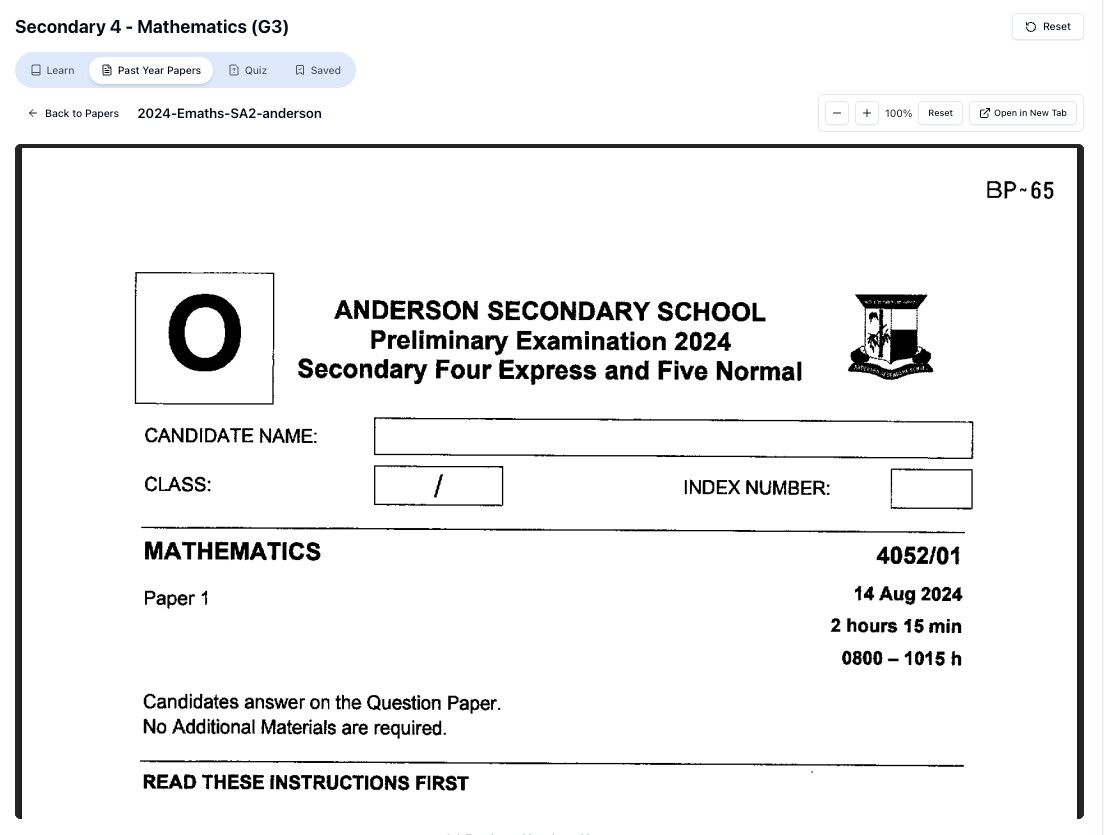 ### 1. Mathematics: “shortcut thinking” without being careless #### a) Scan the whole question first For longer questions with multiple parts (a), (b), (c): - Quickly read all parts **before** starting (a). - Sometimes (b) or (c) gives a hint or formula that helps with (a). - This prevents you from doing long, unnecessary working. #### b) Use line-by-line algebra Messy working = wasted time checking. Train yourself to write **one clear step per line**: Instead of:2 x^2 - 5 x = 3 \Rightarrow 2 x^2 - 5 x - 3 = 0 \Rightarrow (2 x + 1)(x - 3) = 0 \Rightarrow 𝑥 = -\frac{1}{2} \text{ or } 3$$ Do: $$\begin{aligned} 2𝑥^2 - 5𝑥 &= 3 \\ 2𝑥^2 - 5𝑥 - 3 &= 0 \\ (2𝑥 + 1)(𝑥 - 3) &= 0 \\ 𝑥 &= -\frac{1}{2} \text{ or } 3 \end{aligned}$$ This is slightly more writing, but: - Easier to check. - Less chance of skipping a step and making a hidden mistake. - Marker can follow your logic and award method marks even if your final answer is wrong. #### c) Estimate to check quickly When you get a numerical answer, ask: - “Does this make sense?” Examples: - Area of a rectangle with sides 2 cm and 3 cm → your answer should be **around 6 cm²**, not 60 or 0.06. - Speed of a car → should be something like **10–30 m/s**, not 1000 m/s. This 2-second “sanity check” catches a lot of careless errors **without redoing everything**. ### 2. Science: Use “mark-bucket” answers For structured questions, marks are usually distributed like this: - 1 mark for **statement** (what). - 1–2 marks for **explanation** (why/how). - 1 mark for **link to data/graph** (if relevant). So your answer should aim to “hit” these buckets. #### Example: Chemistry – graph question > Using the graph, explain how temperature affects solubility of salt X. Fast structure: 1. **Statement** (with data): “As temperature increases from 20°C to 60°C, the solubility of salt X increases from 10 g to 30 g per 100 g of water.” 2. **Explanation**: “Higher temperature gives particles more kinetic energy, so more solute particles can break away from the solid and dissolve.” You’ve covered:Free on Tutorly.sg
Practise with step-by-step help — free to start
On Tutorly.sg/app you can practise unlimited Singapore syllabus questions, get instant explanations when you are stuck, and use past-year papers — no sign-up needed to start.
- ✓ PSLE, O Level, A Level, and more
- ✓ Step-by-step working when you are stuck
- ✓ Works on phone and laptop
- Trend + numbers (data mark)
- Explanation (concept mark)
3. Humanities (SS/Geography/History): PEEL faster
For O Level Humanities, writing in PEEL (Point, Evidence, Explanation, Link) is standard, but you can do it quickly if you prepare ready-made sentence starters.
For example, Social Studies:
- Point: “One reason why [issue] occurs is due to [factor].”
- Evidence: “For example, in Singapore, …”
- Explanation: “This leads to … because …”
- Link: “Therefore, [factor] contributes to [issue] as it …”
If you’ve memorised a few of these patterns, you don’t waste time thinking about how to phrase your answer – you focus on content.
Worksheet practice: Timed drills (with harder variants)
To really learn how to get answers quickly, you need to practise under time pressure.
Below are some practice sets you can try. After each set, I’ll show you how to use Tutorly.sg to push yourself further.
Set A: O Level Math – Algebra & Functions (15 minutes total)
Try to finish these within 15 minutes.
-
Simplify:
-
Solve:
-
Given that , find 𝑓(2).
-
Harder variant (discriminant):
Solve completely:and state the nature of its roots.
-
Harder variant (function composition):
Given and , find 𝑓(𝑔(2)) and 𝑔(𝑓(2)).
After you try:
- Go to https://tutorly.sg/app
- Ask Tutorly something like:
“Give me 5 more O Level Algebra questions similar to these, with at least 2 harder ones involving discriminant or functions.” - After you submit your final answers, compare your speed and the step-by-step solution Tutorly shows.
- Did Tutorly use a shorter method?
- Did you do any unnecessary steps?
Repeat this a few times and you’ll naturally adopt faster solution paths.
Set B: O Level Physics – Kinematics & Forces (20 minutes total)
Aim for 20 minutes.
-
A car accelerates from rest to 20 m/s in 10 s. Find its acceleration.
-
A 5 kg object experiences a resultant force of 15 N. Find its acceleration.
-
A ball is thrown vertically upwards with a speed of 12 m/s. Take .
- (a) Find the time taken to reach the highest point.
- (b) Find the maximum height reached.
-
Harder variant (two-step reasoning):
A trolley of mass 2 kg is pulled with a force of 8 N along a horizontal surface. The frictional force is 2 N.- (a) Find the resultant force.
- (b) Hence, find its acceleration.
-
Harder variant (graph interpretation):
The velocity-time graph of a moving object is a straight line increasing from 0 m/s to 10 m/s in 4 s.- (a) Find the acceleration.
- (b) Find the distance travelled in these 4 s.
Again, after trying:
- Use https://tutorly.sg/app
- Ask: “Give me 5 O Level Physics questions on kinematics and forces that I should finish in 15 minutes, with at least 2 graph questions.”
- Try to beat your own time while keeping accuracy above, say, 80%.
Set C: O Level Chemistry – Particulate Nature & Chemical Reactions (20 minutes total)
Target 20 minutes.
-
Define “element”.
-
State one difference between a compound and a mixture.
-
Magnesium reacts with dilute hydrochloric acid to form magnesium chloride and hydrogen gas.
Write a balanced chemical equation for this reaction, including state symbols. -
Harder variant (moles & mass):
Calculate the number of moles in 12 g of magnesium.
(Relative atomic mass, Mg = 24) -
Harder variant (application of particle theory):
Explain, in terms of particles, why a gas can be compressed but a liquid cannot be compressed easily.
After:
- Use Tutorly to generate more structured questions with “Explain” and “State” type prompts.
- Ask it to “give me harder variants that combine moles with balanced equations” so you get used to multi-step reasoning under time pressure.
Set D: Social Studies – Structured Response (20 minutes total)
Pick one of the following questions and aim to plan + write a full PEEL answer within 20 minutes.
-
“Government policies are the most important factor in maintaining social cohesion in Singapore.”
How far do you agree with this statement? Explain your answer. -
“Globalisation has only brought benefits to Singapore.”
How far do you agree with this statement? Explain your answer.
Steps:
- Spend 3–4 minutes planning:
- 2–3 points (for/against).
- Quick evidence examples (e.g. policies, events, statistics if you remember).
- Spend 15–16 minutes writing using PEEL.
Then:
“Doing Secondary Science? Pick a topic and practise like it’s a real exam — with clear answers right after.”
👉 Try Tutorly now and start a Science topic in seconds.

- Go to https://tutorly.sg/app
- Ask: “Give me feedback-style guidance on how I can improve the structure and depth of this O Level SS answer. Show me a model answer and highlight what I missed.”
- Compare your answer with the model and note:
- Did you waste time on long introductions?
- Did you repeat the same explanation?
- Did you miss key factors?
Use this to refine your speed + quality balance.
Common mistakes that slow you down (and how to fix them)
Let’s be honest – most time problems in exams come from a few very common habits.
1. Over-writing for low-mark questions
Writing a 6-line explanation for a 1-mark question is a huge time sink.
Fix:
- Look at the mark:
- 1 mark → 1 key idea or 1 sentence.
- 2 marks → 2 distinct points or point + explanation.
- Train yourself to stop once you’ve clearly hit the mark requirement.
2. Leaving the hardest question for last (but staring at it too long)
Many students “leave the hard one for later”, but then:
- Spend 5 minutes just staring at it at the end.
- Panic because there’s no time left.
Fix:
- When you first see the hard question, give it a quick 1–2 minute attempt:
- Write down formulas, diagrams, or known data.
- Sometimes the act of writing triggers your memory.
- If nothing clicks, circle it and move on.
- When you return later, you’ll at least see some starting work and not a blank space.
3. Not practising under exam conditions
Doing homework slowly, with your phone next to you, is not exam practice.
Fix:
- At least once a week, do a full timed section:
- E.g. 1 full Paper 1 Math, or 1 structured section of Science.
- Use past-year papers or generate timed sets using Tutorly.sg.
- Review where you lost time:
- Reading too slowly?
- Getting stuck on graphs?
- Over-thinking long questions?
4. Writing everything you know instead of what is asked
Especially in Science and Humanities, students write “story answers”:
- Long paragraphs.
- Extra facts not needed.
- No clear link to the question.
This wastes time and can even confuse the marker.
Fix:
- Always start by rephrasing the question in your head:
- “They want causes, not effects.”
- “They want me to compare, so I must mention both sides.”
- After writing, quickly check:
“Did I actually answer what they asked, or did I just write everything I remember?”
5. Not having a “panic plan”
When your mind blanks out, you waste time panicking.
Fix:
Prepare a simple panic plan you can follow automatically:
- Take two deep breaths.
- Underline keywords again.
- Write down any relevant formula or concept.
- Ask yourself: “Can I at least get partial marks by:
- Substituting known values?
- Drawing a labelled diagram?
- Stating a definition?”
Even if you can’t finish, you might grab 1–2 marks quickly and move on.
Using Tutorly.sg to train for faster answers (the smart way)
Since you’re reading this on Tutorly’s blog, you should know exactly how to use the AI tutor to fix your speed issues.
Here’s a simple routine you can follow 2–3 times a week:
-
Go to https://tutorly.sg/app
-
Choose your level and subject (e.g. Sec 4 / O Level Math, Physics, Chemistry, SS).
-
Tell Tutorly exactly what you want, for example:
- “Give me 10 O Level Math questions on algebra and functions that I should finish in 15 minutes. Include 3 hard variants.”
- “Give me 5 O Level Chemistry ‘Explain’ questions about rate of reaction, and show me model answers after I attempt.”
- “Give me a Social Studies SRQ on globalisation and then show me a band 1 sample answer to compare with mine.”
-
Set a timer yourself and attempt under pressure.
-
After submitting your final answers:
- Look at the step-by-step solutions Tutorly shows.
- Spot where Tutorly’s method is shorter or more direct.
- Adjust your own technique next time.
Because Tutorly.sg is a website, you can use it anytime on your laptop or browser – no need to download any app, and it’s available . This is perfect if you’re revising late at night or during short breaks.
And remember:
- It’s aligned to the MOE syllabus, so you’re not practising random overseas content.
- It’s already been used by thousands of Singapore students, and even featured on CNA, so it’s a trusted tool to add to your exam prep.
Final thoughts: Getting faster is a skill, not luck
Finishing your Secondary or O Level papers on time is not just about being “naturally fast” or “naturally smart”.
It’s about:
- Reading questions strategically.
- Using answer templates for common question types.
- Practising under realistic timing.
- Learning from faster solution paths and adjusting your habits.
If you start applying the techniques in this guide now, you’ll notice:
- Less panic when you see long questions.
- More time left to check your answers.
- A much better chance of converting your understanding into actual marks.
When you’re ready to put this into practice, head over to:
- Learn more about the AI tutor: https://tutorly.sg/ai-tutor-singapore
- Start practising immediately in your browser: https://tutorly.sg/app
Use it to drill timed questions, see efficient solutions, and train yourself to get to the right answers quickly and confidently in your Singapore exams.
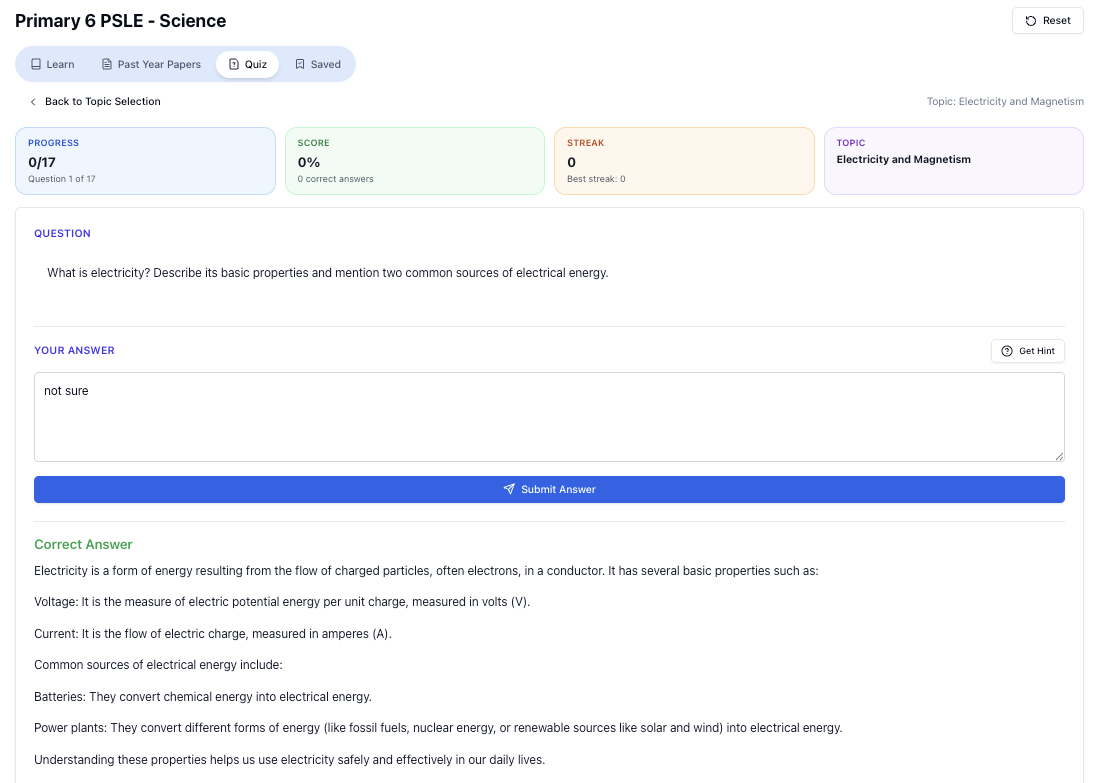
“Practice PSLE Science questions and get clear, step-by-step answers instantly.”
👉 Try a question now and see how fast you can improve.
Ready to practise?
If you want a Singapore-focused AI tutor you can use immediately (website, no sign-up), try Tutorly here:
Related Articles
Free on Tutorly.sg
Practise with step-by-step help — free to start
On Tutorly.sg/app you can practise unlimited Singapore syllabus questions, get instant explanations when you are stuck, and use past-year papers — no sign-up needed to start.
- ✓ PSLE, O Level, A Level, and more
- ✓ Step-by-step working when you are stuck
- ✓ Works on phone and laptop