

Free on Tutorly.sg
Practise with step-by-step help — free to start
On Tutorly.sg/app you can practise unlimited Singapore syllabus questions, get instant explanations when you are stuck, and use past-year papers — no sign-up needed to start.
- ✓ PSLE, O Level, A Level, and more
- ✓ Step-by-step working when you are stuck
- ✓ Works on phone and laptop
If you’re doing O-Level maths in Singapore, you cannot escape gradient questions.
Whether it’s in E-Maths or A-Maths, gradient shows up everywhere: straight-line graphs, coordinate geometry, kinematics graphs, and even in some tricky word problems. Good news: once you really understand gradient, a lot of graph questions suddenly feel much easier.
“Stuck on a question? See simple explanations that help you understand fast.”
👉 Give it a try and turn confusion into clarity in minutes.
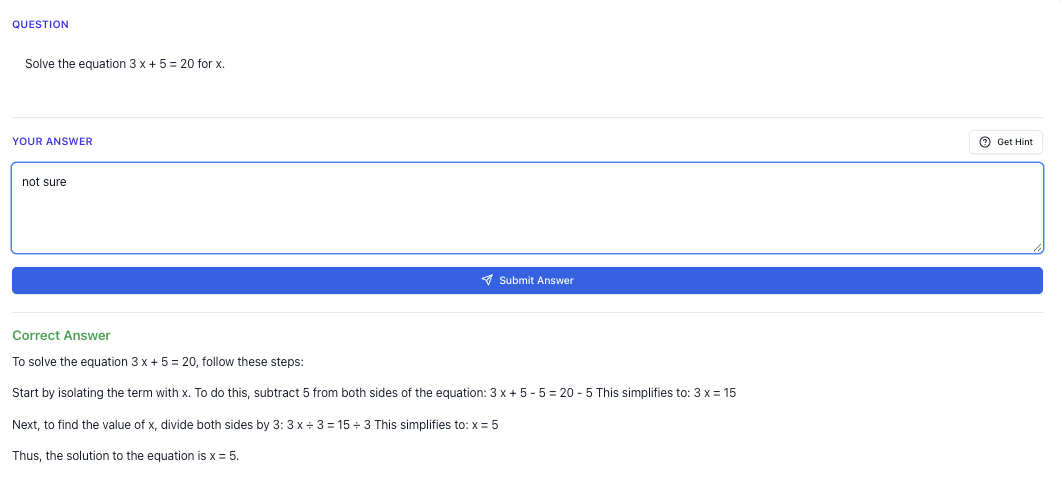
This guide is written for Secondary / O-Level students in Singapore, following the MOE syllabus. I’ll walk you through:
- How to find gradient of a line (step-by-step, like a proper tutorial)
- How O-Level exam questions like to twist gradient concepts
- Practice question ideas (including harder variants)
- Common mistakes Singapore students make
- How to use Tutorly.sg, a AI tutor website, to drill gradient questions effectively
By the way, Tutorly.sg has already been used by thousands of students in Singapore and has even been mentioned on Channel NewsAsia (CNA), so you’re in pretty safe hands if you use it for revision.
Useful links:
- Main AI tutor page: https://tutorly.sg/ai-tutor-singapore
- Direct web app access: https://tutorly.sg/app
Step-by-step tutorial
Let’s start from the basics and build up to exam-style questions.
1. What is gradient, really?
In O-Level maths, the gradient (or slope) of a straight line measures how steep the line is.
- Positive gradient: line goes upwards from left to right
- Negative gradient: line goes downwards from left to right
- Gradient $0$: horizontal line
- Undefined gradient: vertical line (you usually write , not in form)
Conceptually:
Gradient = how much 𝑦 changes when 𝑥 increases by 1
Formally, between two points and :
You must remember “𝑦 over 𝑥”, not the other way round.
2. Method 1: Gradient from two points
This is the most common way gradient appears in O-Level questions.
Formula
Given and :
You can label either point as 1 or 2, as long as you are consistent.
Example 1 (basic)
Find the gradient of the line joining 𝐴(1, 3) and 𝐵(5, 11).
-
Label:
-
Substitute into formula:
So the gradient is $2.
Example 2 (negative gradient)
Find the gradient of the line joining 𝐶(-2, 7) and 𝐷(4, -5).
-
Label:
-
Substitute:
Gradient is -2 (line slopes downwards from left to right).
3. Method 2: Gradient from the equation of a line
In O-Level E-Maths, straight-line equations are usually written in slope-intercept form:
- 𝑚 is the gradient
- 𝑐 is the 𝑦-intercept (value of 𝑦 when )
So if you can rearrange an equation to , you can read off the gradient directly.
Example 3
Find the gradient of the line .
Already in form.
- Gradient
Example 4 (needs rearranging)
Find the gradient of the line $2 x + 3 y = 12.
- Rearrange to make 𝑦 the subject:
- Compare with :
- Gradient
This “rearrange to find gradient” style is very common in O-Level structured questions.
4. Method 3: Gradient from a graph
Sometimes, you’re given a graph in the paper and asked to “find the gradient of the line”. You’re expected to:
- Choose two clear points on the line (preferably where it crosses grid intersections).
- Read off the coordinates carefully.
- Use the same formula: .
Example 5 (conceptual)
Suppose a straight line passes through (0, 2) and (4, 10) on the graph.
Even if the graph is from a real-life context (e.g. distance–time graph in a combined science paper, or a linear real-world model in E-Maths), gradient still means “change in vertical / change in horizontal”.
5. Using gradient to form the equation of a line
O-Level questions often mix “find gradient” and “find equation of line” together. A classic style:
Given the gradient and one point, find the equation of the line.
You usually use:
Then simplify to .
Example 6
A line has gradient $3and passes through(2, 5)$. Find its equation.
- Use point-slope form:
- Expand:
- Rearrange:
You might be asked to “hence find the gradient” of another line that is parallel or perpendicular – we’ll handle that in the strategy section.
Exam strategy guide
Knowing the formula is not enough for O-Level. The exam likes to test gradient in disguised ways. Here’s how to handle them confidently.
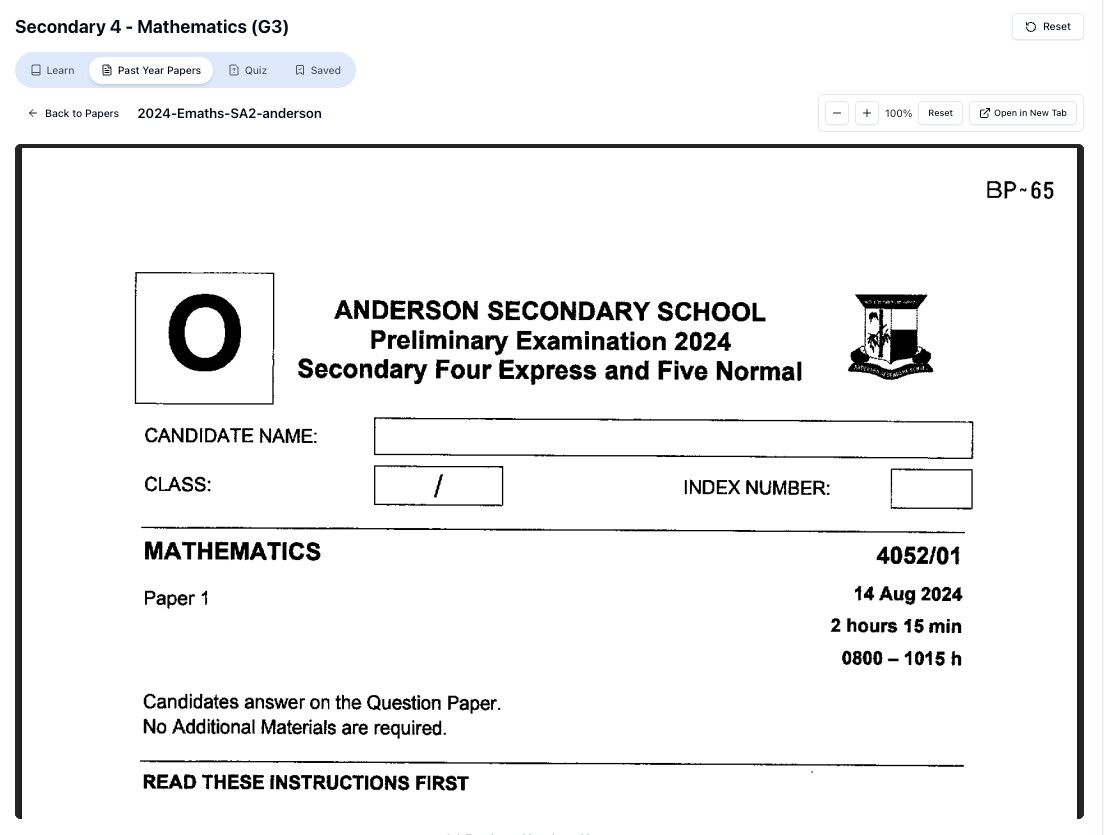
“Access more than 1000+ past year papers to practice”
👉 Start a paper today and test yourself like it’s the real exam.
1. Recognise gradient keywords in questions
Look out for phrases like:
- “Find the gradient of the line…”
- “Hence, find the gradient of the line ”
- “A line 𝑙 has gradient 𝑚 and passes through…”
- “A line is parallel / perpendicular to…”
- “The rate of change of 𝑦 with respect to 𝑥…”
Whenever you see these, your gradient instincts should switch on.
2. Parallel and perpendicular lines (very common in O-Level)
This is a favourite in O-Level E-Maths.
Parallel lines
- Parallel lines have the same gradient.
If line has gradient 𝑚, any line parallel to it also has gradient 𝑚.
Example
Line has equation . Find the equation of a line parallel to passing through (1, 4).
- Gradient of is .
- Parallel line also has gradient $2.
- Use point-slope form:
Perpendicular lines
- If two lines are perpendicular, their gradients and satisfy:
- So if , then .
Example
Line has equation . Find the gradient of a line perpendicular to .
- Gradient of is .
- Let gradient of perpendicular line be 𝑚.
3. Multi-step exam questions involving gradient
O-Level questions often hide gradient inside a longer coordinate geometry question. Typical pattern:
- Find gradient from two points.
- Use gradient to form equation of a line.
- Use equation to find intersection point / show some property.
Example (O-Level style)
Points 𝐴(1, 2) and 𝐵(5, 10) lie on line .
- Find the gradient of .
- Find the equation of .
- A line is perpendicular to and passes through 𝐵. Find the equation of .
Solution sketch
- Gradient of :
- Equation of using point 𝐴(1, 2):
- Gradient of is perpendicular to :
passes through 𝐵(5, 10):
Free on Tutorly.sg
Practise with step-by-step help — free to start
On Tutorly.sg/app you can practise unlimited Singapore syllabus questions, get instant explanations when you are stuck, and use past-year papers — no sign-up needed to start.
- ✓ PSLE, O Level, A Level, and more
- ✓ Step-by-step working when you are stuck
- ✓ Works on phone and laptop
You can leave it like this or simplify to , depending on the question.
4. Interpreting gradient in context (rate of change)
In some O-Level questions, especially word problems, gradient is described as “rate of change”.
Examples:
- A linear graph of distance against time: gradient = speed
- A graph of cost against number of items: gradient = cost per item
- A graph of temperature against time: gradient = rate of temperature change per unit time
The maths is the same: still , but the units matter.
Example
A graph shows the mass of a substance (in grams) against time (in minutes). The line passes through (0, 50) and (10, 20). Find the rate at which the mass is decreasing.
Gradient:
So mass is decreasing at 3 g per minute.
If you see “rate of change” in an O-Level maths question, think gradient.
5. Using Tutorly.sg for gradient revision (smartly)
Since you’re doing O-Levels in Singapore, your schedule is probably packed with CCA, tuition, and school homework. Gradient questions are actually perfect for short, focused practice sessions.
On Tutorly.sg (the AI tutor website built for MOE syllabus students):
- Go to: https://tutorly.sg/app
- Choose your level (e.g. Sec 3, Sec 4) and subject (E-Maths / A-Maths).
- Ask specific things like:
- “Give me 5 O-Level style questions on finding gradient from two points.”
- “Show me step-by-step how to find the gradient of a line parallel to passing through (1, 7).”
- “Create a challenging gradient question involving perpendicular lines and midpoints.”
Tutorly will give you questions and, after you submit your final answer, it will show you the full working so you can compare your method and fix your mistakes.
Because it’s aligned to the Singapore MOE syllabus, you don’t have to worry about weird foreign notation or off-syllabus content.
Worksheet practice
Here are practice ideas you can turn into your own “gradient worksheet”. I’ll include easy, medium, and hard variants similar to what you might see in school tests or O-Level prelims.
Try them on your own first. After that, you can use Tutorly.sg to generate more questions of the same style and check your answers.
A. Basic gradient from points (warm-up)
-
Find the gradient of the line joining:
- (a) 𝑃(2, 5) and 𝑄(6, 17)
- (b) 𝐴(-3, 4) and 𝐵(1, -8)
- (c) 𝐶(0, 0) and 𝐷(-4, 10)
-
The points 𝑀(1, -2) and 𝑁(5, 𝑦) lie on a straight line with gradient $3. Find the value ofy$.
Hint: Use and solve for 𝑦.
- The line joining 𝑆(4, 7) and 𝑇(𝑘, 19) has gradient $2. Find the value ofk$.
Hint: Use .
B. From equation to gradient (and back)
- Find the gradient of each line:
- (a)
- (b)
- (c) $3 x + 2 y = 8
- (d) $4 y - 𝑥 = 12
-
A line has gradient and passes through (2, 1). Find its equation in the form .
-
The line 𝐿 has equation $2 y + 5 x = 7$.
- (a) Find the gradient of 𝐿.
- (b) Find the 𝑦-intercept of 𝐿.
- (c) Find the 𝑥-intercept of 𝐿.
C. Parallel and perpendicular (medium)
- Line has equation .
- (a) Find the gradient of a line parallel to .
- (b) Find the gradient of a line perpendicular to .
- (c) Find the equation of the line perpendicular to and passing through (3, 4).
- Line passes through 𝐴(1, 2) and 𝐵(5, 10).
- (a) Find the gradient of .
- (b) Find the equation of .
- (c) A line is parallel to and passes through 𝐶(0, -1). Find the equation of .
- Line has equation .
- (a) Find the gradient of .
- (b) Find the equation of the line perpendicular to and passing through (3, 0).
D. Harder exam-style variants (good for Sec 4 / O-Level prep)
These are closer to what you might see in school exams or O-Level Paper 2.
Question 10 (midpoint + gradient + equation)
“Doing Secondary Science? Pick a topic and practise like it’s a real exam — with clear answers right after.”
👉 Try Tutorly now and start a Science topic in seconds.

Points 𝐴(2, 3) and 𝐵(8, 15) lie on a straight line.
- Find the gradient of .
- Find the coordinates of the midpoint 𝑀 of .
- A line 𝐿 is perpendicular to and passes through 𝑀. Find the equation of 𝐿.
Why this is useful: Combines gradient, midpoint, and perpendicular line — a very typical O-Level mix.
Question 11 (show that…, a common phrasing)
The points 𝑃(1, 4), 𝑄(3, 8) and 𝑅(7, 16) lie on a straight line.
- Show that the gradient of is equal to the gradient of .
- Hence, explain why 𝑃, 𝑄 and 𝑅 are collinear.
Hint:
- Calculate gradient of and gradient of .
- If they are equal, then 𝑃, 𝑄, and 𝑅 lie on the same straight line.
This “show that” style appears often in O-Level questions involving gradient and collinearity.
Question 12 (rate of change context)
The total cost 𝐶 (in dollars) of renting a study room is related to the number of hours 𝑡 by a straight-line graph. The graph passes through (0, 10) and (5, 40), where 𝑡 is in hours.
- Find the gradient of the line.
- Interpret the gradient in the context of the question.
- Find the equation connecting 𝐶 and 𝑡.
- Use your equation to find the cost of renting the room for 8 hours.
Why this is useful: Tests your understanding of gradient as rate of change and forming linear models.
Question 13 (harder perpendicular variant)
Line passes through 𝐴(-2, 1) and 𝐵(4, 7).
- Find the gradient of .
- Find the equation of .
- Point 𝐶 lies on such that and 𝐶 has a positive 𝑥-coordinate.
- (i) Show that the coordinates of 𝐶 are (4, 7).
- (ii) A line is perpendicular to and passes through 𝐶. Find the equation of .
This is more challenging because it mixes distance formula, gradient, and perpendicular lines.
Question 14 (O-Level style coordinate geometry twist)
The straight line 𝐿 has equation .
- Find the coordinates of the point where 𝐿 cuts the 𝑥-axis.
- Find the coordinates of the point where 𝐿 cuts the 𝑦-axis.
- A point 𝑃 lies on 𝐿 and has 𝑥-coordinate 𝑘. Express the coordinates of 𝑃 in terms of 𝑘.
- The line 𝑀 is perpendicular to 𝐿 and passes through 𝑃. Find the gradient of 𝑀 in terms of 𝑘.
Focus: You must be comfortable manipulating the equation and working in terms of variables.
Using Tutorly.sg to extend this worksheet
After trying these questions, you can get infinite variations by using Tutorly.sg:
- Go to: https://tutorly.sg/app
- Select your level and E-Maths / A-Maths.
- Ask:
- “Give me 10 practice questions on gradient of a line, from easy to O-Level difficulty, with answers.”
- “Generate 5 hard coordinate geometry questions involving gradient, midpoints and perpendicular lines for O-Level.”
- “I keep making sign mistakes when finding gradient. Give me targeted practice and explanations.”
Tutorly will:
- Give you questions aligned with the MOE O-Level syllabus.
- Check your final answer.
- Show you step-by-step working so you can see exactly where you went wrong and how to fix it.
This is especially helpful if you’re revising late at night and don’t have a tutor or teacher to ask.
Common mistakes
Here are the most frequent gradient mistakes I see from Singapore secondary students, especially in Sec 3–4.
1. Mixing up 𝑥 and 𝑦 in the formula
Wrong:
Correct:
Fix:
When you write the formula, say it in your head: “change in 𝑦 over change in 𝑥”.
2. Inconsistent labelling of points
Example:
You accidentally do:
- but then
This flips the sign.
Fix:
Once you choose which point is 1 and which is 2, stick with it for both numerator and denominator.
3. Sign errors (especially with negative numbers)
Common example:
Students often write -2 - 3 = -1 or -1 - 4 = 3 by accident.
Fix:
- Write intermediate steps clearly.
- Use brackets: (-2) - 3, (-1) - 4.
- Simplify carefully: (-2) - 3 = -5, (-1) - 4 = -5 so .
4. Forgetting to rearrange to
When the equation is given in a different form (e.g. $3 x + 2 y = 8), some students try to “guess” the gradient or think the coefficient ofx$ is the gradient.
It’s not, unless the equation
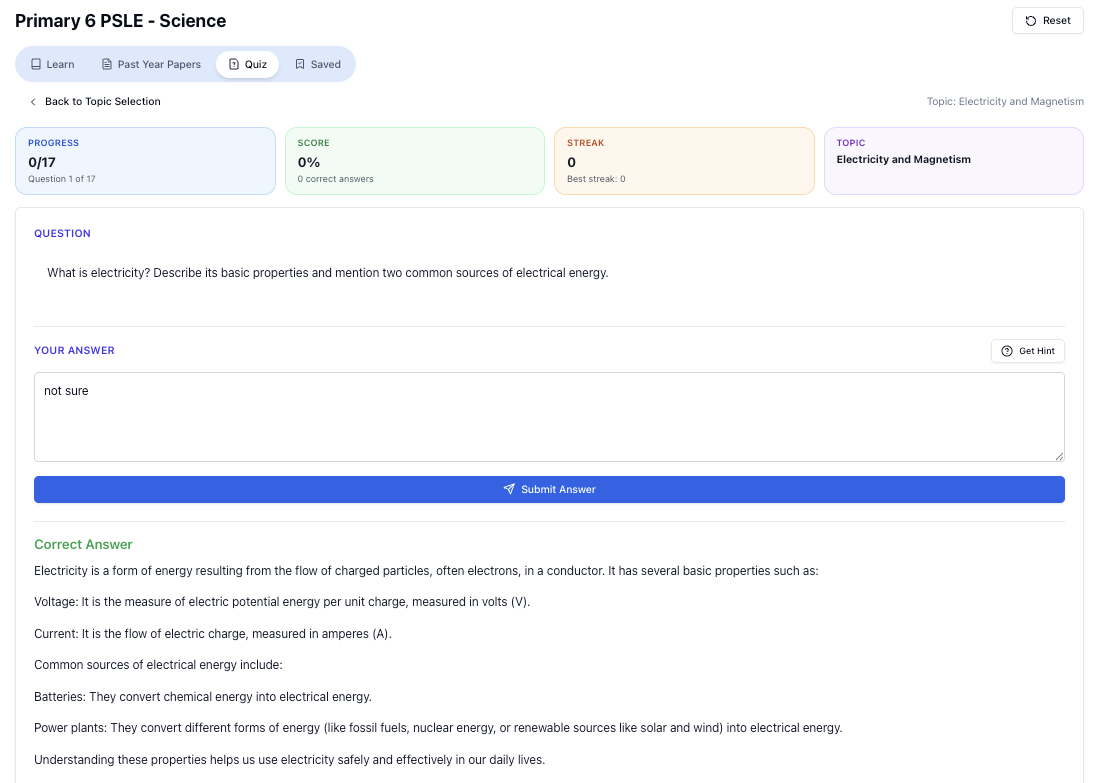
“Practice PSLE Science questions and get clear, step-by-step answers instantly.”
👉 Try a question now and see how fast you can improve.
Ready to practise?
If you want a Singapore-focused AI tutor you can use immediately (website, no sign-up), try Tutorly here:
Related Articles
Free on Tutorly.sg
Practise with step-by-step help — free to start
On Tutorly.sg/app you can practise unlimited Singapore syllabus questions, get instant explanations when you are stuck, and use past-year papers — no sign-up needed to start.
- ✓ PSLE, O Level, A Level, and more
- ✓ Step-by-step working when you are stuck
- ✓ Works on phone and laptop