

Free on Tutorly.sg
Practise with step-by-step help — free to start
On Tutorly.sg/app you can practise unlimited Singapore syllabus questions, get instant explanations when you are stuck, and use past-year papers — no sign-up needed to start.
- ✓ PSLE, O Level, A Level, and more
- ✓ Step-by-step working when you are stuck
- ✓ Works on phone and laptop
If you’re in Secondary school or preparing for O Levels, you’ve probably felt this before:
“I actually understood the paper… but I ran out of time.”
“Stuck on a question? See simple explanations that help you understand fast.”
👉 Give it a try and turn confusion into clarity in minutes.
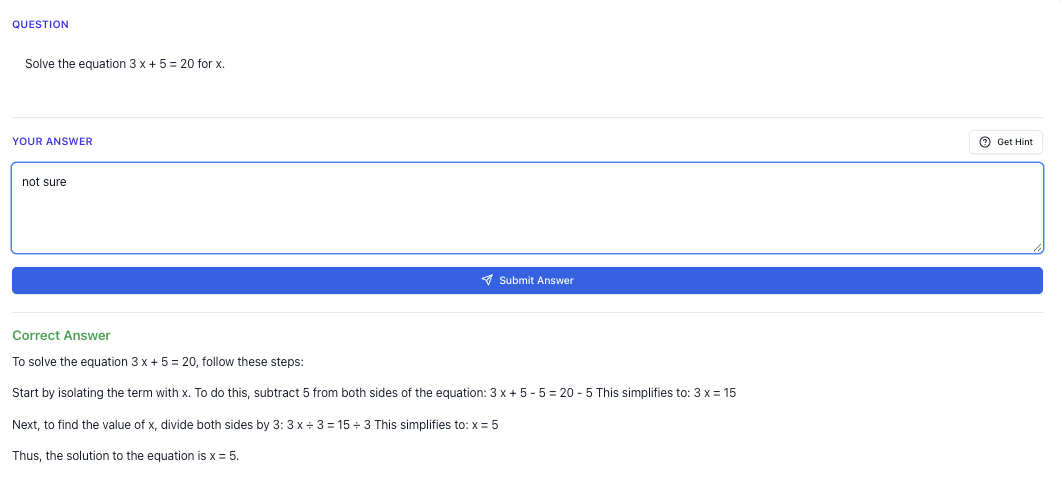
In Singapore, MOE exams are designed to test both your understanding and your ability to work under time pressure. It’s not enough to “know your stuff” – you also need to answer fast, accurately, and confidently.
This guide is for Secondary and O Level students who want to:
- Finish papers with time to check
- Speed up without becoming careless
- Practise exam-style questions with proper timing
- Use AI in a smart, Singapore-specific way (not just generic tips)
Throughout this article, I’ll show you concrete techniques you can try immediately, and how to use Tutorly.sg as your “speed trainer” for exam questions.
Tutorly.sg is a Singapore-built AI tutor website (not an app), aligned to the MOE syllabus, and has already been used by thousands of students in Singapore. It’s even been mentioned on Channel NewsAsia (CNA) – so you’re not experimenting with some random tool.
Let’s go step by step.
Step-by-step tutorial: Build speed the smart way
You don’t become faster just by “trying to be faster”. You need a system.
Here’s a 5-step routine you can follow for any Secondary / O Level subject (Math, Science, English, Humanities), and I’ll show you how to plug Tutorly.sg into it.
Step 1: Know your timing per mark
Most students only look at the total time.
Example:
- O Level E-Math Paper 1: 80 marks, 2 hours
- That’s 120 minutes for 80 marks → 1.5 minutes per mark
But you can’t treat a 1-mark question and a 6-mark question the same way.
Use this rough rule:
- 1–2 mark question → 30 sec – 2 min
- 3–4 mark question → 3–5 min
- 5–6+ mark question → 6–9 min
Action:
- Take a past-year paper.
- For each question, write the max time you allow yourself based on marks.
- During practice, force yourself to move on when that time is up.
You can always come back later. The goal is to train your brain to feel what “too long” feels like.
Step 2: Set up “exam conditions” at home
You’ll never speed up if you always practise slowly “for understanding”. You need two modes:
- Learning mode – slow, detailed, making notes
- Exam mode – strict timing, no distractions
For exam mode:
- Clear your table
- Only allowed items: paper, pen, calculator (if allowed), formula sheet (if allowed)
- Use a timer (phone on airplane mode is fine)
If you’re practising with Tutorly.sg:
- First, attempt the question fully on your own under timing.
- Only after you’ve written an answer, then ask Tutorly:
- “Explain step-by-step how to solve this O Level Math question: …”
- Or “Show me a faster method for this type of question.”
Tutorly will show you the final answer and then the step-by-step solution, so you can compare:
- Where you wasted time
- Which step you made longer than necessary
- Whether there’s a shortcut you didn’t know
Step 3: Use “first sweep, second sweep” answering
This is a huge time-saver that many strong students use quietly.
First sweep (fast scan through the paper):
- Start the paper and move question by question.
- If you see:
- A familiar, straightforward question → do it immediately
- A question you know but need time → star it, skip for now
- A question you’re totally blank on → double-star and skip
Your goal in first sweep:
Secure all the “easy and medium” marks quickly.
You don’t want to be stuck 12 minutes on one killer question while 10 easy questions at the back are untouched.
Second sweep:
- Go back to the starred questions.
- Now you can spend more time, because your easy marks are already secured.
- For the double-star ones, decide:
- Can I attempt something reasonable?
- Or is it better to write what I know and move on?
This method alone can easily give you 5–10 extra marks, just by preventing “I ran out of time” disasters.
Step 4: Develop fixed routines for common question types
You should not be “thinking from scratch” for every question. For common types, you want a fixed routine.
Example (E-Math algebraic simplification):
Your routine might be:
- Expand brackets (if any)
- Group like terms
- Factorise if possible
- Check if any common factor can be cancelled
When you see a question like:
Simplify:
You don’t panic. You just run your routine:
- Factorise numerator:
- Expression becomes
- Cancel 2:
- Factorise: →
The more of these routines you build, the less mental energy you use per question, and the faster you go.
You can train this on Tutorly:
- Paste a question type, e.g. “O Level Math: simultaneous equations word problem”.
- Ask: “Show me a general step-by-step method to handle this type of question.”
- Practise using that method on other similar questions (from school papers or Ten-Year Series).
Step 5: Analyse your timing after every practice
After each timed practice:
- Mark your paper (or check with Tutorly).
- Next to each question, write:
- Time taken
- Marks scored
- Ask yourself:
- Which questions did I spend too long on for the marks?
- Where did I lose marks due to carelessness?
- Which question types were surprisingly fast? (Those are your strengths.)
This reflection is where your speed actually improves.
You can also paste a question into Tutorly and ask:
- “Is there a faster way to solve this, suitable for O Level standards?”
- “Which steps can I shorten while still being clear for the examiner?”
Exam strategy guide: Subject-specific speed tactics
Now let’s go into concrete strategies for typical Secondary / O Level subjects in Singapore.
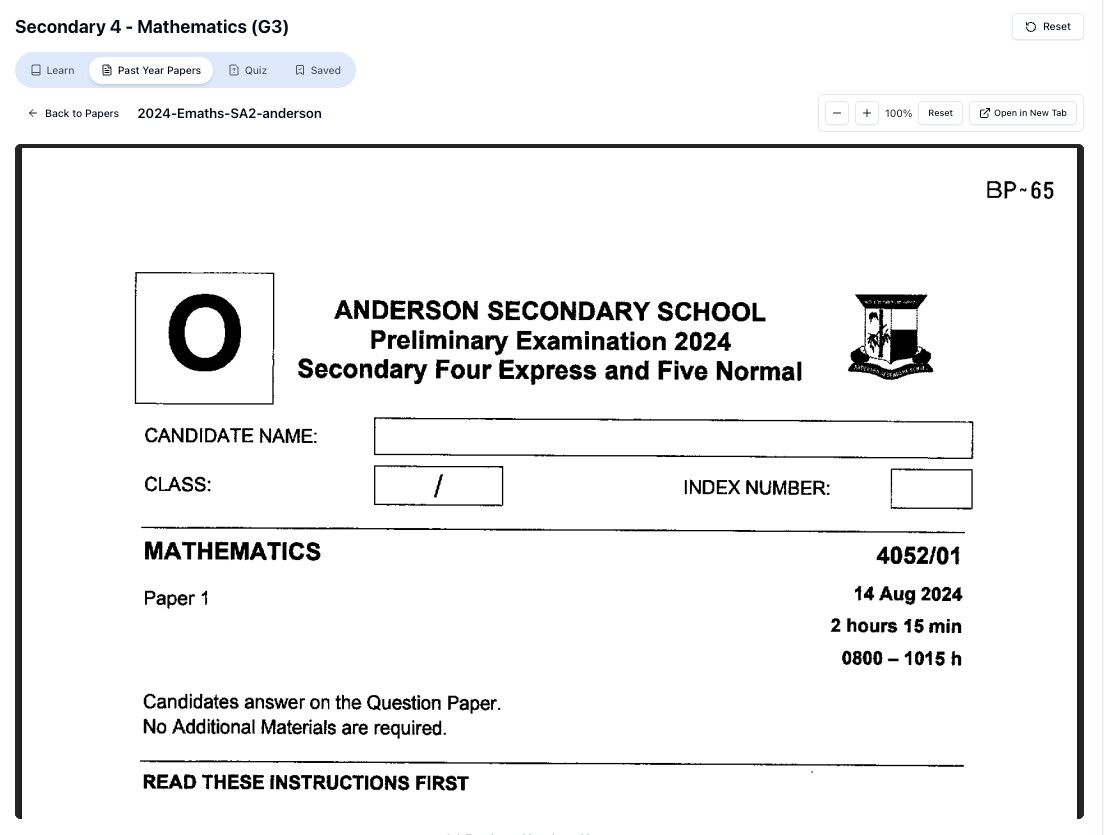
“Access more than 1000+ past year papers to practice”
👉 Start a paper today and test yourself like it’s the real exam.
1. Math (E-Math / A-Math): Cut working time, not accuracy
Math is where timing problems show up most clearly.
a) Use “answer first, then justify” for MCQs
For MCQs:
- Estimate or shortcut to get a likely answer
- Then do a quick check to see if it’s reasonable
Example:
The gradient of a line is 3 and it passes through (2, 5). What is the equation of the line?
Instead of doing long working, use the formula :
- Substitute :
- So
If this is MCQ, once you see in the options and your logic is sound, move on. No need to rewrite everything neatly.
b) Memorise common forms and identities
You answer way faster if you don’t need to “re-derive” things.
Examples:
- Trig identities (for A-Math): , etc.
On Tutorly, you can:
- Ask: “List the must-know formulas for O Level E-Math [topic] with simple examples.”
- Then create your own mini formula sheet and drill them.
c) Use structured checking
Instead of redoing the whole paper, check high-risk areas:
- Sign errors (+/–)
- Copying errors from one line to the next
- Final units (cm, cm², cm³, m/s, etc.)
- Rounding (3 s.f. vs 2 d.p.)
In the last 5–10 minutes, just scan:
- Are all answers clearly written in the answer space?
- Any blank sub-parts? (Very common)
- Any answers obviously unreasonable? (e.g. negative length)
2. Science (Pure / Combined): Speed up using keywords
In Science, marks are often about keywords and clear structure more than long sentences.
a) Use fixed answer templates
For common question types, have “templates” you can fill in.
Example (Biology: enzyme question):
Explain how temperature affects enzyme activity.
Template:
- As temperature increases, kinetic energy of particles increases.
- More frequent effective collisions between enzyme and substrate.
- Rate of reaction increases, up to optimum temperature.
- Beyond optimum, enzyme denatures; active site changes shape.
- Substrate no longer fits active site; rate of reaction decreases.
Once you memorise this structure, you can answer in under a minute.
You can use Tutorly to:
- Ask: “Give me exam-style model answers for O Level Biology on [topic], in bullet points.”
- Then practise writing them out from memory, timing yourself.
b) Underline command words
In structured questions:
- Define
- Describe
- Explain
- Compare
- State
- Suggest
Each has a specific expectation.
Example:
- “Define” → usually short, precise statement
- “Explain” → cause and effect, using “because”, “therefore”, etc.
- “Compare” → similarities and differences, often in a table or paired points
Underlining the command word helps you avoid overwriting (wasting time) or under-answering (losing marks).
3. English: Faster comprehension and writing
Many students run out of time in English Paper 1 and 2.
a) For comprehension: question-first reading
Instead of reading the whole passage slowly, try:
- Skim the passage quickly (1–2 minutes) to get the general idea.
- Then go straight to the questions.
- For each question, read the relevant part of the passage more carefully.
This saves time and keeps your brain focused on what the question actually wants.
b) For summary: prepare a fixed structure
Summary is all about speed + precision.
Have a routine:
- Underline key points in the passage related to the question.
- Number them (1, 2, 3, …) in the margin.
- Check the word limit (e.g. 80 words).
- Combine points and rephrase to cut down words.
The more you practise this, the faster you become at spotting “summary-worthy” points.
You can ask Tutorly:
- “Give me a sample O Level English summary passage and show a band 1 summary answer.”
- Then try to write your own summary and compare.
4. Humanities (SS / History / Geography): Faster planning, not longer essays
In Humanities, speed is about planning quickly and writing focused paragraphs.
a) Use PEEL/PEEEL structures
To avoid waffling:
- Point
- Evidence / Example
- Explanation
- (Optional) Evaluation
- Link back to question
Before writing, spend 2–3 minutes planning:
- How many points?
- What examples?
- Any case studies?
This planning time saves you from going off-topic and rewriting halfway.
You can ask Tutorly:
- “Show me a PEEL paragraph for O Level Social Studies on [issue], with Singapore context.”
- Practise writing your own, then compare structure and depth.
Worksheet practice: Timed drills with easier and hard variants
Free on Tutorly.sg
Practise with step-by-step help — free to start
On Tutorly.sg/app you can practise unlimited Singapore syllabus questions, get instant explanations when you are stuck, and use past-year papers — no sign-up needed to start.
- ✓ PSLE, O Level, A Level, and more
- ✓ Step-by-step working when you are stuck
- ✓ Works on phone and laptop
Here are some practice sets you can try. Use a timer. After you attempt them, you can paste each question into Tutorly.sg to:
- Check the answer
- See step-by-step solutions
- Ask for a faster method if your way feels too long
Set A: Quick-fire Math (E-Math level)
Target: ~1–1.5 minutes per question
-
Simplify:
-
Solve for 𝑥:
-
Expand and simplify:
-
Factorise completely:
-
Express 𝑦 in terms of 𝑥:
Once you’re comfortable, try the hard variants.
Set A (Hard variants)
Target: ~3–5 minutes per question
-
Solve the simultaneous equations:
\begin{cases} 2𝑥 + 3𝑦 = 7 \\ 4𝑥 - 𝑦 = 5 \end{cases}$$ -
A number is increased by 20%, then decreased by 20%. The final value is 96.
Find the original number. -
The points 𝐴(2, 3) and 𝐵(8, 9) are the endpoints of a line segment.
Find the coordinates of the midpoint. -
The length of a rectangle is (3𝑥 + 2) cm and its breadth is (𝑥 - 1) cm.
Express the area in terms of 𝑥 and simplify. -
A student scored 15, 18, 20, 19, 18 in five tests.
Find the mean and the median.
After doing these:
- Check your answers with Tutorly.
- For any question where you took longer than the target time, ask:
- “Show me a more efficient way to solve this for O Level standards.”
Set B: Science structured questions
Target: 3–4 minutes per question (depending on marks)
B 1 (Biology – easier)
Explain why enzymes are described as “specific” in their action.
(3–4 marks)
B 2 (Physics – easier)
State the difference between speed and velocity.
(2 marks)
B 3 (Chemistry – easier)
Define oxidation in terms of oxygen and electrons.
(2–3 marks)
Now try the hard variants.
Set B (Hard variants)
B 4 (Biology – application)
A student investigates the effect of pH on the activity of an enzyme.
Describe how the student should carry out this experiment and explain what results you would expect.
(6–8 marks)
B 5 (Physics – calculation)
A car accelerates from rest to a speed of in 8 seconds.
Calculate:
- Its acceleration
- The distance travelled in this time
(4–5 marks)
B 6 (Chemistry – reasoning)
Magnesium reacts with dilute hydrochloric acid to produce hydrogen gas.
Explain, in terms of particle collisions, why the reaction is faster when the acid is heated.
(3–4 marks)
Do these under timing, then:
- Check answers with Tutorly.
- Ask: “What keywords must appear in my answer to get full marks for this O Level [subject] question?”
- Compare your answer and highlight missing keywords.
Set C: English & Humanities
C 1 (English summary – easier)
You don’t need a full passage now; just practise planning.
- Set a timer for 5 minutes.
- Imagine you’re given a passage about “The impact of social media on teenagers”.
- The question: “Summarise the negative effects of social media on teenagers.”
In 5 minutes:
“Doing Secondary Science? Pick a topic and practise like it’s a real exam — with clear answers right after.”
👉 Try Tutorly now and start a Science topic in seconds.

- List at least 8 distinct points that could be in the passage (e.g. distraction from studies, cyberbullying, etc.).
- Try to combine them into 3–4 concise sentences (no need to count words strictly yet).
After that, you can ask Tutorly:
- “Give me a model summary answer (around 80 words) for the negative effects of social media on teenagers, O Level style.”
- Compare structure and concision.
C 2 (Social Studies – easier)
Question:
“Explain how one government measure helps to maintain social cohesion in Singapore.”
(4–5 marks)
- Set a timer for 6–7 minutes.
- Write 1 PEEL paragraph with a clear example (e.g. National Service, public housing, bilingual policy).
Then, try the hard variants.
Set C (Hard variants)
C 3 (English – situational writing)
You are the chairperson of your school’s environment club.
Write an email to your principal proposing a school-wide “Green Week” campaign.
Include:
- Purpose of the campaign
- 2–3 key activities
- How it benefits the school
(Target: 250–300 words, 30 minutes)
Tips:
- Spend 5 minutes planning (bullet points).
- Spend 20 minutes writing.
- Spend 5 minutes checking.
Afterwards, paste your email into Tutorly and ask:
- “Comment on the clarity, tone, and organisation of this situational writing piece for O Level English. Suggest improvements.”
C 4 (Social Studies – SBQ)
You can’t see the actual source here, but you can still practise timing and structure.
- Set 10 minutes.
- Pick a past SS SBQ from your school / Ten-Year Series.
- Attempt only ONE part (e.g. “How far does Source A support the view that…”).
After that, type your answer into Tutorly and ask:
- “Is this answer well-structured for an O Level Social Studies SBQ? How can I improve my explanation and use of the source?”
Common mistakes that make you slow (and how to fix them)
Speed problems are usually not about “I’m just a slow person”. They’re often about habits. Here are some common ones I see in Singapore students.
1. Over-writing for small-mark questions
Writing a huge paragraph for 1–2 marks is a classic time-waster.
Fix:
- Train yourself to look at the mark allocation first.
- For 1 mark: usually one clear point or definition.
- For 2 marks: two distinct points or point + explanation.
Use Tutorly to check:
- Paste your answer and ask: “Is this too long for a 2-mark O Level [subject] question? Show me a concise full-mark answer.”
2. Staring at hard questions too long
Some students feel “guilty” skipping questions, so they freeze.
Fix:
- Decide a personal rule: e.g. maximum 2 minutes thinking time before you move on.
- Circle or star the question, then come back later.
You are not weaker for skipping; you are being strategic.
3. Copying question information again and again
In Math and Science, students often rewrite the entire question into their working. That wastes time.
Fix:
- Underline or box the important numbers/phrases in the question.
- Only copy what you truly need (e.g. formulas, given values).
4. Not practising under real timing
Doing worksheets “slowly and nicely” is good for learning, but if that’s all you do, you’ll crash in the exam.
Fix:
- Have at least 2–3 sessions per week where you:
- Set a timer
- Do a section / paper under real exam timing
- Mark and review
Tutorly is helpful here because it’s always available:
- You can do a quick 15–20 minute timed drill after tuition, CCA, or dinner.
- Immediately check answers and see solutions, instead of waiting for the next school lesson.
5. Panicking when you see unfamiliar wording
Sometimes the question looks new, but the underlying concept is something you actually know.
Fix:
- Train yourself to ask:
- “Which topic is this actually testing?”
- “What is the question really asking me to find or explain?”
If you’re stuck, after the exam you can paste the question into Tutorly and ask:
- “Explain what this O Level question is really about and which topic it comes from.”
- Over time, you’ll see patterns in how exam setters phrase questions.
How Tutorly.sg can be your speed coach
Since you’re reading this on Tutorly.sg, you already know it’s an AI tutor website built specifically for Singapore students, aligned to the MOE syllabus from Primary 1 to JC 2.
For Secondary and O Level speed training, here’s how to use it effectively:
-
Timed attempts first, help later
- Do the question on paper first, with a timer.
- Only then ask Tutorly for the final answer and step-by-step solution.
-
Ask for faster methods
- “Is there a shorter way to solve this that is acceptable in O Level exams?”
- “Which steps can I skip or combine while still being clear?”
-
Generate more practice
- “Give me 5 O Level-style questions on [topic], with a mix of easy and hard.”
- Time yourself for each set.
-
Clarify marking expectations
- “What keywords or points are needed to get full marks for this question?”
- This helps you avoid overwriting.
Because Tutorly is built for Singapore exams and has already been used by thousands of local students, you don’t have to filter out irrelevant content from overseas syllabuses.
You can start using it instantly here:
👉 https://tutorly.sg/ai-tutor-singapore
Ready to answer faster in your next exam?
Speed in exams isn’t about rushing. It’s about:
- Knowing your time per mark
- Using first sweep, second sweep
- Having fixed routines for common question types
- Practising under real exam timing
- Learning shorter, smarter methods and key phrases
You don’t need to figure this out alone at 11pm the night before a test.
If you want a , MOE-aligned AI tutor website to drill questions with you, explain step-by-step solutions, and suggest faster approaches, you can start with Tutorly here:
- Learn more and ask questions: https://tutorly.sg/ai-tutor-singapore
- Or jump straight into the AI tutor: [https://tutorly.sg
Try Tutorly.sg (Singapore)
Start here: AI Tutor Singapore
Try Tutorly on the website (no sign-up): https://tutorly.sg/app
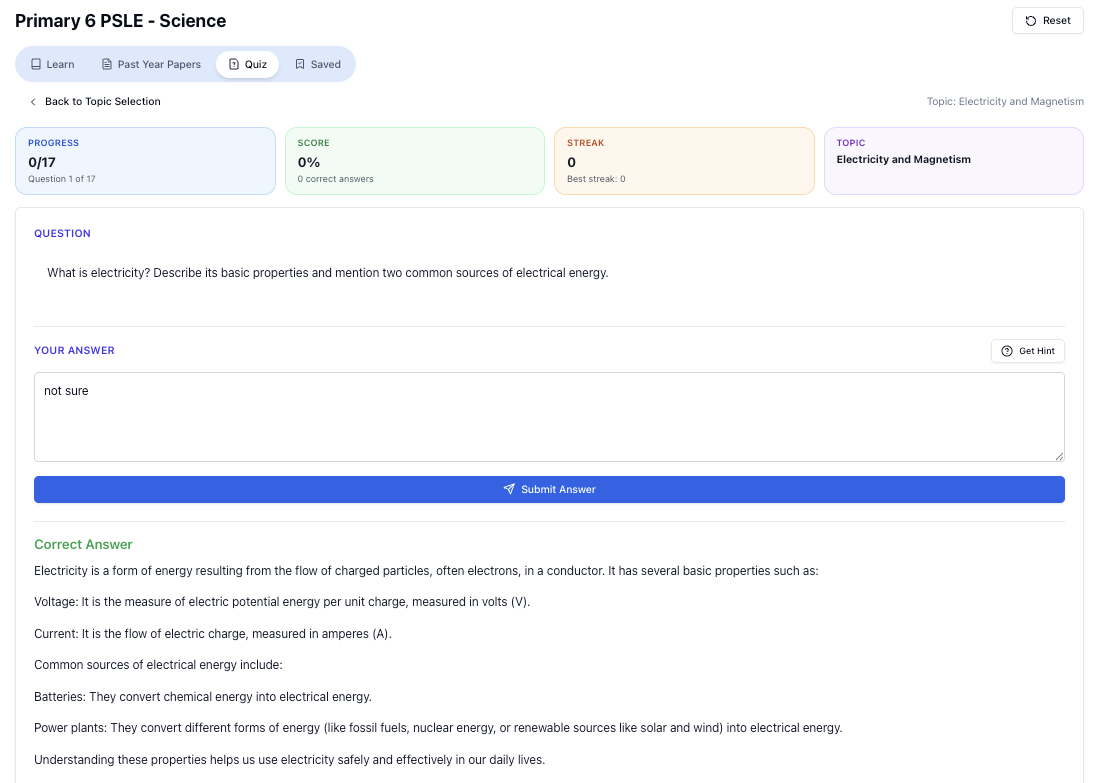
“Practice PSLE Science questions and get clear, step-by-step answers instantly.”
👉 Try a question now and see how fast you can improve.
Ready to practise?
If you want a Singapore-focused AI tutor you can use immediately (website, no sign-up), try Tutorly here:
Related Articles
Free on Tutorly.sg
Practise with step-by-step help — free to start
On Tutorly.sg/app you can practise unlimited Singapore syllabus questions, get instant explanations when you are stuck, and use past-year papers — no sign-up needed to start.
- ✓ PSLE, O Level, A Level, and more
- ✓ Step-by-step working when you are stuck
- ✓ Works on phone and laptop