

Free on Tutorly.sg
Practise with step-by-step help — free to start
On Tutorly.sg/app you can practise unlimited Singapore syllabus questions, get instant explanations when you are stuck, and use past-year papers — no sign-up needed to start.
- ✓ PSLE, O Level, A Level, and more
- ✓ Step-by-step working when you are stuck
- ✓ Works on phone and laptop
If you’re in secondary school in Singapore, “easy math” probably sounds like a joke.
You’ve got:
- Algebra that suddenly has fractions inside fractions
- Coordinate geometry with weird midpoints
- Trigonometry that looks okay… until they throw in angles of elevation and depression
- And of course, the pressure of O Levels
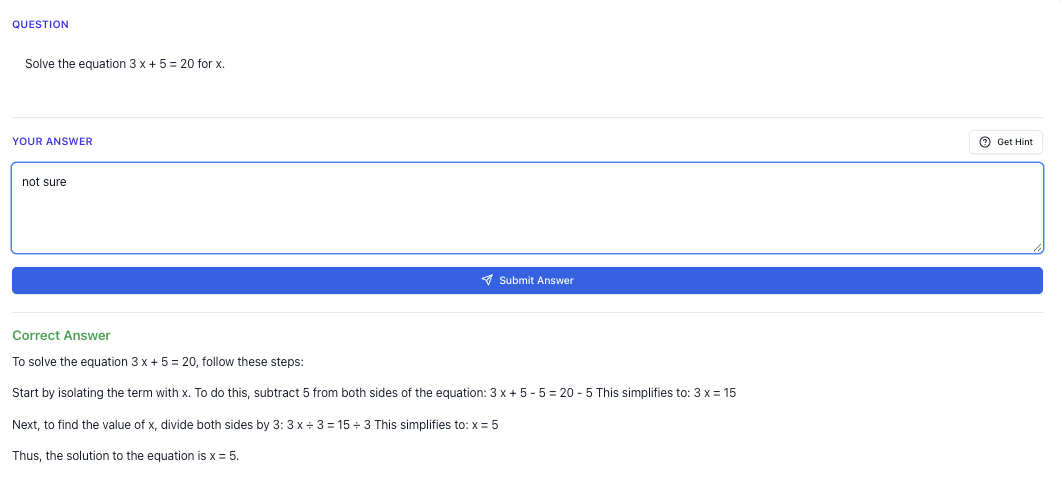
“Stuck on a question? See simple explanations that help you understand fast.”
👉 Give it a try and turn confusion into clarity in minutes.
The problem usually isn’t that you’re “bad at math”. It’s that:
- No one showed you a simple, repeatable way to think about each topic
- You don’t get enough targeted practice with feedback
- When you’re stuck at 11pm, there’s no one to ask
That’s where a good system (and a good tutor) makes math feel easy.
In this guide, I’ll walk you through:
- A step-by-step way to handle common Secondary / O Level math topics
- Exam strategies that are specific to the MOE syllabus and O Levels
- How to practise with easy → medium → hard variants of questions
- Common mistakes that cost Sec 3–4 students marks every year
- And how to use Tutorly.sg, a AI tutor website built for Singapore students, to make math much less stressful
Tutorly.sg isn’t some generic overseas tool. It’s built for MOE, N(A), N(T), Express, and O Level math, has been mentioned on Channel NewsAsia (CNA), and has already helped thousands of students in Singapore. You can try it here:
👉 https://tutorly.sg/ai-tutor-singapore
👉 https://tutorly.sg/app
Step-by-step tutorial
Let’s go through a few core areas that almost every Secondary 2–4 / O Level student struggles with:
- Algebra (especially factorisation and equations)
- Quadratic graphs
- Trigonometry
- Word problems (the classic “I don’t even know where to start”)
I’ll show you a simple way to approach each, and how you can use an “easy math tutoring” mindset to break things down.
1. Algebra: Stop guessing, follow a fixed routine
Algebra is the foundation for almost everything in Sec 3–4 math. If algebra feels messy, the rest of math will feel messy too.
(a) Factorisation: 3 main patterns
Instead of memorising 10 formulas, focus on 3 key patterns:
-
Common factor
- Example:
- Step 1: Look for the biggest number and variable you can factor out
-
Difference of squares
- Pattern:
- Example:
-
Quadratic trinomial
- For simple ones where :
- Example:
- Find two numbers that multiply to 6 and add to 5 → 2 and 3
- So: (𝑥 + 2)(𝑥 + 3)
- For simple ones where :
- For , use “cross method” or grouping:
- Example:
- Multiply
- Find two numbers that multiply to 6 and add to 7 → 1 and 6
- Rewrite 7𝑥 as 𝑥 + 6𝑥:
Group:
Factor each group: 𝑥(2𝑥 + 1) + 3(2𝑥 + 1)
Final: (2𝑥 + 1)(𝑥 + 3)
Routine to practise:
- Look at the expression
- Ask: “Common factor? Difference of squares? Trinomial?”
- Try the pattern that fits
- Check by expanding back
On Tutorly.sg, you can type your factorisation question, get the final answer checked, then see a step-by-step explanation to compare with your own method.
(b) Solving linear equations: Always “clean” first
Example:
Solve
Step-by-step:
-
Clear denominators
Multiply both sides by 4 (LCM of 4 and 2):
-
Expand brackets
-
Move 𝑥 terms to one side, numbers to the other
-
Quick check (sub back if unsure)
When you practise:
- Don’t rush the “clear denominators” step
- Use one line per step
- Circle your final answer, especially in exams
2. Quadratic graphs: Turn the equation into a story
For O Level E Math, you often get quadratic graphs like .
You should be able to:
- Find 𝑥-intercepts
- Find 𝑦-intercept
- Sketch roughly
- Use the graph to answer questions
Example:
-
𝑦-intercept: set
So (0, 3) -
𝑥-intercepts: set
Factor:
So or → points (1, 0) and (3, 0) -
Shape:
Coefficient of is positive (+1) → opens upwards -
Axis of symmetry:
Midpoint between and → -
Vertex (turning point):
Substitute :
Turning point is (2, -1)
If you follow this fixed sequence every time, quadratic graphs stop being scary.
3. Trigonometry: One triangle, three main ideas
For O Level E Math, focus on these:
- SOH CAH TOA (right-angled triangles)
- Sine rule (non-right-angled, with pairs of angle + opposite side)
- Cosine rule (non-right-angled, when you have 3 sides or 2 sides + included angle)
(a) SOH CAH TOA
SOH:
CAH:
TOA:
Routine:
- Identify the right angle
- Label the side opposite the angle you’re using
- Label the hypotenuse (longest side)
- Decide which ratio to use (SOH, CAH, or TOA)
- Substitute and solve
Example:
Right-angled triangle, , opposite side = 5 cm, find hypotenuse .
Use because we have opposite and hypotenuse:
So → cm
4. Word problems: Turn English into math in 3 steps
Most Sec 3–4 students freeze at word problems. Use this 3-step approach:
-
Define variables clearly
- “Let 𝑥 be the number of…”
- “Let 𝑡 be the time in hours…”
-
Translate sentence by sentence
- “Twice as many” → 2𝑥
- “Total of 60” → equation equals 60
- “Difference between” → subtraction
-
Solve, then check if your answer makes sense
- Negative number of people? Something is wrong.
- Time is 100 hours? Probably wrong.
Example:
“A school canteen sells curry puffs at $1.40 each and drinks at $1.10 each. On one day, a total of 120 items were sold, and the total sales were $152. Find how many curry puffs were sold.”
Step 1: Variables
Let 𝑥 = number of curry puffs
Let 𝑦 = number of drinks
Step 2: Equations
Total items:
Total money:
Step 3: Solve (you can use substitution or elimination)
From →
Sub into money equation:
This is not a whole number → check your understanding.
Actually, for O Level questions, they would usually choose numbers that give a whole answer. If this came from your own worksheet, maybe you copied a number wrongly.
This is where a tool like Tutorly.sg helps: you can type the full question, get the correct final answer, and see the official working to compare with your own.
Exam strategy guide
Knowing the content is one thing; scoring in O Level math is another. Here’s a practical strategy for E Math / A Math papers.
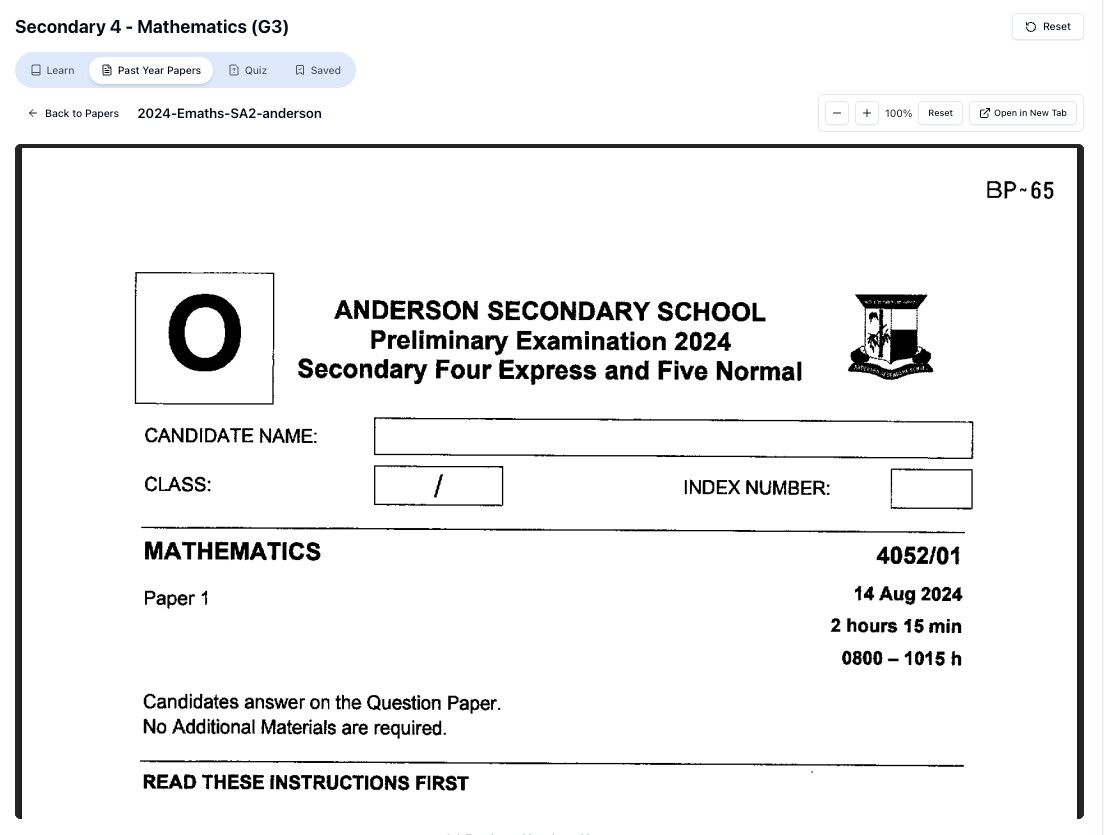
“Access more than 1000+ past year papers to practice”
👉 Start a paper today and test yourself like it’s the real exam.
1. Know the paper structure (O Level E Math)
Paper 1 (usually 2 hours):
- Shorter questions, no calculator (for some years) or limited calculator use depending on syllabus version
- Tests basic skills, algebra, simple graphs, basic geometry
Paper 2 (usually 2 hours 30 mins):
- Longer questions, full calculator allowed
- More word problems, graphs, statistics, geometry/trigo application
Check the latest format from SEAB or your teacher, but the idea is the same:
- Paper 1 = accuracy + speed
- Paper 2 = application + stamina
2. How to use your first 5 minutes
When you get the paper:
-
Flip through quickly
-
Circle/mark:
- Topics you’re strong in
- Any “weird-looking” questions
-
Decide your game plan:
- Start with questions you’re confident in
- Leave long word problems / proofs for later
This reduces panic. You’ll warm up with easier marks first.
3. Time management formula
For a 2-hour paper with 80 marks:
- Total time: 120 minutes
- Rough guide: 1.5 minutes per mark
- So a 5-mark question → ~7–8 minutes
During practice, actually time yourself:
- Do a 10-mark section in 15 minutes
- Check how many marks you actually got
- Adjust your speed
On Tutorly.sg, you can:
- Take a question, try it under timed conditions
- Then ask Tutorly to show you the step-by-step solution
- Compare your approach and see where you’re wasting time
4. “3-pass” method for each paper
Instead of doing the paper once from front to back, try this:
Pass 1: Easy marks
- Do all the questions you recognise and feel okay about
- Don’t get stuck more than 2–3 minutes on any question
- Circle questions you skipped
Free on Tutorly.sg
Practise with step-by-step help — free to start
On Tutorly.sg/app you can practise unlimited Singapore syllabus questions, get instant explanations when you are stuck, and use past-year papers — no sign-up needed to start.
- ✓ PSLE, O Level, A Level, and more
- ✓ Step-by-step working when you are stuck
- ✓ Works on phone and laptop
Pass 2: Medium difficulty
- Go back to circled questions
- Spend more time, write down proper working
- If still stuck, leave a small gap and move on
Pass 3: Hard / stubborn questions
- Last 10–15 minutes
- Now you try the hardest ones, or questions you left earlier
- Even if you can’t finish, write some working – method marks are real
This method helps you secure 60–70% of the paper before you fight with the killer questions.
5. How to check effectively (without redoing everything)
In the last 10 minutes:
-
Check units: cm vs cm² vs cm³, dollars vs cents
-
Check if your answers are reasonable:
- Lengths shouldn’t be negative
- Probabilities between 0 and 1
- Angles in a triangle add to
-
Scan for:
- Missing labels on graphs
- Missing final statements (e.g. “Therefore, or ”)
- Answers not rounded to required accuracy (e.g. 3 s.f.)
You don’t need to re-solve. Just quickly scan and correct obvious errors.
Worksheet practice
Here’s how to structure your own “easy math tutoring” practice at home, even without a human tutor sitting beside you.
1. Use a 3-level practice system: Easy → Exam → Hard
For each topic (e.g. algebra, trigo, graphs), do:
-
Easy:
- Basic skills
- Simple numbers
- One concept at a time
-
Exam-style:
- Taken from past-year O Level / school papers
- Slightly longer, more steps
-
Hard variants:
- Combined topics
- Non-obvious starting point
- Require you to choose the method yourself
With Tutorly.sg, you can:
- Paste any question from school
- Ask follow-up questions like “show me a similar but slightly harder question”
- Get instant answers and step-by-step methods any time of the day
Try it here:
👉 https://tutorly.sg/ai-tutor-singapore
2. Sample practice set: Algebra (with hard variants)
Easy
- Factorise:
- Solve:
- Simplify:
Suggested answers:
- = \dfrac{2𝑥 \cdot 8𝑥^3}{4𝑥^2 \cdot 𝑥}= \dfrac{16𝑥^4}{4𝑥^3}
Exam-style
- Solve:
- Factorise completely:
Outline of solutions:
-
Multiply both sides by 6:
-
Multiply
Need two numbers that multiply to -6 and add to -5 → -6 and 1
Rewrite:
Group: 2𝑥(𝑥 - 3) + 1(𝑥 - 3)
Factor: (2𝑥 + 1)(𝑥 - 3)
Hard variants (Algebra)
-
Solve:
-
A rectangle has length (2𝑥 + 3) cm and breadth (𝑥 - 1) cm.
- (a) Write an expression for the area in terms of 𝑥
- (b) Given that the area is , form an equation and solve for 𝑥
These are the kind of questions where many students get stuck at the setup. You can try them on your own first, then paste them into Tutorly.sg to see the full working and compare.
3. Sample practice set: Trigonometry (with hard variants)
Easy
- In a right-angled triangle, is an acute angle, and .
- Find
“Doing Secondary Science? Pick a topic and practise like it’s a real exam — with clear answers right after.”
👉 Try Tutorly now and start a Science topic in seconds.

(Hint: Draw a right-angled triangle with opposite = 3, hypotenuse = 5, find adjacent using Pythagoras.)
Exam-style
- A ladder of length 5 m leans against a wall. The foot of the ladder is 1.2 m away from the wall.
- (a) Find the angle the ladder makes with the ground, correct to 1 decimal place.
You’d use .
Hard variants (Trigo)
- The diagram (imagine it) shows a hill. From point A on level ground, the angle of elevation of the top of the hill is . From a point B, 40 m closer to the hill, the angle of elevation is .
- Find the height of the hill, correct to 1 decimal place.
This kind of question combines:
- Trigo
- Two different right-angled triangles
- Distance difference
You’ll need to:
- Express heights in terms of
- Use the fact that horizontal distances differ by 40 m
- Solve a pair of equations
This is exactly the type of question where having a AI tutor like Tutorly.sg is useful: you can try it, then check your final answer and see every step you missed.
4. How to build your own “mini worksheets”
Each week, pick 1–2 topics and do:
- 5 easy questions (warm-up, from textbook / notes)
- 5 exam-style questions (from Ten-Year Series, school papers)
- 2–3 hard variants (mix of topics, or questions you got wrong before)
After each session:
- Mark your work honestly
- For any wrong question:
- Try again without looking at the answer
- If still stuck, ask Tutorly.sg to explain step-by-step
- Add the “stubborn” questions to a “mistake book” (see below)
Common mistakes
Here are the classic mistakes I see from Sec 3–4 / O Level students in Singapore, and how you can avoid them.
1. Skipping algebra steps “to save time”
Example:
Solving
Many students jump straight to:
But they forget to show the intermediate step:
In exams, if you make a mistake and your working is incomplete, you lose both method and accuracy marks.
Fix:
- Always write at least one line per transformation
- Especially for algebra, equations, and proofs
2. Using the wrong formula in trigo / geometry
Common mix-ups:
- Using sine rule when you should use cosine rule
- Using Pythagoras on non-right-angled triangles
- Using area formula wrongly
Fix:
- Before you start, ask yourself:
- Is there a right angle?
- What information is given (sides, angles)?
- Decide the correct formula first, then substitute
You can practise this by:
- Taking a bunch of mixed questions
- For each, write only: “Use: cosine rule” or “Use: SOH CAH TOA”
- Check with Tutorly.sg if your choice is correct before actually solving
3. Not answering the actual question
You get the math right but lose marks because:
- You didn’t round to the correct number of significant figures
- You forgot units
- You didn’t give the final statement (e.g. “Hence, the value of 𝑘 is 3”)
- For probability, you left the answer as a decimal when they wanted a fraction (or vice versa)
Fix:
- Underline key words in the question: “correct to 3 significant figures”, “give your answer in terms of ”, “hence or otherwise”
- At the end, re-read the last sentence of the question and check if your answer matches the requirement
4. Panic when seeing long word problems
Many students see a big paragraph and immediately think, “I don’t know how to do this.”
But usually, the question is just:
- 1–2 equations
- Plus basic algebra / ratio / percentage
Fix:
- Underline numbers and keywords
- Write down what the question is actually asking for (e.g. “Find number of students in Group A”)
- Start with something simple:
- A table
- A small diagram
- A simple equation
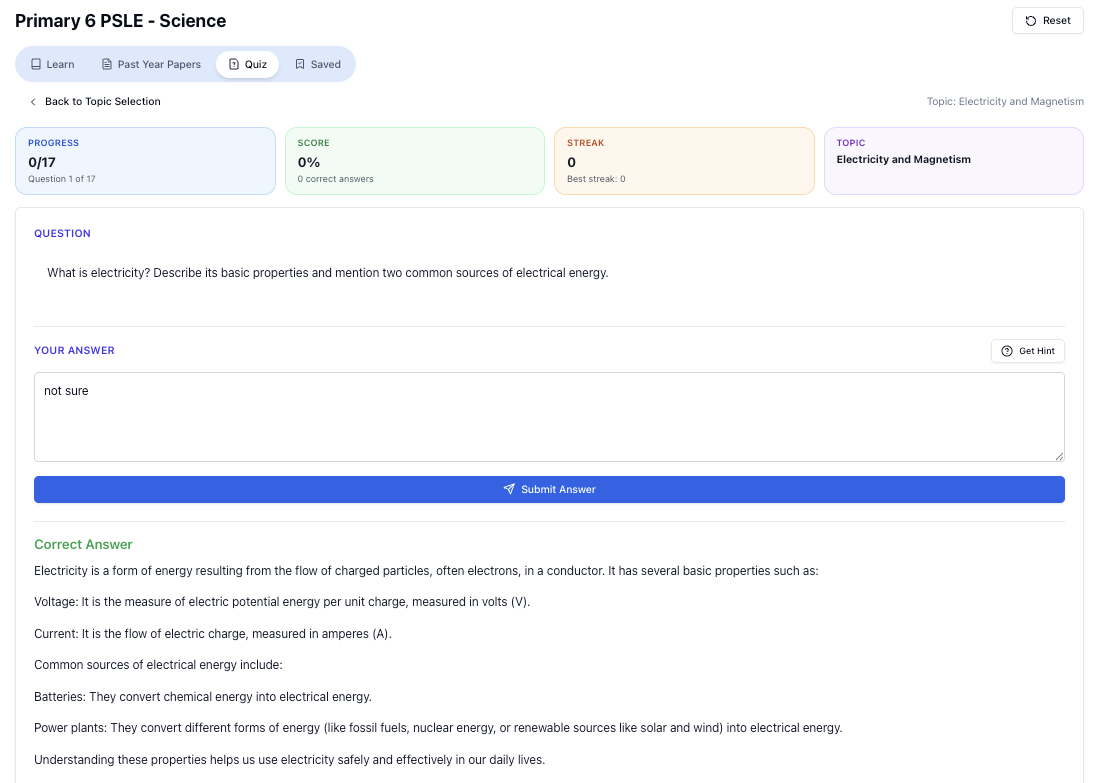
“Practice PSLE Science questions and get clear, step-by-step answers instantly.”
👉 Try a question now and see how fast you can improve.
Ready to practise?
If you want a Singapore-focused AI tutor you can use immediately (website, no sign-up), try Tutorly here:
Related Articles
Free on Tutorly.sg
Practise with step-by-step help — free to start
On Tutorly.sg/app you can practise unlimited Singapore syllabus questions, get instant explanations when you are stuck, and use past-year papers — no sign-up needed to start.
- ✓ PSLE, O Level, A Level, and more
- ✓ Step-by-step working when you are stuck
- ✓ Works on phone and laptop