

Free on Tutorly.sg
Practise with step-by-step help — free to start
On Tutorly.sg/app you can practise unlimited Singapore syllabus questions, get instant explanations when you are stuck, and use past-year papers — no sign-up needed to start.
- ✓ PSLE, O Level, A Level, and more
- ✓ Step-by-step working when you are stuck
- ✓ Works on phone and laptop
If you’re taking A Level Math in Singapore, you already know this: the syllabus is huge, your school tutorials are heavy, and the exam questions can feel like they’re from another planet.
But here’s the good news — A Level Math papers (H 1/H 2) from MOE and Cambridge are not random. There are very clear patterns in the types of questions that keep appearing: differentiation with application, tricky integration, AP/GP, conditional probability, vectors in 3 D, functions and graph transformations, and more.
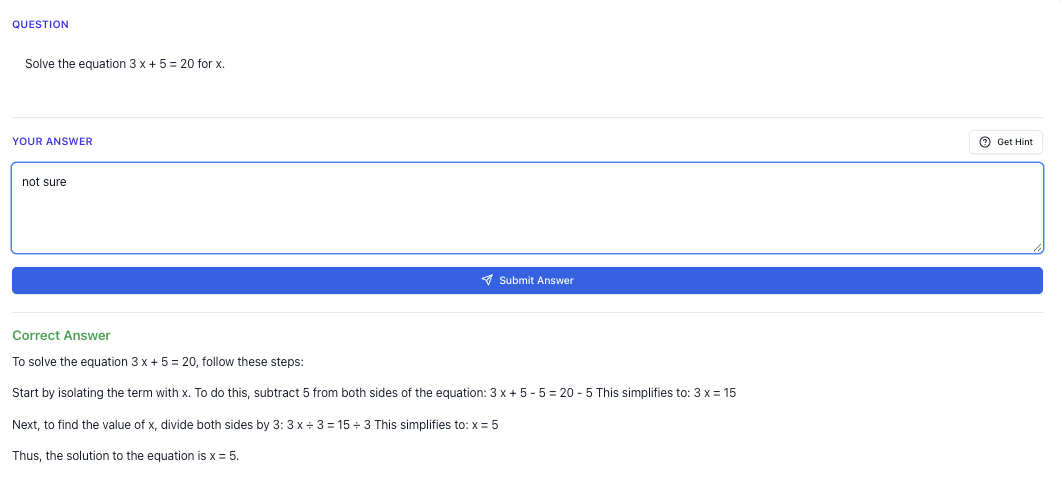
“Stuck on a question? See simple explanations that help you understand fast.”
👉 Give it a try and turn confusion into clarity in minutes.
In this guide, I’ll walk you through:
- The most common A Level Math question types in Singapore
- How examiners usually twist them
- Step-by-step methods you can follow
- Practice-style questions (including hard variants) you can try on your own
- How to use Tutorly.sg as your “on standby” AI tutor to drill these patterns
Tutorly.sg is a Singapore-built AI tutor website (not an app) aligned to the MOE JC syllabus. It’s been mentioned on Channel NewsAsia (CNA) and used by thousands of students in Singapore, especially during the mad rush before promos and A Levels.
You can try it here anytime:
- Main AI tutor page: https://tutorly.sg/ai-tutor-singapore
- Direct web app: https://tutorly.sg/app
Let’s go topic by topic, but in a way that’s actually exam-focused.
Step-by-step tutorial
In this section, I’ll break down common exam-style question types and show you a repeatable way to attack them.
I’ll focus on H 2 Math, but H 1 students can still benefit for overlapping topics (just check what’s in your syllabus).
1. Differentiation With Application (Maxima/Minima, Rates of Change)
This is one of the most frequently tested areas. Examiners love:
- Optimisation word problems (e.g. fencing, box, tank, area/volume)
- Tangent/normal questions
- Rates of change (related rates)
Typical optimisation flow
A classic A Level-style question:
A rectangular garden has perimeter . Find the dimensions that maximise its area.
Step-by-step approach:
-
Define variables
Let length 𝑥, breadth 𝑦. -
Write constraint (from the word problem)
Perimeter: . -
Write the quantity to optimise
Area: . -
Differentiate
-
Find stationary point
Set :
.
Then . -
Check it’s a maximum
Second derivative: so gives a maximum. -
Conclude with context
The garden is a square.
What to remember for exams:
- Always express everything in terms of one variable first.
- Differentiate, set derivative to zero, then check max/min using second derivative or sign change.
- Give units and answer in context (“dimensions”, not just ).
2. Integration With Area/Volume
This is another favourite. Common A Level patterns:
- Area between curve and line
- Area between two curves
- Volume of revolution about 𝑥- or 𝑦-axis
Typical area-between-curves flow
Example style:
Find the area enclosed between the curves and .
Step-by-step:
-
Find points of intersection
Set :
-
Decide which curve is on top
Compare at a point between 0 and 2, say :
So is above .
-
Set up integral
Area:
-
Integrate
Evaluate from 0 to 2:
Exam habits:
- Always show the intersection working; examiners want to see it.
- State clearly which curve is “on top”.
- Don’t forget absolute values if the context demands positive area.
3. Sequences & Series (AP/GP, Sigma Notation)
These are very “scorable” if you know the templates.
Common A Level question types:
- Find 𝑛th term, sum of first 𝑛 terms
- “At least / at most” type questions using sums
- Mixed AP/GP in the same question
Typical GP sum flow
Example style:
A geometric progression has first term 3 and common ratio 2.
(a) Find the sum of the first 8 terms.
(b) Find the least 𝑛 such that the sum of the first 𝑛 terms exceeds 1000.
Step-by-step:
(a) Sum of first 𝑛 terms of GP:
So:
(b) Need smallest 𝑛 such that :
Find smallest 𝑛 where .
(too small), (big enough).
So .
Exam habits:
- Write the formula first, then substitute.
- For “least 𝑛” or “smallest integer”, check by direct substitution at the end (e.g. compute , ).
4. Probability & Statistics (Binomial, Normal, Conditional)
For H 2, Probability + Statistics is a major chunk. Common patterns:
- Binomial distribution with “at least / at most”
- Normal approximation to binomial
- Conditional probability using tree diagrams or formula
- Hypothesis testing (for stats paper)
Typical binomial flow
Example style:
The probability that a machine produces a defective item is 0.02.
A sample of 20 items is selected at random.
(a) Find the probability that there are exactly 2 defective items.
(b) Find the probability that there are at most 1 defective item.
Step-by-step:
Let 𝑋 = number of defective items.
.
(a)
(b)
“At most 1” means or :
Then add them.
Exam habits:
- Always define 𝑋 clearly with distribution.
- Use correct notation: .
- For “at least / at most”, translate carefully to or and decide if you want to use .
5. Vectors in 3 D Geometry
This topic is heavily tested because it checks both algebra and spatial reasoning.
Common patterns:
- Show that lines are parallel / intersecting / skew
- Find angle between lines or between line and plane
- Find shortest distance between point and line / point and plane
Typical line–plane angle flow
Example style:
A line 𝑙 has direction vector
A plane has normal vector .
Find the acute angle between the line and the plane.
Step-by-step:
Angle between line and plane is complementary to angle between line and normal.
- Find angle between and using:
Compute dot product:
Norms:
So:
Take acute angle:
(ignore sign for angle).
- Angle between line and plane is:
\phi = 90^\circ - \theta
Exam habits:
- Always state what angle you’re finding (line–line, line–plane, plane–plane).
- For line–plane, remember to use the normal and then subtract from .
6. Functions & Graphs (Transformations, Inverses)
This is where many students lose marks unnecessarily.
Common patterns:
- Sketching transformed graphs
- Finding inverse functions and domains
- Showing functions are one-to-one / many-to-one
Typical inverse function flow
Example style:
Given , .
(a) Show that 𝑓 is one-to-one.
(b) Find and state its domain.
Step-by-step:
Free on Tutorly.sg
Practise with step-by-step help — free to start
On Tutorly.sg/app you can practise unlimited Singapore syllabus questions, get instant explanations when you are stuck, and use past-year papers — no sign-up needed to start.
- ✓ PSLE, O Level, A Level, and more
- ✓ Step-by-step working when you are stuck
- ✓ Works on phone and laptop
(a) One-to-one: show .
Set:
Cross-multiply:
Expand both sides, simplify, you should end up with .
(b) Find inverse:
- Start with .
- Swap 𝑥 and 𝑦:
- Solve for 𝑦:
So:
Domain of is the range of 𝑓.
Also, from the formula, (denominator).
You can find the range of 𝑓 by excluding the horizontal asymptote value from 𝑦.
Exam habits:
- For inverse, always swap 𝑥 and 𝑦 then solve.
- State domain and range clearly, especially when graph transformations are involved.
Exam strategy guide
Now that you’ve seen common question types, let’s talk strategy for the actual A Level exam in Singapore.
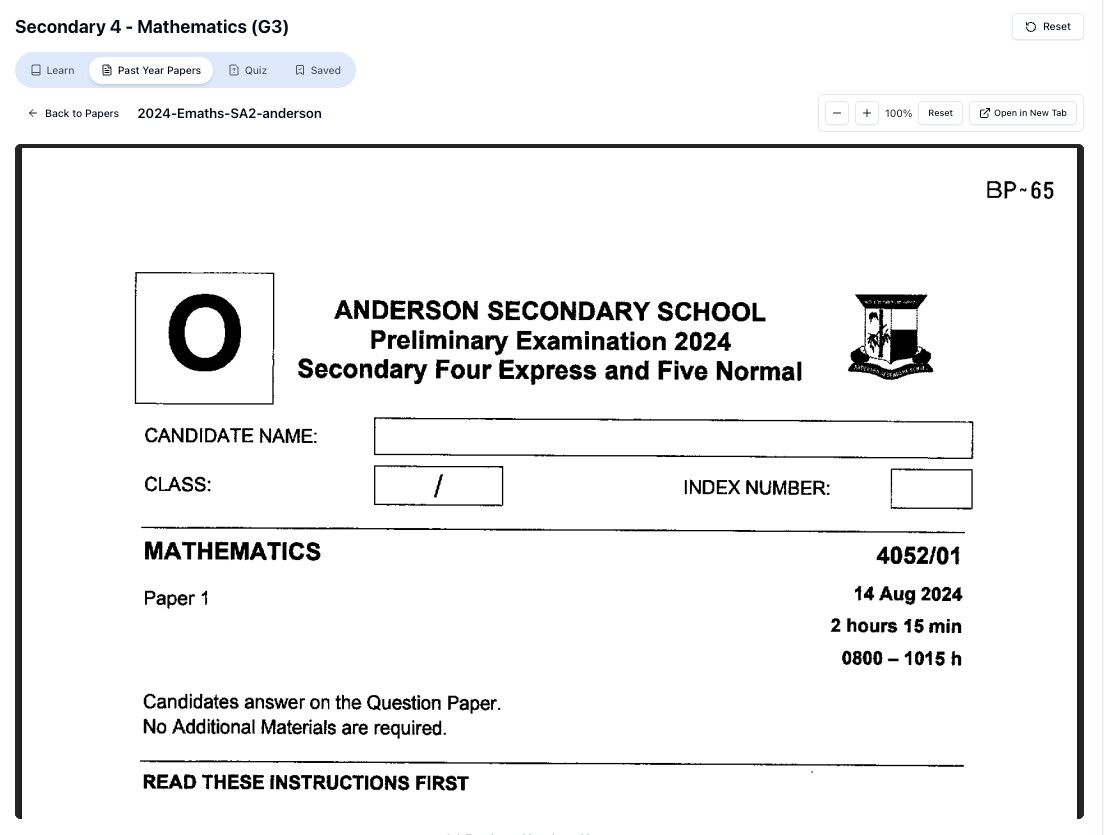
“Access more than 1000+ past year papers to practice”
👉 Start a paper today and test yourself like it’s the real exam.
1. Know the weightage and plan your time
For H 2 Math (9740):
- Paper 1: Pure math focus
- Paper 2: Pure math + probability & statistics
You don’t need to be perfect in every topic, but you must:
- Be solid in high-frequency topics: differentiation, integration, sequences & series, vectors, probability.
- Have a plan for time management:
- Do the “standard pattern” questions first.
- Leave long proofs or weird geometry to later.
A simple approach:
- First 10–15 minutes: Scan through, mark questions as Easy / Medium / Hard based on familiarity.
- Start with Easy → Medium → Hard.
- Don’t get stuck more than 8–10 minutes on a single question early on.
2. Recognise question “templates”
A Level questions often follow templates with small twists:
- “Show that …” in AP/GP → usually wants you to write general term and manipulate algebraically.
- “Hence, or otherwise” → you are supposed to use the previous result (saves time).
- “Given that Binomial / Normal” → define 𝑋 properly and write the probability in notation first.
Train yourself to label the pattern in your head:
- “This is a standard optimisation.”
- “This is area between curves.”
- “This is conditional probability (Bayes).”
- “This is a vector line–plane angle question.”
Once you recognise the pattern, your brain knows which formulas and steps to use.
When you practise using Tutorly.sg, you can literally type something like:
“Give me an A Level H 2 Math question on optimisation (differentiation) similar to past year papers.”
And it will generate a question aligned to MOE A Level style, plus a step-by-step solution so you can see the full template.
Try it here: https://tutorly.sg/ai-tutor-singapore or go straight to the web app at https://tutorly.sg/app.
3. Use the marking scheme mindset
Markers in Singapore look for:
- Correct setup (equations, definitions, notation)
- Logical progression (each step follows from the previous)
- Final answer with units or context
This means:
- Even if you can’t finish, write as many correct intermediate steps as you can.
- For probability, define 𝑋 and write properly before using calculator.
- For vectors, write vector equations clearly, e.g.
4. Calculators are tools, not brains
In Singapore A Levels, your GC is powerful, but:
- It won’t help if your setup is wrong.
- You must still show key steps.
Use your calculator for:
- Solving equations numerically (e.g. for 𝑛 in series questions)
- Checking binomial probabilities
- Checking your integration/differentiation answers quickly
But don’t rely on it to guess the method. In practice sessions, do the setup without GC first, then check with GC.
5. Simulate exam conditions regularly
Doing one or two questions at a time is okay for learning, but for exam performance, you need:
- Full-paper practice under timed conditions
- No notes, no pausing, no checking answers in between
You can use Tutorly.sg as your “question generator”:
- Ask it for a full set of mixed-topic questions (e.g. “10-question A Level H 2 Math mock set focusing on vectors, integration, and probability”).
- Attempt them under a fixed time (e.g. 90 minutes).
- Only after finishing, check each answer with Tutorly and compare with the step-by-step solution.
Because Tutorly.sg is online and available , you can do this even at 1am during mugging season.
Worksheet practice
Here are some practice-style questions that mirror common A Level patterns, including hard variants. Try them on your own first before checking solutions (you can ask Tutorly.sg to walk you through them).
“Doing Secondary Science? Pick a topic and practise like it’s a real exam — with clear answers right after.”
👉 Try Tutorly now and start a Science topic in seconds.

A. Differentiation & Optimisation
Q 1 (Standard):
A closed rectangular box with a square base is to have a volume of . The material for the base and top costs 3 times as much per as the material for the sides. Find the dimensions of the box that minimise the total cost.
Hints:
- Let base side length be 𝑥, height be .
- Volume constraint: .
- Express cost in terms of 𝑥 only, then differentiate.
Hard variant – Q 2 (Trickier optimisation):
A piece of wire of length is cut into two parts. One part is bent to form a square, and the other is bent to form a circle. How should the wire be cut so that the total area enclosed is minimised?
Hints:
- Let 𝑥 be length used for square, so 40 - 𝑥 for circle.
- Side of square: , radius of circle: .
- Total area: .
- Differentiate, set derivative to zero, check for minimum.
You can paste Q 2 into Tutorly at https://tutorly.sg/app and ask it to “show me the full working and final answer”. It will give you the step-by-step differentiation and reasoning.
B. Integration & Area/Volume
Q 3 (Standard area):
The curve intersects the 𝑥-axis at .
Find the total area of the regions enclosed between the curve and the 𝑥-axis.
Hints:
- Sketch sign of 𝑦 between the roots.
- You’ll need to split the integral into intervals where the curve is above/below the axis and use absolute values.
Hard variant – Q 4 (Volume of revolution):
The region 𝑅 is bounded by the curve , the line , and the 𝑥-axis.
Find the volume when 𝑅 is rotated about the 𝑥-axis.
Hints:
- Identify limits: where does meet the 𝑥-axis?
- Use formula for volume of revolution:
- Here, so integrate .
If you get stuck integrating , ask Tutorly.sg to “show the integration of step-by-step using integration by parts”.
C. Sequences & Series
Q 5 (Standard AP/GP mix):
The first, third and fifth terms of an arithmetic progression (AP) are also the first three terms of a geometric progression (GP).
Given that the first term of the AP is 3 and the common difference is 𝑑,
(a) express the second and third terms of the GP in terms of 𝑑,
(b) find the value of 𝑑.
Hints:
- AP terms: , 3 + 𝑑, 3 + 2𝑑, 3 + 3𝑑, 3 + 4𝑑, …
- GP first three terms: , 3 + 2𝑑, 3 + 4𝑑.
- Use GP property: .
Hard variant – Q 6 (Inequality with sum):
A geometric progression has positive terms, first term 𝑎 and common ratio 𝑟 where 0 < 𝑟 < 1.
Given that the sum to infinity is 20 and the sum of the first 3 terms is more than 15,
find the range of possible values of 𝑟.
Hints:
- Sum to infinity: .
- Sum of first 3 terms: .
- Substitute 𝑎 and solve inequality in 𝑟.
D. Probability
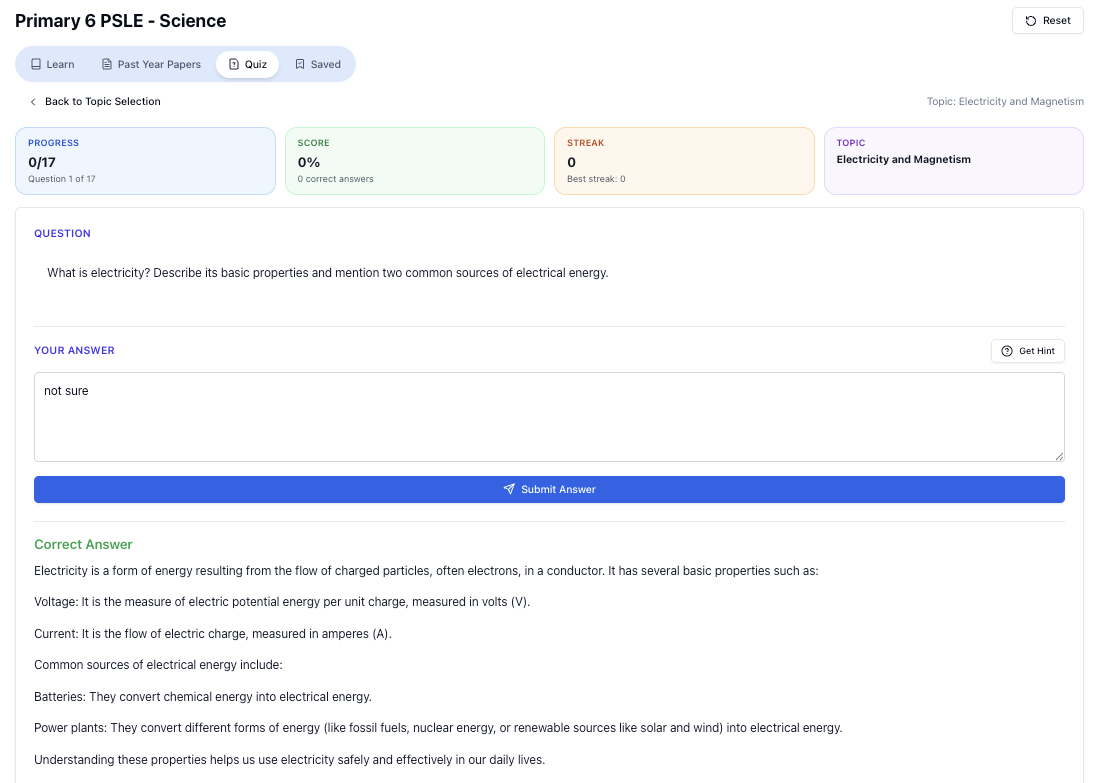
“Practice PSLE Science questions and get clear, step-by-step answers instantly.”
👉 Try a question now and see how fast you can improve.
Ready to practise?
If you want a Singapore-focused AI tutor you can use immediately (website, no sign-up), try Tutorly here:
Related Articles
Free on Tutorly.sg
Practise with step-by-step help — free to start
On Tutorly.sg/app you can practise unlimited Singapore syllabus questions, get instant explanations when you are stuck, and use past-year papers — no sign-up needed to start.
- ✓ PSLE, O Level, A Level, and more
- ✓ Step-by-step working when you are stuck
- ✓ Works on phone and laptop