

Free on Tutorly.sg
Practise with step-by-step help — free to start
On Tutorly.sg/app you can practise unlimited Singapore syllabus questions, get instant explanations when you are stuck, and use past-year papers — no sign-up needed to start.
- ✓ PSLE, O Level, A Level, and more
- ✓ Step-by-step working when you are stuck
- ✓ Works on phone and laptop
If you’re searching for an AI tutor in Singapore, you’re probably asking a practical question:
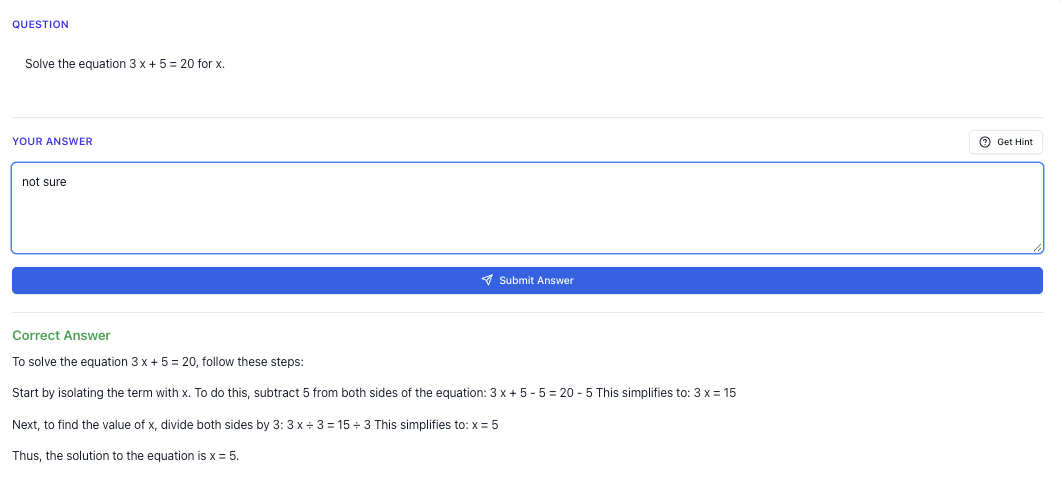
“Stuck on a question? See simple explanations that help you understand fast.”
👉 Give it a try and turn confusion into clarity in minutes.
Should I replace tuition with an AI tutor, or use both?
This guide gives you a decision framework you can use today for PSLE, O Levels, and A Levels.
A quick reality check (Singapore parents know this feeling)
If you’ve ever watched your child stare at a question at 10:30pm and say “I almost get it…”, you already understand the real problem:
- You don’t need more “resources”.
- You need fast feedback and a repeatable routine.
That’s why the AI tutor vs tuition question matters. The wrong choice usually looks like either:
- paying for more tuition but still seeing the same mistakes repeat between lessons, or
- switching tools but never building the daily practice habit that actually moves grades.
The short answer (Singapore context)
- Use an AI tutor for daily practice, instant explanations, and high-volume revision.
- Use tuition for accountability, live coaching, and exam strategy.
- The most common “best of both” setup is: tuition sets direction, AI tutor does the repetition.
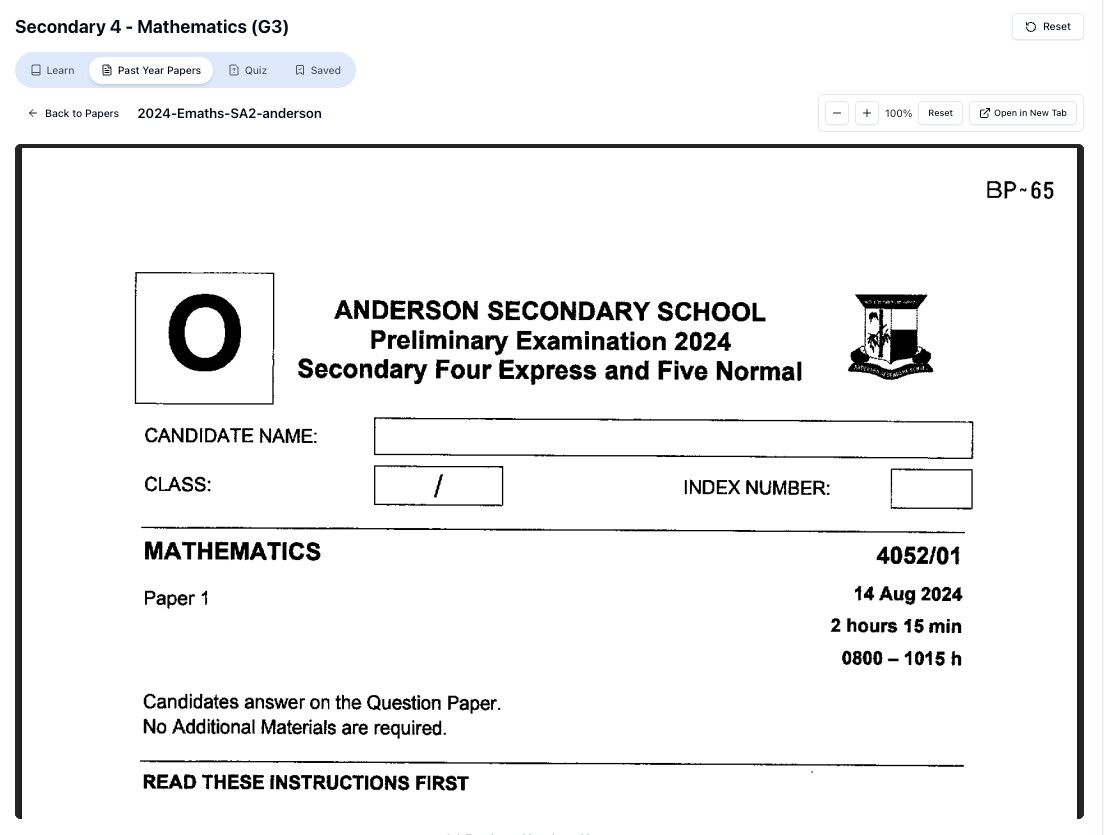
“Access more than 1000+ past year papers to practice”
👉 Start a paper today and test yourself like it’s the real exam.
If you want Tutorly’s AI tutor landing page (Singapore-focused), start here:
AI Tutor Singapore
Use this decision checklist (2 minutes)
Choose AI tutor first if the student:
- needs more practice (not more “teaching”)
- is stuck because they can’t get fast feedback
- has gaps across multiple subjects and needs one place to revise
- can study independently for 20–40 minutes a day
Choose tuition first if the student:
- won’t practise unless someone holds them accountable
- has foundational gaps and needs re-teaching from scratch
- gets anxious in tests and needs coaching on exam approach
Choose both if:
- the student already has tuition but still makes the same mistakes between classes
- you want to reduce tuition hours while keeping results stable
- you want a cheaper way to add more practice across subjects
What “good use” looks like (and what doesn’t)
AI tutor works best when the student:
- attempts first
- asks for the explanation only after they try
- redoes a similar question immediately
AI tutor fails when the student:
- pastes questions and reads the answer passively
- jumps topics every 5 minutes
- never reviews the same mistake twice
Here’s a simple way to spot the difference:
- Good session: “I got it wrong because my setup was wrong. I fixed it and redid two similar questions.”
- Bad session: “I did 30 questions… but I’m not sure what I learnt.”
The hybrid workflow that actually works (weekly plan)
Step 1: Tuition defines the target (10 minutes)
At the end of tuition, write down:
- 2 weak topics
- 3 recurring mistakes
Step 2: AI tutor drills the target (20–30 minutes/day, 4 days/week)
Daily loop:
- Do 6–10 questions from the weak topic
- Mark which step went wrong (not just “wrong answer”)
- Redo 2 similar questions immediately
Step 3: Weekly “proof” session (30 minutes)
Once a week:
- 10 mixed questions (to check recall)
- 10 weak-topic questions (to check improvement)
- record: accuracy %, time taken, top 2 mistakes
What this looks like for each exam level
PSLE (Primary 6)
PSLE improvement is often about:
- reducing careless errors (units, conversions, misreading),
- getting faster at standard patterns (ratio, fraction, speed, model method),
- building confidence through repetition.
The best AI tutor use is short, consistent practice:
- 25 minutes, 4 days/week
- 6 questions, fix mistakes, redo immediately
If you want a PSLE routine you can follow, see:
PSLE: How to Use an AI Tutor Effectively (Singapore)
O Levels (Secondary)
O-Level progress is usually blocked by one of these:
- concept gaps hidden by “can do sometimes” performance
- messy working (method marks leak)
- time pressure causing sign errors / careless steps
AI tutor helps most when it forces you to:
- identify the first wrong line
- drill the same pattern until it’s stable
- add mixed timed sets after accuracy improves
For a workflow, see:
O-Level Math: Using an AI Tutor to Fix Weak Topics (Singapore)
A Levels (JC)
For H2 Math and sciences, the win is:
- pattern recognition,
- clean working for method marks,
- timed practice once accuracy is stable.
AI tutor works best when it generates focused practice by question type (not vague topics), then gives quick feedback on your working.
See:
[JC H2 Math: A Revision Workflow with an AI Tutor (Singapore)](https://tutorly.sg/blog/jc-h 2-math-ai-tutor-singapore-2026)
Prompts that get useful outputs (copy/paste)
Use prompts that force structure and practice:
- “I’m a Secondary 2 student in Singapore. Give me 8 questions on indices. After each question, wait for my answer before explaining.”
- “Here is my working. Point out the first wrong line, explain why it’s wrong, then show the corrected working.”
- “Create a 20-minute revision plan for PSLE fractions with 10 practice questions, increasing difficulty.”
How to tell if it’s working (simple metrics)
Don’t overcomplicate tracking. Use these:
- Accuracy on the weak topic (weekly): is it trending up?
- Time per question: is it trending down without accuracy collapsing?
- Mistake repeat rate: are you repeating the same mistake type less often?
If those three improve, grades usually follow.
Sample questions + step-by-step solutions (what “good correction” looks like)
Free on Tutorly.sg
Practise with step-by-step help — free to start
On Tutorly.sg/app you can practise unlimited Singapore syllabus questions, get instant explanations when you are stuck, and use past-year papers — no sign-up needed to start.
- ✓ PSLE, O Level, A Level, and more
- ✓ Step-by-step working when you are stuck
- ✓ Works on phone and laptop
Example 1 (Secondary 2 style: algebra)
Solve .
Solution (step-by-step)
Step 1: Put all the 𝑥 terms on one side.
Subtract 3𝑥 from both sides:
Why: We want one 𝑥 expression so we can isolate it cleanly.
Step 2: Move the constant term to the other side.
Add 7 to both sides:
Why: This removes the -7 from the left side.
Step 3: Divide to solve for 𝑥.
Final answer:
Example 2 (PSLE style: ratio)
The ratio of apples to oranges is 3:5. There are 48 fruits altogether.
How many apples are there?
Solution (step-by-step)
Step 1: Add the ratio parts.
“Doing Secondary Science? Pick a topic and practise like it’s a real exam — with clear answers right after.”
👉 Try Tutorly now and start a Science topic in seconds.

Why: Total parts represent the whole group of fruits.
Step 2: Find the value of 1 part.
Why: If 8 equal parts make 48 fruits, each part must be 6 fruits.
Step 3: Find apples (3 parts).
Final answer: 18 apples
Example 3 (JC style: differentiation quick check)
Differentiate .
Solution (step-by-step)
Step 1: Differentiate each term.
Why: Differentiation is linear: differentiate term-by-term and add results.
Final answer:
Example 4 (O-Level style: geometry)
A rectangle has length and width . A square has the same area as the rectangle.
Find the side length of the square.
Solution (step-by-step)
Step 1: Find the area of the rectangle.
Why: Area of rectangle = length × width.
Step 2: Set the square’s area equal to 60.
If the side length is 𝑠, then:
Why: Area of a square = side × side = .
Step 3: Solve for 𝑠 using square root.
Why: Square root reverses squaring.
Step 4: Simplify if needed.
Final answer: (about )
If you want an AI tutor built for Singapore
Tutorly.sg is an AI tutor for Singapore students (Primary to JC) with exam-style practice and step-by-step explanations.
Start here: AI Tutor Singapore
If you just want to try it immediately (no sign-up), go here:
https://tutorly.sg/app
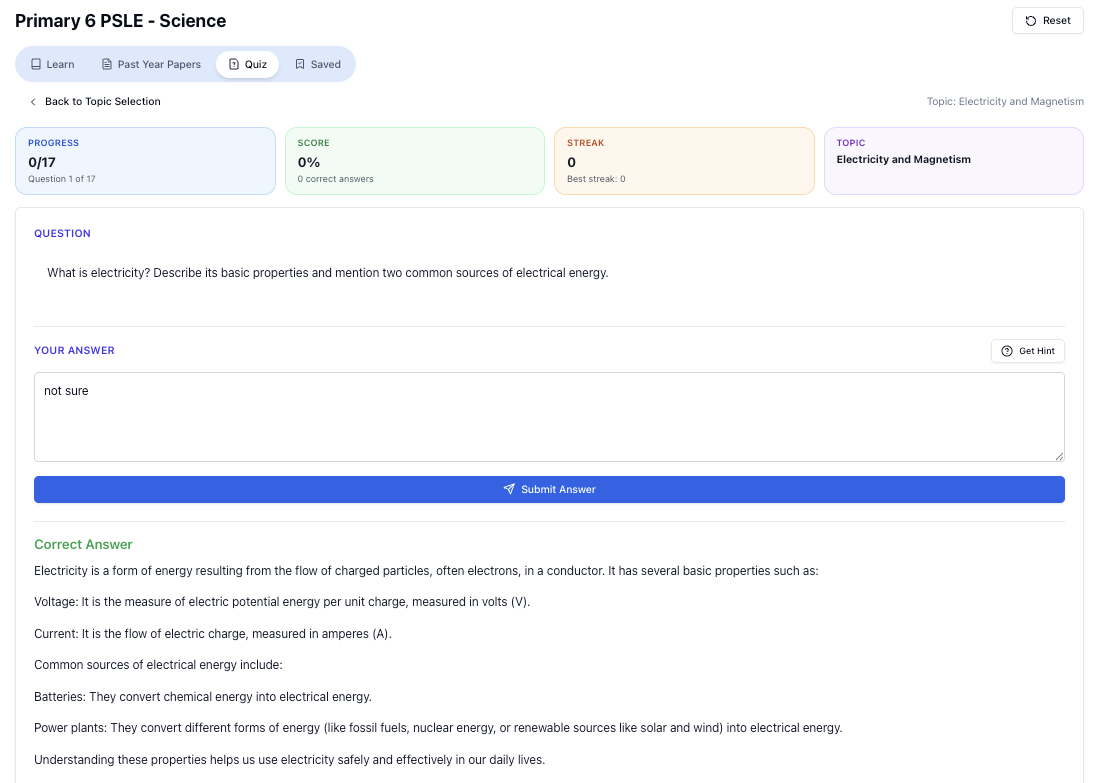
“Practice PSLE Science questions and get clear, step-by-step answers instantly.”
👉 Try a question now and see how fast you can improve.
Free on Tutorly.sg
Practise with step-by-step help — free to start
On Tutorly.sg/app you can practise unlimited Singapore syllabus questions, get instant explanations when you are stuck, and use past-year papers — no sign-up needed to start.
- ✓ PSLE, O Level, A Level, and more
- ✓ Step-by-step working when you are stuck
- ✓ Works on phone and laptop