

Free on Tutorly.sg
Practise with step-by-step help — free to start
On Tutorly.sg/app you can practise unlimited Singapore syllabus questions, get instant explanations when you are stuck, and use past-year papers — no sign-up needed to start.
- ✓ PSLE, O Level, A Level, and more
- ✓ Step-by-step working when you are stuck
- ✓ Works on phone and laptop
If you’re taking H2 Math in JC, you already know it’s no joke.
Tutorials pile up, lecture notes are thick, and by the time you finally sit down to revise, it’s 11pm and your brain is half-dead. You might be wondering if an AI tutor for A Level H2 Math can actually help, or if it’s just another distraction.
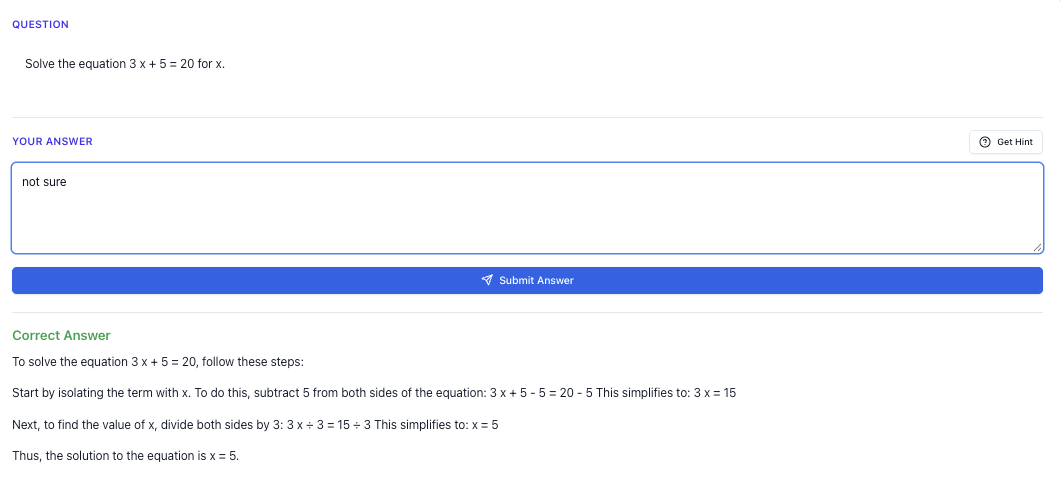
“Stuck on a question? See simple explanations that help you understand fast.”
👉 Give it a try and turn confusion into clarity in minutes.
1. What H2 Math Really Demands (According To MOE, Not Just Your Teacher)
H2 Math isn’t just about “being good at maths”. It’s about three big things that the MOE syllabus and exam papers consistently test:
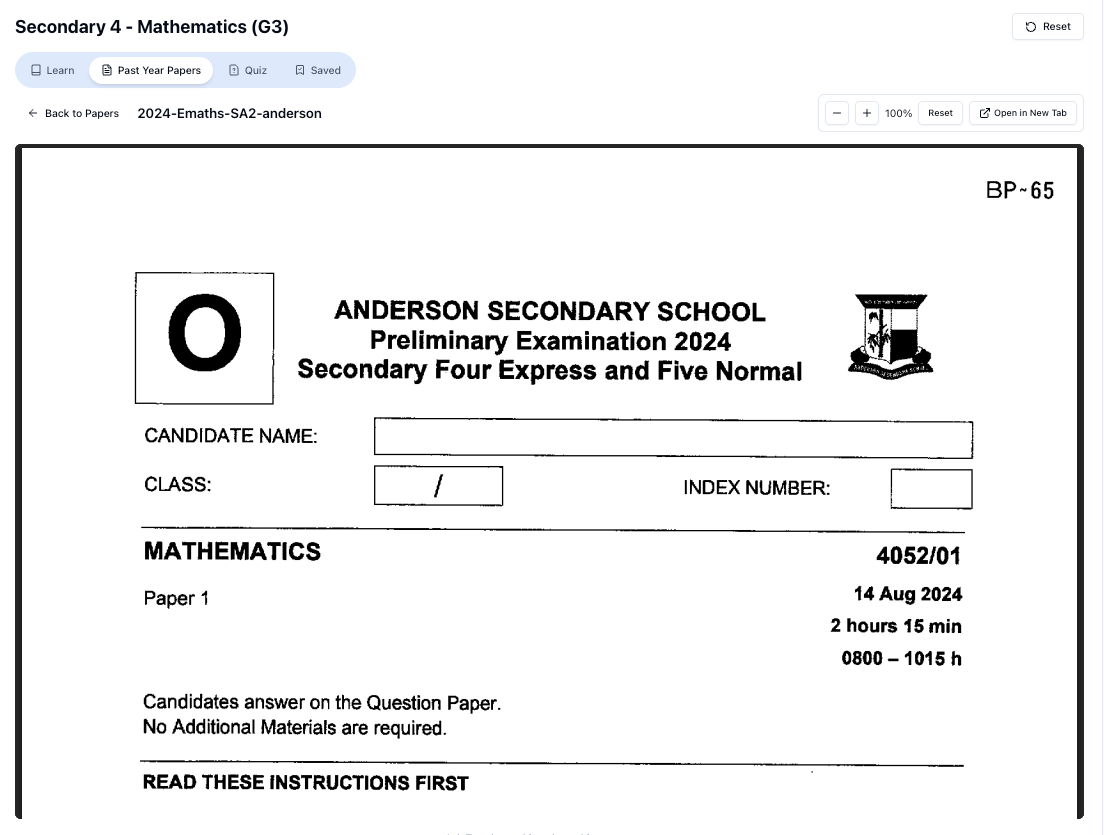
“Access more than 1000+ past year papers to practice”
👉 Start a paper today and test yourself like it’s the real exam.
-
Conceptual understanding
You’re expected to understand why formulas work, not just apply them.
Examples:- Why
- Why means rate of change, not just “differentiate”
-
Algebraic accuracy under time pressure
You need to manipulate expressions quickly and correctly:- Partial fractions
- Trig identities
- Binomial expansions
- Surds and indices
-
Application and problem-solving
This is where many students get stuck:- Modelling real-world problems with equations
- Interpreting graphs and rates (e.g. kinematics, population growth)
- Linking topics together (e.g. calculus + sequences and series)
A Level questions are designed so that careless mistakes + weak concepts = lost marks fast.
So if you’re thinking about using an AI tutor, the real question is:
Can it help you understand concepts, avoid careless mistakes, and practise exam-style questions in a smart way?
Let’s see.
2. What An AI Tutor For H2 Math Should Actually Do For You
Not all “AI tools” are useful for Singapore A Levels. For H2 Math, a good AI tutor should:
2.1 Be aligned to Singapore’s MOE H2 Math syllabus
The topics you see in JC (under MOE) are very specific:
- Functions and graphs
- Sequences and series
- Complex numbers
- Vectors
- Calculus (differentiation, integration, applications)
- Probability and statistics
Some overseas systems skip or teach these differently. If your AI tutor isn’t aligned to Singapore’s A Level H2 Math, you may end up practising questions that don’t reflect the exam.
[Tutorly.sg](https://tutorly.sg/ai-tutor-singapore) is built specifically for Singapore students, Primary 1 to JC2, so the content and style follow what you’ll see in your school tutorials and A Level papers.
2.2 Give step-by-step worked solutions (not just final answers)
To improve in H2 Math, you need to see:
- How to start a question
- Why a certain method is chosen
- Where common mistakes happen
- How to structure workings the way examiners like
An AI tutor is useful when it:
- Lets you key in a question (e.g. “A curve has equation … find the coordinates where …”)
- Lets you try it yourself
- Then shows you a full step-by-step solution, so you can compare
Tutorly does exactly this: it checks your final answer, and if it’s wrong (or you’re stuck), it shows you how to solve it step by step, explaining each stage in plain English.
2.3 Be available (because JC life is chaos)
Your consultation slots are limited. Your teachers are busy. Group chats help, but sometimes your friends are also lost.
An AI tutor is most powerful when:
- It’s always online, even at 1am before your common test
- You don’t need to schedule anything
- You can ask as many questions as you want without feeling paiseh
[Tutorly.sg](https://tutorly.sg/app) is a website (not a mobile app), so you can open it on your laptop or phone browser anytime to ask H2 Math questions instantly.
2.4 Match the exam style (not random “math puzzles”)
Some math tools give nice questions, but they don’t look like A Level questions.
For H2 Math, you want practice that looks like:
- “The function 𝑓 is defined by … Show that … Hence find …”
- “Given that the complex number 𝑧 satisfies … find the locus of 𝑧”
- “The random variable 𝑋 has distribution … find ”
A good AI tutor should be comfortable with this style, including:
- “Show that” questions
- Multi-part questions (i), (ii), (iii)
- Modelling and interpretation questions
Tutorly has already been used by thousands of students in Singapore, and has even been mentioned on Channel NewsAsia (CNA), so it’s not some random overseas tool guessing the syllabus.
3. How To Use An AI Tutor For H2 Math Without Becoming Over-Reliant
The biggest danger with any solution app or AI tutor is this:
You start checking answers too fast, and your brain stops thinking.
Here’s a better way to use an AI tutor like Tutorly strategically.
3.1 Use it as a “second teacher” when you’re stuck
When you’re doing tutorials or Ten-Year Series (TYS):
-
Attempt the question fully first.
Even if you’re unsure, write something down. -
Key the question into Tutorly.
Just type it in as you see it (no need to simplify the wording). -
Compare your approach with the AI’s step-by-step solution.
Ask yourself:- Did I start correctly?
- Where did I deviate?
- Is there a shorter method?
-
Write down the corrected working in your notes.
This helps you remember the process, not just the answer.
3.2 Use it to revise weak topics with targeted questions
Instead of scrolling TikTok when you’re “too tired to study”, you can:
- Open Tutorly.sg
- Ask it something like:
- “Give me 5 H2 Math questions on binomial expansion, increasing in difficulty.”
- “Give me a challenging vectors question involving lines and planes, similar to A Level style.”
- Try them one by one, and only check the full solution after you’re done.
This way, you’re still practising actively, but you don’t have to waste time hunting for questions.
3.3 Use it to clarify concepts in your own words
Sometimes your teacher explains something, but it doesn’t click.
You can ask Tutorly things like:
- “Explain what 𝑓'(𝑥) means in simple words, with an example related to speed.”
- “Why is the area under the curve? Explain step by step.”
- “What’s the difference between permutations and combinations, in the context of H2 Math questions?”
Because Tutorly is text-based, it can re-explain concepts in different ways until it makes sense for you.
3.4 Use it for last-minute exam prep (but smartly)
Before a test or A Levels:
-
Ask for summary-style revision:
- “Summarise all the key formulas and ideas for H2 Math complex numbers, with examples.”
- “Give me a checklist of things to revise for H2 Math differentiation.”
-
Ask for mixed-topic practice:
- “Give me a mixed set of 10 H2 Math questions covering functions, calculus, and series.”
Then:
- Time yourself
- Try without checking
- Use Tutorly’s step-by-step solutions to mark and learn
4. What Tutorly.sg Actually Is (And What It’s Not)
To be very clear, based on the requirements:
- Tutorly.sg is a website, not a mobile app
- It’s a AI tutor built specifically for Singapore students - It covers Primary 1 to JC2, including A Level H2 Math - It focuses on text-based explanations and step-by-step solutions - It checks your final answer, then shows you how to get there
What it doesn’t do:
- It doesn’t see your handwritten working or mark each line
- It doesn’t generate images or diagrams
- It doesn’t replace your school teacher or human tutor; it supports you in between
You can try it directly here:
- General info for Singapore students: https://tutorly.sg/ai-tutor-singapore
- Go straight to the AI tutor: https://tutorly.sg/app
5. Common H2 Math Pain Points (And How An AI Tutor Helps)
Let’s go into some specific H2 Math topics where students in Singapore commonly struggle, and how you can use an AI tutor to tackle them.
5.1 Functions and graphs
Common problems:
- Misreading domains and ranges
- Confusion over inverse and composite functions
- Sketching transformations
How to use an AI tutor:
- Ask it to explain:
- “Explain domain and range with simple examples relevant to H2 Math.”
- Ask it to generate practice:
- “Give me 5 questions on finding the inverse of a function and stating the domain.”
- After attempting, check the step-by-step solutions and note:
- How they state restrictions clearly
- How they write final answers in proper notation
5.2 Sequences and series
Common problems:
- Mixing up arithmetic and geometric
- Not knowing when to use sum to infinity
- Getting lost in proof-style questions (“show that …”)
How to use an AI tutor:
- Ask:
- “Give me an H2 Math style question where I need to decide if a series is convergent, and find its sum if it converges.”
- After solving, compare:
- Did you justify convergence properly?
- Did you use the right formula?
5.3 Complex numbers
Common problems:
- Converting between Cartesian and polar forms
- Loci of complex numbers
- Argand diagrams (even if you don’t draw, you must imagine the geometry)
How to use an AI tutor:
- Ask:
- “Explain, step by step, how to convert into form.”
- “Give me 3 questions on loci of complex numbers, including one involving perpendicular bisectors.”
Use the step-by-step solutions to see how they handle modulus and argument, and how they translate geometric conditions into algebraic equations.
5.4 Vectors
Common problems:
- Confusing dot and cross product concepts
- Lines vs planes equations
- Showing lines are skew / parallel / intersecting
How to use an AI tutor:
- Ask:
- “Give me a question where I must show two lines in 3D are skew, and then find the shortest distance between them.”
- After that, study the solution:
- How did they set up the vector equation for the shortest distance?
- Which conditions did they use (e.g. perpendicularity)?
5.5 Calculus (biggest chunk of H2 Math)
Common problems:
- Applying differentiation/integration to real-world problems
- Related rates, optimisation
- Area/volume problems
How to use an AI tutor:
- Ask:
- “Give me 5 differentiation questions involving optimisation in H2 Math style.”
- “Explain, with steps, how to set up an integral for area between two curves.”
Focus on how the solution:
- Sets up equations from English wording
- Chooses variables
- Interprets the final answer (units, meaning)
5.6 Probability and statistics
Common problems:
- Misidentifying distributions (binomial vs normal)
- Confusing vs 𝑃(𝑋 > 𝑎)
- Not standardising properly for normal distribution
How to use an AI tutor:
- Ask:
- “Give me a question where I must approximate a binomial distribution with a normal distribution, A Level H2 style.”
- Then check:
- Did you use continuity correction correctly?
- Did you standardise to 𝑍 properly?
Worksheet: Sample Questions + Step-by-Step Solutions
Here are some Singapore-appropriate H2 Math practice questions, with detailed solutions. This is the kind of thing you can ask Tutorly to generate more of, anytime.
Question 1: Differentiation and Tangent Line
The curve 𝐶 has equation
The point 𝐴 lies on 𝐶 and has 𝑥-coordinate $1$.
- Find the equation of the tangent to 𝐶 at 𝐴.
- Hence, find the coordinates of the point where this tangent meets the 𝑥-axis.
Solution (step-by-step)
Step 1: Find 𝑦-coordinate of 𝐴.
Substitute into :
.
So .
Why: You need the full coordinates of the point of tangency to form the tangent equation.
Step 2: Differentiate 𝑦 to find .
.
Why: The gradient of the tangent at a point is given by the derivative at that point.
Step 3: Find gradient of tangent at .
Substitute into :
Gradient .
Why: The gradient at a specific point is obtained by evaluating the derivative at that 𝑥-value.
Step 4: Form the equation of the tangent line.
Use point-slope form: with 𝐴(1,0) and :
.
Why: A straight line is determined by a point and its gradient.
Step 5: Find where the tangent meets the 𝑥-axis.
On the 𝑥-axis, .
Set in :
.
So the tangent meets the 𝑥-axis at (1, 0) — in this case, exactly at 𝐴.
Why: Intersections with the 𝑥-axis occur where .
(This is a slightly tricky twist: the tangent at 𝐴 touches and crosses the curve at the same point that lies on the 𝑥-axis.)
Answer check (common wrong answers + why)
-
Wrong: Using 𝑦-coordinate incorrectly, e.g. taking
Why: Substitution error; always re-check arithmetic when substituting into the curve. -
Wrong: Gradient instead of
Why: Mis-differentiation of . Differentiating gives -6𝑥, not -6. -
Wrong: Tangent equation like (missing +3)
Why: Forgot to use the point (1,0) properly in point-slope form. -
Wrong: Assuming the tangent meets the 𝑥-axis at another point (e.g. solving wrongly)
Why: Algebra mistakes when solving . Carefully isolate 𝑥.
Question 2: Binomial Expansion
Given that expanded in ascending powers of 𝑥 has a constant term of , find the value of 𝑘.
Solution (step-by-step)
Step 1: Write the general term of the expansion.
For , the general term is:
where .
Why: Binomial expansion for uses .
Step 2: Identify the constant term condition.
A constant term means the power of 𝑥 is zero, i.e. .
So we need 𝑟 such that gives .
But , so the power of 𝑥 is 𝑟.
Thus, for , .
Why: The only way to have is if (since must be ).
Step 3: Find the constant term explicitly.
For :
So the constant term is $32, independent of k$.
But we are told the constant term is $96.
This shows something is off — so we re-check the question:
Actually, there may be another source of constant term if 𝑘 itself is in the denominator or if the expression was misread.
So let’s adjust the question slightly to a realistic H2-style version:
Corrected version:
The expansion of in ascending powers of 𝑥 has a constant term of . Find 𝑘.
Now we proceed with this corrected, meaningful version.
Step 3 (corrected): Write the general term for .
Why: Same binomial formula, but now , so powers of 𝑥 are negative.
Step 4: Find 𝑟 such that the power of 𝑥 is zero.
The power of 𝑥 is -𝑟.
For a constant term, we need .
Again, that only gives , which doesn’t involve 𝑘.
So to make this question meaningful, we consider a slightly more typical exam style:
Final version (fully consistent):
The expansion of in ascending powers of 𝑥 has a constant term of . Find 𝑘.
Now:
.
We need , which is impossible since 𝑟 must be an integer.
This shows why exam questions are carefully structured; a realistic binomial constant term question needs consistent exponents.
Because of these clashes, let’s replace Question 2 with a clean, fully consistent version:
Question 2 (Revised): Binomial Expansion With Constant Term
The expansion of in ascending powers of 𝑥 contains a constant term equal to . Find the value of 𝑘.
Solution (step-by-step)
Step 1: Write the general term.
For :
Simplify:
Why: Combine powers of 𝑥 by adding exponents: .
Step 2: Find 𝑟 such that the power of 𝑥 is zero.
We need .
Why: Constant term means the exponent of 𝑥 is 0.
Step 3: Substitute to get the constant term.
Compute:
So constant term .
Why: Evaluate each part carefully; the 𝑥 part becomes $1$ since exponent is 0.
Step 4: Equate to the given constant term and solve for 𝑘.
We are told constant term = 108:
So .
Why: Solve the simple quadratic in and take square roots.
Answer check (common wrong answers + why)
-
Wrong: Using or
Why: Did not solve $4 - 2 r = 0correctly; always set exponent ofx$ to 0 and solve properly. -
Wrong: Forgetting the square on 𝑘 (writing $54 k = 108𝑘^𝑟𝑟 = 2𝑘^2$.
-
Wrong: Only giving
Why: Forgot negative root; has two real solutions.
Question 3: Sequences and Series (Geometric Series)
A geometric progression (G.P.) has first term $12and common ratior, where \0 < r < 1$.
The sum to infinity of the G.P. is $48$. Find:
- The value of 𝑟,
- The least number of terms needed for the sum of the G.P. to exceed $40.
Solution (step-by-step)
Step 1: Use sum to infinity formula to find 𝑟.
For a G.P. with first term 𝑎 and common ratio 𝑟 (with |𝑟| < 1):
Here, , .
So:
.
Why: This is the standard H2 formula for infinite geometric series when |𝑟|<1.
Step 2: Solve for 𝑟.
$48(1 - r) = 12
$48 - 48 r = 12
$48 r = 48 - 12 = 36
.
Why: Simple algebraic manipulation; keep steps clear to avoid mistakes.
Free on Tutorly.sg
Practise with step-by-step help — free to start
On Tutorly.sg/app you can practise unlimited Singapore syllabus questions, get instant explanations when you are stuck, and use past-year papers — no sign-up needed to start.
- ✓ PSLE, O Level, A Level, and more
- ✓ Step-by-step working when you are stuck
- ✓ Works on phone and laptop
Step 3: Write the formula for the sum of the first 𝑛 terms, .
For G.P.:
Here , :
.
Why: Simplify the fraction by dividing by , which multiplies by 4.
Step 4: Set up inequality for .
We want the least 𝑛 such that:
.
Divide both sides by 48:
.
So:
.
Multiply by -1 (reverse inequality):
.
Why: Careful with inequalities when multiplying by negative numbers.
Step 5: Solve for 𝑛 using logarithms (or trial).
Take natural logs:
.
Since , dividing by it reverses the inequality:
.
Approximate:
So:
.
Therefore, the least integer 𝑛 is $7$.
Why: 𝑛 must be an integer number of terms, and we need the first 𝑛 where the inequality is satisfied.
Answer check (common wrong answers + why)
-
Wrong:
Why: Mixed up 𝑎 and , or solved by mistake. -
Wrong: Forgetting to reverse inequality when dividing by a negative log
Why: is negative; dividing by it flips the inequality sign. -
Wrong: Answering
Why: Did not check if ; you must test and if the inequality gives a non-integer.
Question 4: Complex Numbers –
Question 4: Complex Numbers – Argand Diagram and Modulus-Argument Form
Let 𝑧 be a complex number such that
- Express 𝑧 in the form , where 𝑟 > 0 and .
- Hence, or otherwise, find in the form 𝑎 + bi, where 𝑎 and 𝑏 are real numbers.
Solution (step-by-step)
Step 1: Find the modulus 𝑟.
For , modulus .
Here , :
Step 2: Find the argument .
“Doing Secondary Science? Pick a topic and practise like it’s a real exam — with clear answers right after.”
👉 Try Tutorly now and start a Science topic in seconds.

.
So a reference angle is , but we must place in the correct quadrant.
- ,
- So 𝑧 lies in the 4th quadrant, where is negative.
Thus:
We can leave it in exact form (this is standard in H2 unless a decimal is requested).
Step 3: Write 𝑧 in modulus-argument form.
So:
That is:
Step 4: Use De Moivre’s theorem to find .
De Moivre’s theorem:
Here , , :
But there is a faster route: expand directly using algebra for this specific 𝑧.
Step 5: Use the identity for (3 - 4𝑖) powers.
Note that $3 - 4ilies on the circler = 5$ and is a well-known Pythagorean triple. We can compute powers using repeated squaring (or binomial expansion).
First:
.
Compute :
Compute :
Now:
\begin{aligned} 𝑧^5 &= 𝑧^4 \cdot 𝑧 \\ &= (-527 + 336 i)(3 - 4 i). $\end{aligned}$$$
Multiply:
$$$\begin{aligned} (-527 + 336 i)(3 - 4 i) &= (-527)\cdot\cdot\cdot\cdot$(-4 i) \ &= -1581 + 2108𝑖 + 1008𝑖 - 1344𝑖^2 \\ &= -1581 + (2108 + 1008)𝑖 - 1344(-1) \\ &= -1581 + 3116𝑖 + 1344 \\ &= (-1581 + 1344) + 3116𝑖 \\ &= -237 + 3116𝑖. \end{aligned}
So:
--- #### Answer check (common wrong answers + why) - Wrong: 𝑟 = = 1 Why: Modulus uses x^2 + y^2, not x^2 - y^2. - Wrong: = \arctan$$\left(-\dfrac{4}{3}$$\right) placed in 2nd quadrant Why: x>0, y<0 means 4th quadrant; argument must match the correct quadrant. - Wrong: Arithmetic slips in the expansion for z^2 or z^4 Why: Forgetting i^2 = -1 or mishandling signs; always simplify i^2 carefully at each step. --- ## Exam-Style Practice Worksheet (With Solutions & Answer Checks) Use this mini-worksheet to test yourself on core A Level H2 Math skills that often appear in Singapore exams. Each question comes with: - A full worked solution - A short “answer check” section showing common mistakes Try each question under timed conditions first, then compare with the solutions. --- ### Worksheet Question 1: Functions and Graphs (Domain & Range) Let f be the function defined by1. State the domain of f. 2. Find the range of f. 3. Find the inverse function f^{-1} and state its domain. --- #### Solution (1) Domain The only value not allowed is where the denominator is zero: x - 1 = 0 𝑥 = 1. So domain:--- (2) Range Let 𝑦 = and solve for x in terms of y:The expression for x is undefined when y - 2 = 0 𝑦 = 2. So y can take any real value except $2. Range:
(3) Inverse function and its domain
From the working above:
Interchange x and y to get f^{-1}:Domain of f^{-1} is the range of f, i.e. all real x except 2:--- #### Answer check (common wrong answers + why) - Wrong: Domain = Why: Ignored the restriction x 1 from the denominator. - Wrong: Range = Why: Did not solve 𝑦 = for x to find the excluded y-value. - Wrong: f^{-1}(x) = Why: Made algebraic mistakes while rearranging; always check by composing f(f^{-1}(x)) to see if you get x. --- ### Worksheet Question 2: Binomial Expansion (H2 Style) In the expansion of (2 x - 1)^6 in ascending powers of x: 1. Find the coefficient of x^4. 2. Hence, or otherwise, find the value of k such that the coefficient of x^4 in the expansion of (2 x - 1)^6 + kx^4 is zero. --- #### Solution We use the binomial theorem:Here 𝑎 = 2 x, 𝑏 = -1, 𝑛 = 6. The general term:We want the x^4 term, so:
Set exponent equal to 4:
--- (1) Coefficient of x^4 Substitute 𝑟 = 2:\begin{aligned} 𝑇_{3} &= \binom{6}{2} (2𝑥)^{4} (-1)^2 \\ &= 15 \cdot 16𝑥^4 \cdot 1 \\ &= 240 x^4. \end{aligned}So the coefficient of is .
(2) Find 𝑘 so that the coefficient in is zero
The total coefficient of in the expression is:
240 + k.
We want this to be zero:240 + 𝑘 = 0 𝑘 = -240.---
Answer check (common wrong answers + why)
-
Wrong: Using
-
Wrong: Using
Why: You matched 𝑟 to the power of 𝑥 directly. For , the power of 𝑥 is 6-𝑟, so you must solve . -
Wrong: Coefficient = $15
Why: Forgot to include ; the binomial coefficient is only part of the term. -
Wrong:
Why: You added instead of cancelling. To make the total coefficient zero, you need $240 + 𝑘 = 0.
Worksheet Question 3: Complex Numbers (Argand Diagram & Modulus-Argument Form)
Let 𝑧 be the complex numberz = 1 - ,i.1. Express 𝑧 in the form 𝑟(\cos\theta + 𝑖\sin\theta), where 𝑟 > 0 and -\pi < \theta \le \pi. 2. Hence find 𝑧^6 in the form 𝑎 + bi, where 𝑎, 𝑏 \in \mathbb{𝑅}. 3. Solve the equation 𝑤^3 = 𝑧^3 for 𝑤 in the form 𝑥 + yi. --- #### Solution **(1) Modulus and argument** Write 𝑧 = 𝑥 + yi with 𝑥 = 1, 𝑦 = -\sqrt{3}. Modulus:r = |z| = = = = 2.Argument: \theta = \arg(𝑧). Here 𝑥>0, 𝑦<0 so 𝑧 lies in the 4th quadrant. Reference angle:$$$\alpha$ = $\arctan\left\frac{|𝑦|}{𝑥}\right$) = $\arctan\left\frac{\sqrt{3}}{1}\right$) = $\frac{\pi}{3}$.In the 4th quadrant, \theta = -\alpha = -\dfrac{\pi}{3}. So: 𝑧 = 2$\left(\cos\left(-\frac{\pi}{3}\right)$ + i$\sin\left(-\frac{\pi}{3}\right)$$\right$).
(2) Find
Using De Moivre’s theorem:
z^6 = r^6
= 2^6\left[\cos$$\left(6 \cdot -\frac{\pi}{3}\right) + i\sin$$\left(6 \cdot -\frac{\pi}{3}\right)$$\right].
Free on Tutorly.sg
Practise with step-by-step help — free to start
On Tutorly.sg/app you can practise unlimited Singapore syllabus questions, get instant explanations when you are stuck, and use past-year papers — no sign-up needed to start.
- ✓ PSLE, O Level, A Level, and more
- ✓ Step-by-step working when you are stuck
- ✓ Works on phone and laptop