

Free on Tutorly.sg
Practise with step-by-step help — free to start
On Tutorly.sg/app you can practise unlimited Singapore syllabus questions, get instant explanations when you are stuck, and use past-year papers — no sign-up needed to start.
- ✓ PSLE, O Level, A Level, and more
- ✓ Step-by-step working when you are stuck
- ✓ Works on phone and laptop
If you’re taking O-Level A Math in Singapore, you’ve probably heard people say:
“Just go ACC lah, the teacher very good one.”
“Stuck on a question? See simple explanations that help you understand fast.”
👉 Give it a try and turn confusion into clarity in minutes.
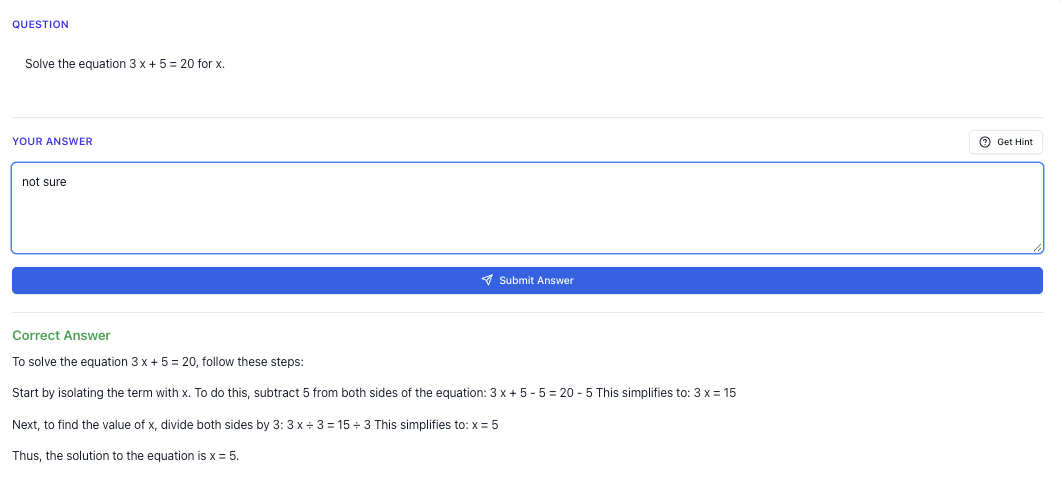
ACC tuition centres are popular for A Math because they’re structured, fast-paced, and very exam-focused. But here’s the honest truth: just sitting in ACC class every week is not enough to secure that A 1.
You need:
- A clear step-by-step way to learn each topic
- A solid exam strategy
- Lots of targeted worksheet practice (including hard variants)
- A way to get help any time, not just once a week in class
That’s where a mix of ACC tuition + smart self-study + support from an AI tutor like Tutorly.sg can really make the difference.
Tutorly.sg is a AI tutor website built specifically for Singapore students, aligned to the MOE syllabus. It’s been mentioned on Channel NewsAsia (CNA) and has already been used by thousands of students in Singapore to get instant help with A Math questions, even at 11.45pm the night before a test.
In this guide, I’ll walk you through:
- How to use ACC tuition effectively (not just passively attend)
- A step-by-step way to tackle O-Level A Math topics
- Exam strategies that actually work for the O-Level paper
- How to design your own worksheet practice, including hard variants
- The most common A Math mistakes I see as a tutor (and how to avoid them)
Throughout, I’ll show you how to plug Tutorly into your routine so you’re not stuck waiting till the next ACC class to clear doubts.
Step-by-step tutorial
Let’s build a practical, topic-by-topic approach that fits with how ACC tuition usually runs in Singapore.
I’ll use three core A Math topics as examples:
- Quadratic functions and graphs
- Trigonometry (identities and equations)
- Differentiation (and applications)
You can apply the same structure to other topics like indices & surds, AP/GP, binomial theorem, and so on.
1. Quadratic functions: from basics to graph sketching
Step 1: Get fluent with forms of quadratics
You must be comfortable switching between:
- General form:
- Factorised form:
- Completed square (vertex) form:
In ACC class, your tutor will usually run through a few examples quickly. After class, this is how you can reinforce it on your own:
- Take a random quadratic, e.g.
- Factorise it
- Then complete the square
- Then compare: what do you “see” more easily in each form?
- Roots are clear in factorised form
- Turning point is clear in completed square form
- 𝑐 is the y-intercept in general form
Use Tutorly.sg to generate more practice:
“Give me 10 O-Level standard A Math questions converting quadratics between general, factorised and completed square form, with answers.”
Then try them, and when you’re stuck, ask Tutorly to show you step-by-step how to get the answer.
Step 2: Connect algebra to the graph
Your ACC teacher will probably say things like “𝑎 > 0 opens upwards” and “𝑘 is the maximum/minimum value”. Don’t just memorise — link it to what you write in exams.
For example, for :
- Turning point: (3, 5)
- Minimum value: (since 𝑎 > 0)
- Axis of symmetry:
Practice writing full sentences like you would in Paper 2:
“The graph of has a minimum value of 5 at .”
Then push yourself with slightly harder variants:
“The graph of has a maximum value of 9 at and passes through (0, 1). Find 𝑎, 𝑏, 𝑐.”
Try first, then use Tutorly to check your final answer and see a full worked solution.
Step 3: Word problems involving quadratics
This is where many students who rely only on ACC worksheets struggle. The teacher goes through it once; you understand it in class; then a week later, you forget.
Create a mini-routine for word problems:
- Identify the variable clearly: “Let 𝑥 be the length of …”
- Write expressions for area, perimeter, cost, etc.
- Form the quadratic equation
- Solve, then reject invalid answers (negative length, etc.)
Example:
The length of a rectangle is (𝑥 + 3) cm and the breadth is (𝑥 - 2) cm. Its area is .
(a) Form a quadratic equation in 𝑥.
(b) Find the possible values of 𝑥.
(c) Hence find the dimensions of the rectangle.
After you try it, ask Tutorly:
“Explain step-by-step how to solve this A Math quadratic word problem and how to decide which value of 𝑥 to reject.”
This way, you aren’t waiting till the next ACC lesson when you’ve already forgotten the question.
2. Trigonometry: identities and equations
Trigo is one of the biggest pain points for O-Level A Math students in Singapore, even with tuition.
Let’s break it down.
Step 1: Core identities you must know
You must memorise and know how to use these:
- \sin 2 x = 2\sin x \cos x
- \cos 2 x = \cos^2 x - \sin^2 𝑥 = 2\cos^2 x - 1 = 1 - 2\sin^2 x
Don’t just stare at them. Practise converting:
Convert everything to and and simplify.
Example:
Use :
After doing a few, ask Tutorly:
“Give me 15 A Math trigonometric identity questions at O-Level standard, mixed difficulty, with worked solutions.”
This gives you extra practice beyond your ACC worksheet.
Step 2: Solving trig equations in
Most students mess up here because they don’t have a system.
Use this 4-step approach:
-
Isolate the trig term
- e.g.
-
Find the reference angle
-
Decide which quadrants based on sign
- For , use Quadrant I and II
-
Generate all solutions in the interval
For harder equations:
Convert :
2(1 - \sin^2 x) - 3\sin 𝑥 = 0 \ 2 - 2\sin^2 x - 3\sin 𝑥 = 0 \ 2\sin^2 x + 3\sin x - 2 = 0
Let :
Solve for 𝑦, then find 𝑥.
When you’re stuck, don’t just look at the answer key. Use Tutorly to walk through:
“Show me step-by-step how to solve for .”
This is exactly the kind of question that appears as a 4–5 mark part in O-Level Paper 2.
3. Differentiation: from basics to applications
Differentiation is a major topic, and ACC tuition usually spends many weeks on it. To make that time count, you should split your learning into:
- Rules
- Skills
- Applications (tangents, normals, rates of change, maxima/minima)
Step 1: Nail the basic rules
You should be able to differentiate quickly:
- (constant)
- Polynomials term by term
And also:
Use Tutorly to drill:
“Give me 20 quick-fire differentiation questions (no word problems) for O-Level A Math, with answers only.”
Time yourself to build speed.
Step 2: Tangent and normal lines
A very exam-friendly structure:
- Differentiate to get
- Substitute 𝑥 (or the point) to find gradient at that point
- Use to form the equation of the tangent
- For normal, use
Example:
The curve cuts the x-axis at 𝐴 and 𝐵.
(a) Find the coordinates of 𝐴 and 𝐵.
(b) Find the gradient of the curve at 𝐴.
(c) Find the equation of the normal to the curve at 𝐴.
Try it yourself, then ask Tutorly to show full working. Pay attention to how each mark is earned — this matches O-Level marking schemes closely.
Step 3: Maxima, minima, and word problems
This is where many ACC students lose marks because they rely too much on the tutor’s worked examples and not enough on independent practice.
Standard process:
- Express the quantity to be maximised/minimised (area, volume, cost, etc.) in terms of one variable
- Differentiate and set
- Solve for 𝑥
- Use second derivative or sign change to confirm max/min
- Answer the question in context (with units)
Example structure:
“A rectangular field of fixed perimeter is to be fenced. Show that the area is maximised when it is a square.”
Even if your ACC teacher covered something similar, you need to try new variants on your own. Use Tutorly to generate:
“Create 10 O-Level A Math differentiation word problems involving maxima/minima, at mixed difficulty, with full solutions.”
Work through them over a week. This is how you turn tuition content into exam-ready skills.
Exam strategy guide
O-Level A Math is not just about knowing how to do questions. It’s about doing the right things in the right order under time pressure.
“Access more than 1000+ past year papers to practice”
👉 Start a paper today and test yourself like it’s the real exam.
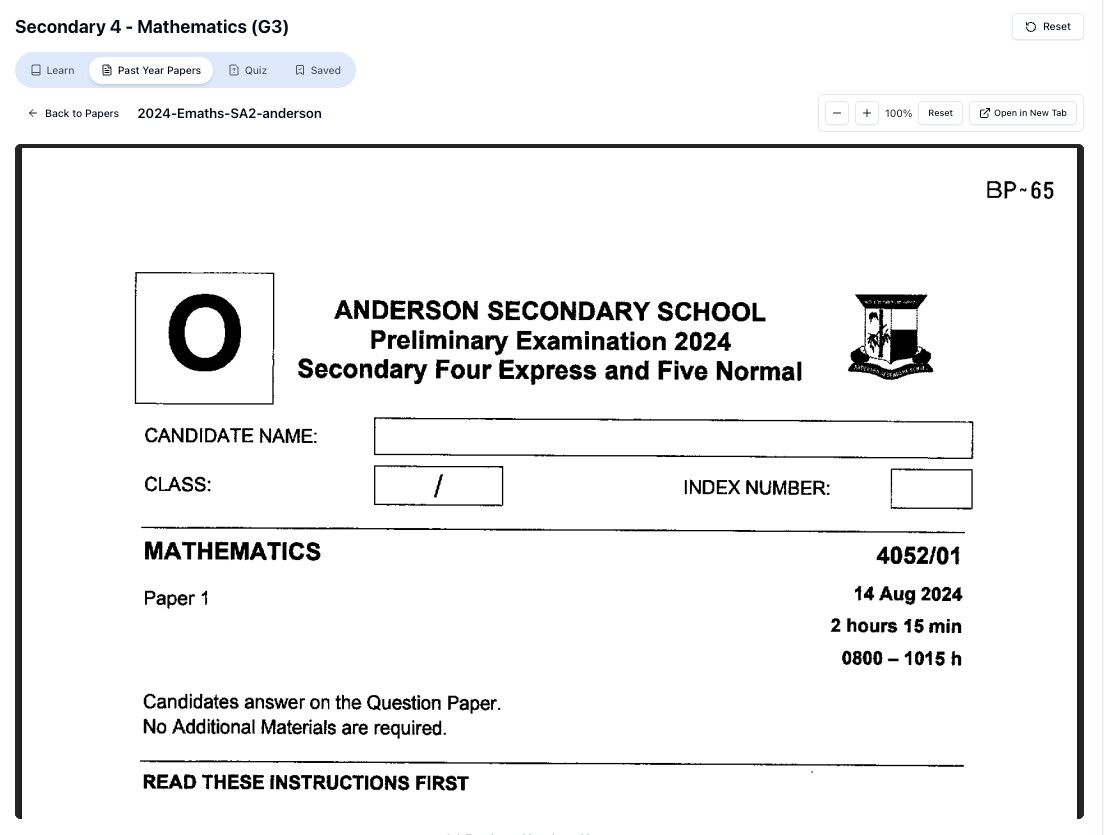
Here’s a practical strategy specific to the Singapore O-Level A Math papers.
1. Know the paper structure and mark weightage
Currently, O-Level A Math has:
- Paper 1: Shorter questions, no graph paper, usually more straightforward
- Paper 2: Longer, structured questions, often with graphs and word problems
Your ACC tuition teacher may already drill you with past-year papers, but you should also:
- Time yourself doing full papers from TYS (Ten-Year Series)
- Use Tutorly to check answers and understand the steps you missed
For example, after finishing a TYS paper, you can ask:
“Explain why my answer to this O-Level A Math question is wrong: [paste question and your final answer]. Show me the correct solution.”
This is much faster than waiting a week for your tuition teacher to go through it.
Free on Tutorly.sg
Practise with step-by-step help — free to start
On Tutorly.sg/app you can practise unlimited Singapore syllabus questions, get instant explanations when you are stuck, and use past-year papers — no sign-up needed to start.
- ✓ PSLE, O Level, A Level, and more
- ✓ Step-by-step working when you are stuck
- ✓ Works on phone and laptop
2. Question selection and time management
Many students try to do the paper from Q 1 to the end, no matter what. That’s risky.
A better approach:
-
First pass (fast scan)
- Quickly flip through the paper
- Circle questions that look “doable”
- Put a small “?” beside those that look long or unfamiliar
-
Second pass (secure marks)
- Start with the questions you circled as doable
- Aim to secure all the “sure marks” first
-
Third pass (tackle harder ones)
- Now attempt the remaining questions
- Even if you can’t finish, write something: sometimes 1–2 method marks can make a grade difference
Use a rough time rule:
- For a 2-hour paper with 80 marks, that’s 1.5 minutes per mark
- A 6-mark question should not take more than ~9 minutes
When you’re practising at home (with ACC worksheets or TYS), use your phone timer and train this sense of timing.
3. Show working the way markers expect
In Singapore, O-Level A Math marking schemes are quite consistent. You get method marks for:
- Correct substitution
- Correct algebraic manipulation
- Using correct formulae (e.g. quadratic formula, differentiation, etc.)
- Clear use of identities in trigo
So even if you’re not 100% sure, write your method.
Example:
Instead of writing:
Write:
or
This way, even if you miscopy a number, you may still get method marks.
When you use Tutorly, pay attention to how each step is laid out. Try to imitate that structure in your own working.
4. Use your ACC tuition wisely before exams
Most ACC centres will:
- Do revision by topic
- Then do mock papers
- Then go through corrections in class
To make the most of it:
-
Before class:
- Quickly skim your school notes or ACC summary for that topic
- Attempt 3–5 basic questions so you’re warmed up
-
During class:
- Actively annotate your notes: write down “why” steps, not just answers
- Star any question you couldn’t follow fully
-
After class (same day if possible):
- Re-do at least 2–3 of the harder questions without looking
- For any stuck point, paste the question into Tutorly and ask for a step-by-step explanation
This closes the gap between “I understood it in class” and “I can do it alone in the exam”.
Worksheet practice
To master A Math, you need deliberate practice, not just random questions. Let’s structure it into:
- Core practice (standard exam-style)
- Hard variants (stretch your thinking)
- Mixed-topic sets (simulate exam conditions)
You can use ACC worksheets, school homework, TYS, and Tutorly-generated questions together.
1. Core practice: build a strong base
For each topic, aim for:
- 20–30 standard questions
- Spread over 3–4 days (not all in one night)
Example: Quadratics – Standard Practice
Try questions like:
- Solve .
- Express in the form .
- The curve has a minimum value. Find this minimum value and the corresponding value of 𝑥.
- A rectangle has length (𝑥 + 2) cm and breadth (𝑥 - 1) cm. Its area is . Find the possible values of 𝑥.
Ask Tutorly:
“Generate 15 standard O-Level A Math quadratic questions with full solutions so I can practise.”
Do them without looking at solutions first, then check and learn from mistakes.
2. Hard exam variants (this is where A 1 s are made)
Hard variants are not impossible questions. They’re usually:
- Multi-step
- Involve more than one concept
- Or require you to form an equation yourself
Here are some example hard variants you can try.
Hard Variant 1: Quadratics & graphs
The graph of passes through the points (1, 6) and (3, 10).
(a) Find the values of 𝑏 and 𝑐.
(b) Hence, find the coordinates of the turning point of the graph.
(c) State whether the turning point is a maximum or minimum.
This tests:
- Substitution into a quadratic
- Solving simultaneous equations
- Completing the square or using
Try it, then ask Tutorly to show full working.
Hard Variant 2: Trig equation with identity
Solve, for ,
Hint: Use \sin 2 x = 2\sin x \cos x.
This becomes:
2\sin x \cos 𝑥 = \cos x
Factorise and consider cases (including when ).
Hard Variant 3: Differentiation & context
A rectangular piece of card is 20 cm long and 𝑥 cm wide, where 𝑥 < 10. Squares of side 𝑥 cm are cut from each corner and the sides are folded up to form an open box.
(a) Show that the volume 𝑉 of the box is given by .
(b) Find the value of 𝑥 for which 𝑉 is stationary.
(c) Determine whether this stationary value is a maximum or minimum.
(d) Find the maximum volume of the box.
This is very similar to what can appear in O-Level Paper 2 as a 10–12 mark question.
“Doing Secondary Science? Pick a topic and practise like it’s a real exam — with clear answers right after.”
👉 Try Tutorly now and start a Science topic in seconds.

You can ask Tutorly:
“Give me 5 more O-Level A Math differentiation word problems similar to this box question, with full solutions.”
3. Mixed-topic sets (simulate exam conditions)
Closer to exams (or class tests), start doing mixed-topic worksheets:
- 3–4 questions on quadratics
- 3–4 on trigo
- 3–4 on differentiation
- 2–3 on other topics (binomial, AP/GP, etc.)
You can create your own using Tutorly:
“Create a 1-hour O-Level A Math practice paper with 12–15 questions, mixed topics (quadratics, trigo, differentiation, binomial, AP/GP), with marks indicated and full solutions.”
Print or copy them into your notebook, set a timer, and do them like a real exam. After that, mark your own work using the solutions and ask Tutorly to explain any step you don’t understand.
4. How to review your worksheets effectively
Don’t just finish a worksheet and throw it aside.
For every practice set (ACC worksheet, school homework, or Tutorly-generated):
-
Circle every question you got wrong or guessed
-
Classify the mistake:
- Conceptual (don’t understand the idea)
- Careless (sign error, copying mistake)
- Misread question
-
For conceptual mistakes, ask Tutorly:
“Explain this concept to me simply and give me 3 similar questions: [paste question].”
-
For careless mistakes, write a short note:
“Check signs when expanding.”
“Re-read range: .”
Over time, you’ll see patterns — maybe you always slip up in trigo equations, or you always forget to reject negative lengths. That’s exactly what you need to fix before O-Levels.
Common mistakes
Here are the most common A Math mistakes I see from Singapore students, including those who attend ACC tuition regularly.
1. Memorising without understanding
Example: You memorise “use \sin 2 x = 2\sin x \cos x” but don’t know why or when to use it.
Fix:
- After your ACC teacher or Tutorly shows a solution, ask yourself:
“Why did they choose this identity or method?”
- Try to explain it in your own words, even if it’s just in your notebook.
2. Not writing enough working
Some students think, “If I’m not sure, better not write anything.” That’s the opposite of what you should do.
In O-Level A Math, markers often give:
- 1–2 marks for correct method
- 1–2 marks for correct substitution
- 1–2 marks for final answer
So even if your final answer is wrong, you can still earn method marks.
Fix:
- Train yourself to always write the key formula or identity you’re using.
- Look at Tutorly’s step-by-step solutions and copy that style.
3. Messy algebra
You can understand the concept perfectly but still lose marks because of:
- Sign errors
- Wrong expansion
- Mis-cancelling terms
Fix:
- Slow down slightly on algebra steps.
- Do a few “algebra-only” drills with Tutorly:
“Give me 15 algebra simplification questions at O-Level A Math standard (including fractions, indices, surds), with answers.”
Strong algebra makes every other topic easier.
4. Ignoring the domain / range of answers
Classic example: solving trig equations and writing answers beyond , or forgetting to restrict to .
Or in word problems, keeping negative lengths or times.
Fix:
- Underline the range in the question.
- Get into the habit of checking:
Try Tutorly.sg (Singapore)
Start here: AI Tutor Singapore
Try Tutorly on the website (no sign-up): https://tutorly.sg/app
“Practice PSLE Science questions and get clear, step-by-step answers instantly.”
👉 Try a question now and see how fast you can improve.
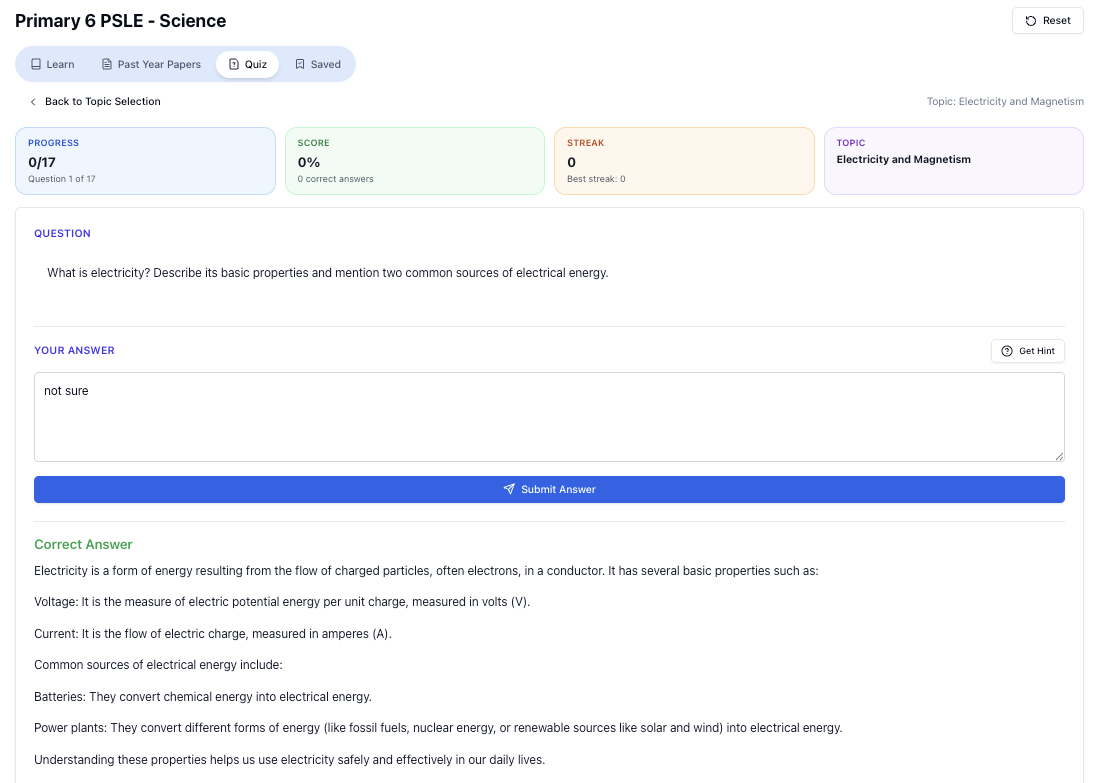
Ready to practise?
If you want a Singapore-focused AI tutor you can use immediately (website, no sign-up), try Tutorly here:
Related Articles
Free on Tutorly.sg
Practise with step-by-step help — free to start
On Tutorly.sg/app you can practise unlimited Singapore syllabus questions, get instant explanations when you are stuck, and use past-year papers — no sign-up needed to start.
- ✓ PSLE, O Level, A Level, and more
- ✓ Step-by-step working when you are stuck
- ✓ Works on phone and laptop