

Free on Tutorly.sg
Practise Vectors with step-by-step help — free to start
On Tutorly.sg/app you can practise unlimited Singapore syllabus questions, get instant explanations when you are stuck, and use past-year papers — no sign-up needed to start.
- ✓ PSLE, O Level, A Level, and more
- ✓ Step-by-step working when you are stuck
- ✓ Works on phone and laptop
Quick answer
You know vectors can be tricky, especially when your mind goes blank during exams. You might lose marks even though you understand the concepts because of small mistakes. In this guide, I'll show you common pitfalls and how to avoid them, so you'll walk into your A Level exam with confidence.
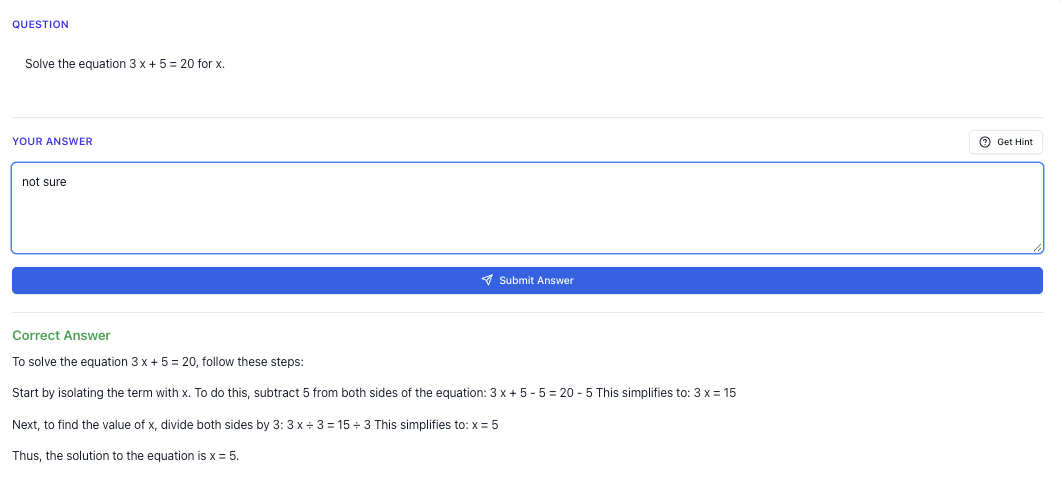
“Stuck on a question? See simple explanations that help you understand fast.”
👉 Give it a try and turn confusion into clarity in minutes.
What you need to know
Vectors are mathematical objects with both a magnitude (size) and a direction. They're often represented as arrows in diagrams or as coordinates like (𝑥, 𝑦, 𝑧). In your exams, you'll need to understand operations like addition, subtraction, dot product, and cross product of vectors. You'll also solve problems involving lines and planes in three-dimensional space.
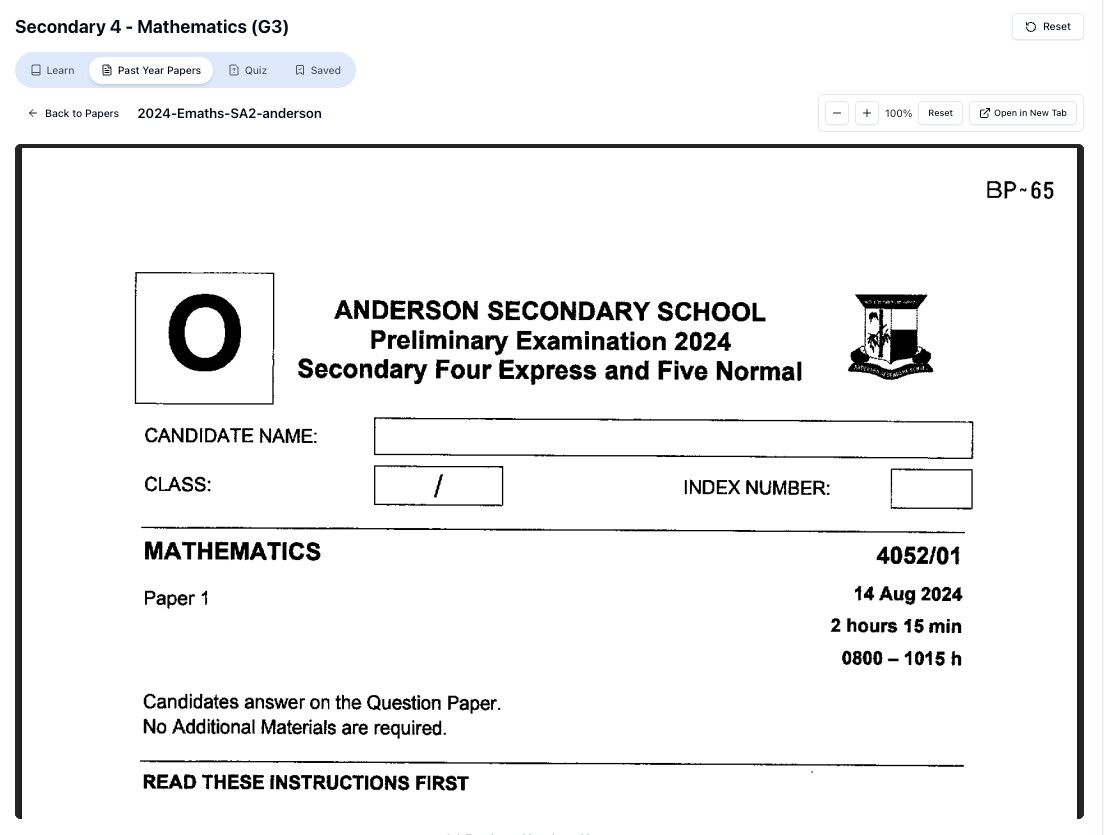
“Access more than 1000+ past year papers to practice”
👉 Start a paper today and test yourself like it’s the real exam.
Quick check
Before we dive into the common mistakes, try these quick questions to see where you stand:
- If and , find .
- What's the dot product of and ?
- Determine if the vectors and are parallel.
Answers:
- (3, 3, 1)
- $12
- Yes, they are parallel.
Common mistakes students make
-
Rushing algebra steps: Many students lose marks here. When multiplying or adding vectors, ensure each component is handled correctly. Slow down and check each step.
-
Confusing dot and cross products: Remember, the dot product gives you a scalar (a single number), while the cross product gives you a vector. You should immediately think of this formula when you see this type of question.
-
Mixing up direction and magnitude: A vector's direction is key. Don't just calculate the magnitude; always check if the direction makes sense for your answer.
-
Overcomplicating simple questions: Sometimes, the simplest solution is the correct one. Here's the shortcut method I teach my students: break complex vectors into components and deal with them one at a time.
-
Forgetting the application of vectors: Singapore exams increasingly test how well you apply what you've learned, not just memorize. Practice applying vectors to real-world problems.
Exam tip
Presentation matters. Write your vectors clearly, and keep your work neat. In a timed setting, panicking can lead to messy work and lost marks. Practice at home under timed conditions to simulate exam pressure.
Question
Find the vector equation of the line passing through the point (1, 2, 3) and parallel to the vector (4, -1, 2).
Solution
Step 1: Write the general vector equation of a line: .
Why: This form is standard for defining a line, with as a point on the line and as the direction vector.
Step 2: Substitute and into the equation: .
Why: We use the given point and direction vector to define the line in vector terms.
“Doing Secondary Science? Pick a topic and practise like it’s a real exam — with clear answers right after.”
👉 Try Tutorly now and start a Science topic in seconds.

Step 3: Simplify the equation: .
Why: Simplifying shows the line's parametric form, which is useful for finding specific points on the line.
Quick summary
- Vectors have both direction and magnitude.
- Slow down to avoid careless algebra slips.
- Dot vs. cross products: Know the difference.
- Application is key in exams, not just memorization.
- Present your work clearly to avoid losing marks.
FAQ
1. How do I know if vectors are parallel?
If one vector is a scalar multiple of the other, they are parallel. Simplify to see if this is true.
2. When should I use the cross product?
Use the cross product to find a vector perpendicular to two given vectors. It's common in questions about planes.
3. What is the dot product used for?
The dot product measures how much one vector extends in the direction of another. It's used to find angles between vectors.
4. How do I handle vector projections?
Project vector onto vector using the formula . This gives the component of in 's direction.
5. Why do I keep losing marks on vectors?
Careless errors and misapplication are common. Practice slowly and check each step, especially under timed conditions.
Free on Tutorly.sg
Practise Vectors with step-by-step help — free to start
On Tutorly.sg/app you can practise unlimited Singapore syllabus questions, get instant explanations when you are stuck, and use past-year papers — no sign-up needed to start.
- ✓ PSLE, O Level, A Level, and more
- ✓ Step-by-step working when you are stuck
- ✓ Works on phone and laptop
Free practice
Try it yourself
Ready to practice more vector questions? Try similar ones and get step-by-step guidance on .
- ✓ Unlimited similar questions
- ✓ Step-by-step help when you are stuck
- ✓ No sign-up needed to start
Related Topics You Should Learn Next
- [JC H 2 Math Vectors](https://tutorly.sg/learn/jc-h 2-math-vectors)
- [Vectors in Physics](https://tutorly.sg/learn/jc-h 2-math-vectors)
- [Coordinate Geometry](https://tutorly.sg/learn/jc-h 2-math-vectors)
- [Complex Numbers](https://tutorly.sg/learn/jc-h 2-math-vectors)
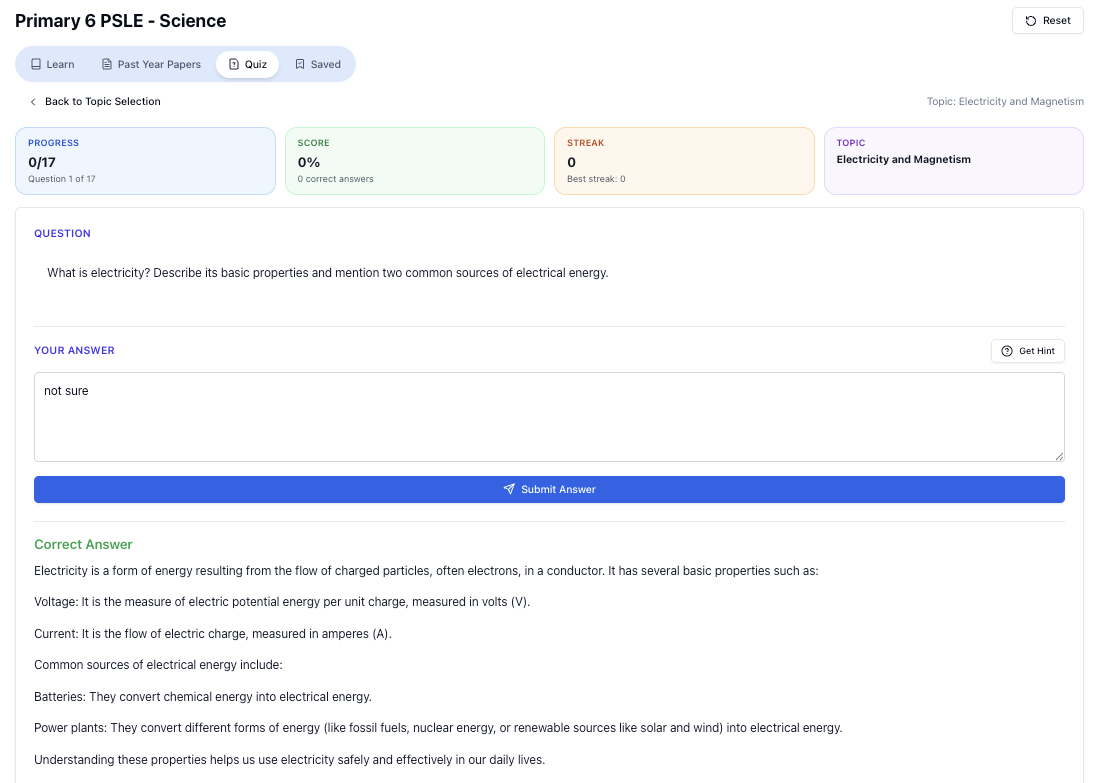
“Practice PSLE Science questions and get clear, step-by-step answers instantly.”
👉 Try a question now and see how fast you can improve.
Free on Tutorly.sg
Practise Vectors with step-by-step help — free to start
On Tutorly.sg/app you can practise unlimited Singapore syllabus questions, get instant explanations when you are stuck, and use past-year papers — no sign-up needed to start.
- ✓ PSLE, O Level, A Level, and more
- ✓ Step-by-step working when you are stuck
- ✓ Works on phone and laptop