

Free on Tutorly.sg
Practise with step-by-step help — free to start
On Tutorly.sg/app you can practise unlimited Singapore syllabus questions, get instant explanations when you are stuck, and use past-year papers — no sign-up needed to start.
- ✓ PSLE, O Level, A Level, and more
- ✓ Step-by-step working when you are stuck
- ✓ Works on phone and laptop
If you’re in JC right now, you already know this: A Level math is not just about “being good at math”. It’s about:
- Handling weird question twists
- Working fast under time pressure
- Avoiding small but deadly mistakes
“Stuck on a question? See simple explanations that help you understand fast.”
👉 Give it a try and turn confusion into clarity in minutes.
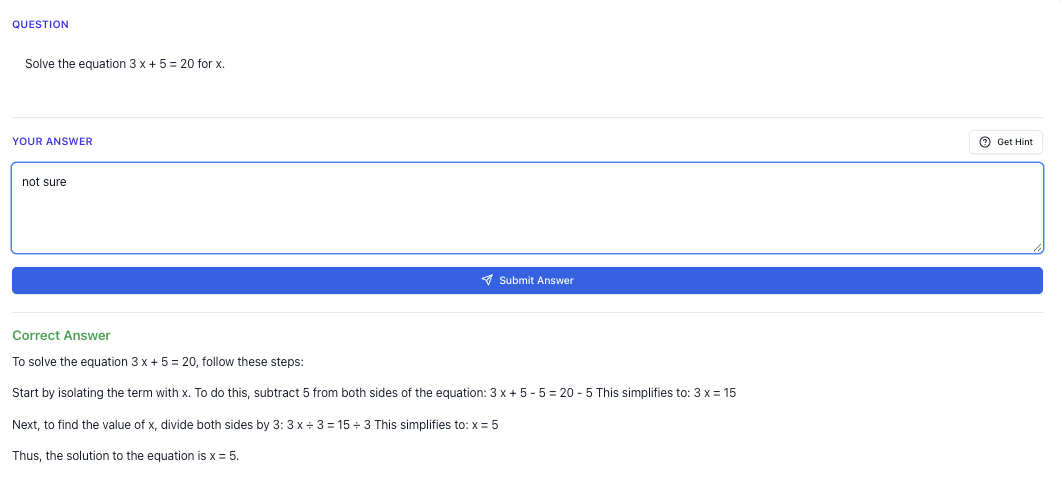
And the only way to really get there? Targeted practice with proper solutions, not just staring at your lecture notes.
This guide is for JC 1 and JC 2 students in Singapore doing H 2 Math (and H 1 where relevant), following the MOE A Level syllabus. I’ll walk you through:
- A step‑by‑step way to attack typical A Level style questions
- Concrete worksheet‑style practice questions with full solutions
- Harder exam‑style variants (the kind that appear in Paper 2)
- Common mistakes Singapore students keep making in A Level math
- How to use Tutorly.sg as your AI tutor for instant practice and solutions
By the way, Tutorly.sg is a Singapore‑built AI tutor website (not an app) that’s aligned to the MOE syllabus from Primary to JC. It’s already been used by thousands of students in Singapore, and has even been mentioned on Channel NewsAsia (CNA) — so you’re not experimenting on something random.
Step-by-step tutorial
Let’s go through a few core A Level topics with worked examples, the way a tutor would guide you. I’ll keep the questions realistic for JC exam standards.
We’ll cover:
- Differentiation (application)
- Integration (including substitution)
- Binomial expansion & series
- Vectors (3 D geometry)
You can treat each as a mini‑worksheet.
1. Differentiation Application: Optimisation
Question 1 (Standard JC 1/H 2 style)
A rectangular field is to be fenced on three sides with wire, with the fourth side along an existing wall that does not need fencing. The total length of fencing available is 80 m.
Let the side perpendicular to the wall be 𝑥 m.
- Express the area 𝐴 of the field in terms of 𝑥.
- Find the value of 𝑥 that maximises the area.
- Find the maximum area.
Step-by-step solution
Step 1: Set up the expression
Let the dimensions be:
- Width (perpendicular to wall): 𝑥
- Length (along the wall): 𝑦
Fencing is used on two widths + one length:
Area:
Answer (1):
Step 2: Differentiate and find stationary point
Set derivative to zero:
Step 3: Check it’s a maximum
So gives a maximum.
Step 4: Find maximum area
Final answers:
- m
- Maximum area
2. Integration: Substitution & Definite Integral
Question 2 (JC 2/H 2 style)
Evaluate the integral:
Step-by-step solution
This screams substitution because of and .
Step 1: Let substitution
Let
Our integral becomes:
But we need to change limits.
Step 2: Change the limits
When :
When :
So:
Step 3: Integrate
Apply limits 2 to 5:
We can leave it in surd form.
Final answer:
3. Binomial Expansion & Series
Question 3 (H 2 style)
Given that is expanded in ascending powers of 𝑥, the coefficient of 𝑥 is 80 and the coefficient of is 720. Find the value of 𝑛.
Step-by-step solution
General term:
So:
- Coefficient of 𝑥 (when ):
- Coefficient of (when ):
We’re told:
Check with :
Coefficient of :
So . That means we cannot just use the first equation; we must set up two equations.
Let:
- (from coefficient of 𝑥)
- (from coefficient of )
Work with (2):
4\binom{n}{2} = 720 \Rightarrow \binom{n}{2} = 180
But:
Solve:
Factor:
So or (reject -18 since 𝑛 is a positive integer).
Check with coefficient of 𝑥:
If :
So something is inconsistent. This tells us: the original numbers (80 and 720) cannot both come from . This is a good example of how exam questions can test your ability to notice inconsistency.
To turn this into a proper, consistent practice question, let’s fix the numbers.
Corrected version (for your practice)
Let’s say:
The coefficient of 𝑥 is 40 and the coefficient of is 720.
Now:
- Check :
Coefficient of :
Still off — so let’s instead start from a chosen 𝑛 and compute the coefficients, which is what you should do when building your own practice.
Take :
- Coefficient of 𝑥:
- Coefficient of :
So a realistic, clean question would be:
In the expansion of , the coefficient of 𝑥 is 18 and the coefficient of is 144. Find 𝑛.
Then:
- Check : ✓
Takeaway for you:
When you practice on your own (or using a tool like Tutorly.sg), use binomial questions to train:
- Writing the general term correctly
- Setting up equations from coefficients
- Checking for consistency
4. Vectors: 3 D Geometry
Question 4 (JC 2/H 2 standard)
In 3 D space, points 𝐴, 𝐵, and 𝐶 have position vectors (relative to origin 𝑂):
- \vec{OA} = \begin{pmatrix}1 \ 2 \ 3\end{pmatrix}
- \vec{OB} = \begin{pmatrix}3 \ 6 \ 9\end{pmatrix}
- \vec{OC} = \begin{pmatrix}4 \ -1 \ 2\end{pmatrix}
- Show that points 𝐴 and 𝐵 are collinear with 𝑂.
- Find the vector equation of line OC.
- Find the acute angle between lines OA and OC.
Step-by-step solution
(1) Collinearity
If 𝐴, 𝐵, and 𝑂 are collinear, then should be a scalar multiple of .
\vec{OA} = \begin{pmatrix}1 \ 2 \ 3\end{pmatrix},\quad \vec{OB} = \begin{pmatrix}3 \ 6 \ 9\end{pmatrix} = 3\begin{pmatrix}1 \ 2 \ 3\end{pmatrix} = 3\vec{OA}
So 𝑂, 𝐴, and 𝐵 are collinear.
(2) Vector equation of line OC
Line through 𝑂 and 𝐶:
- Position vector of a point on line:
- Direction vector: \vec{OC} = \begin{pmatrix}4 \ -1 \ 2\end{pmatrix}
So:
\vec{r} = \lambda \begin{pmatrix}4 \ -1 \ 2\end{pmatrix},\quad \lambda \in \mathbb{R}
(3) Angle between OA and OC
Angle between two vectors and :
Let:
\vec{a} = \vec{OA} = \begin{pmatrix}1 \ 2 \ 3\end{pmatrix},\quad \vec{c} = \vec{OC} = \begin{pmatrix}4 \ -1 \ 2\end{pmatrix}
Free on Tutorly.sg
Practise with step-by-step help — free to start
On Tutorly.sg/app you can practise unlimited Singapore syllabus questions, get instant explanations when you are stuck, and use past-year papers — no sign-up needed to start.
- ✓ PSLE, O Level, A Level, and more
- ✓ Step-by-step working when you are stuck
- ✓ Works on phone and laptop
Dot product:
Magnitudes:
So:
Angle:
This is an acute angle since the cosine is positive.
Exam strategy guide
A Level math in Singapore (especially H 2 Math) is more about exam technique than just content. Here’s how you can train using practice questions and worksheets effectively.
“Access more than 1000+ past year papers to practice”
👉 Start a paper today and test yourself like it’s the real exam.
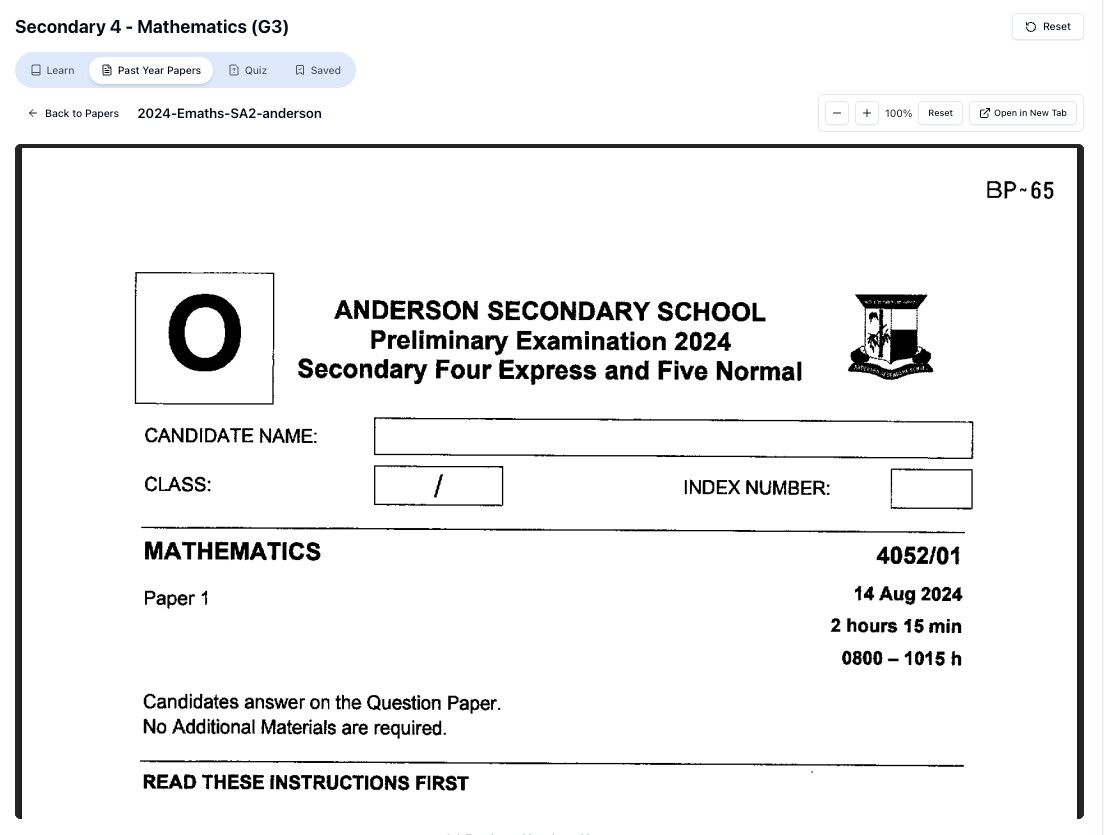
1. Train by paper, not just by topic
In JC, a lot of students keep doing “differentiation worksheets”, “vectors worksheets” and so on. That’s useful in JC 1, but for A Levels you must also train full-paper stamina:
- For H 2 Math:
- Paper 1: Pure math, more straightforward
- Paper 2: Mix of topics, often harder, with application questions
How to practice:
- Once a week (JC 2 especially), do:
- 1 full Paper 1 (under timed conditions) OR
- 1 full Paper 2
- Mark strictly using the scheme (or detailed solutions from a site like Tutorly.sg).
On Tutorly.sg, you can:
- Ask for “A Level H 2 Math vector exam-style question”
- Get a fresh question + solution
- Then ask for “one more but slightly harder”
This way you simulate the variety you see in real papers, not just school tutorial questions.
2. Use “3-pass” timing in the exam
When you sit for the actual A Level paper, don’t go question by question in order like it’s homework.
Use a 3-pass strategy:
-
Pass 1 (easy marks)
- Do all the questions you find straightforward.
- Aim to clear these in about 40–50% of the paper time.
- Skip any part you’re stuck on for more than ~2 minutes.
-
Pass 2 (medium difficulty)
- Go back to the ones you skipped.
- Try the next part even if you didn’t fully complete the previous one (sometimes they’re independent).
- Write something for each part — even a correct method with incomplete answer can get method marks.
-
Pass 3 (hard or time-consuming)
- Now tackle the toughest questions or long application parts.
- Even partial progress can give you marks.
To train this, when you do worksheet practice at home:
- Put a timer (e.g. 10–15 minutes per long question).
- Force yourself to move on when time is up, just like in the exam.
3. Always write down your method clearly
The A Level marker is not your school teacher who knows your style. They only see your script. For calculation-heavy questions:
- Show the formula you’re using (e.g. )
- Don’t skip too many algebra steps when rearranging
- Clearly label answers: e.g. “Maximum value of 𝑦 is 5 when ”
When you practice using Tutorly.sg:
- After you attempt a question, compare your steps with the step-by-step solution it gives.
- Even though Tutorly only checks your final answer, the worked solution lets you see if your method is too “jumpy” or unclear.
Over time, you’ll learn what a marker-friendly solution looks like.
4. Rotate between “comfort topics” and “pain topics”
Every JC student has:
- Comfort topics: e.g. differentiation, AP/GP
- Pain topics: e.g. vectors, complex numbers, probability
If you only do questions you like, you’ll feel productive but your actual grade won’t move.
Weekly plan idea (for JC 2):
- 2 sessions on comfort topics (to secure your A/B range marks)
- 2 sessions on pain topics (to close the gap)
- 1 full-paper or mixed-topic session
On Tutorly.sg, you can be very specific:
- “Give me a hard H 2 math vector question involving line-plane intersection”
- “Give me a medium-difficulty complex number locus problem”
This lets you target your weak spots without spending time hunting through 10-year-series books.
Worksheet practice
Now let’s dive into actual practice questions you can try. I’ll include:
- A mix of medium and hard questions
- Full worked solutions
- Comments on where students usually slip
Try each question on your own first before reading the solution.
Worksheet Set A – Medium difficulty
Question A 1: Logarithms & Graphs (H 2 / JC 1–JC 2 crossover)
The function 𝑓 is defined for 𝑥 > 0 by
- Show that .
- Hence, find the coordinates of the stationary point and determine its nature.
- State the range of 𝑓.
Solution A 1
(1) Differentiate
(2) Stationary point
Set :
Find 𝑓(4):
So stationary point is .
Determine nature using second derivative:
“Doing Secondary Science? Pick a topic and practise like it’s a real exam — with clear answers right after.”
👉 Try Tutorly now and start a Science topic in seconds.

Differentiate again (quotient rule or product rule):
Write .
Then:
At :
So it’s a minimum point.
(3) Range of 𝑓
For 𝑥 > 0, 𝑓(𝑥) has a minimum value at of .
As :
The term dominates, so .
As :
So .
Thus 𝑓(𝑥) has a minimum and goes to on both sides.
Range:
Question A 2: Probability (H 2)
A box contains 5 red balls and 3 blue balls. Three balls are drawn at random without replacement.
- Find the probability that exactly two of the balls drawn are red.
- Given that at least one of the balls is blue, find the probability that exactly one is blue.
Solution A 2
Total number of ways to choose 3 balls from 8:
(1) Exactly 2 red
Choose 2 red from 5 and 1 blue from 3:
So:
(2) Conditional probability
Let:
- 𝐴: “exactly one blue”
- 𝐵: “at least one blue”
We want .
But if there is exactly one blue, that automatically means at least one blue, so . Thus:
First compute 𝑃(𝐴):
Exactly one blue 1 blue from 3 and 2 red from 5:
So:
𝑃(𝐴) = \frac{30}{56} = \frac{ --- ## Try [Tutorly.sg](https://tutorly.sg/app) (Singapore) Start here: [AI Tutor Singapore](https://tutorly.sg/ai-tutor-singapore) Try Tutorly on the website (no sign-up): [https://tutorly.sg/app](https://tutorly.sg/app) --- > “Practice PSLE Science questions and get clear, step-by-step answers instantly.” > [👉 Try 𝑎 question now and see how fast you can improve.](https://tutorly.sg/app) 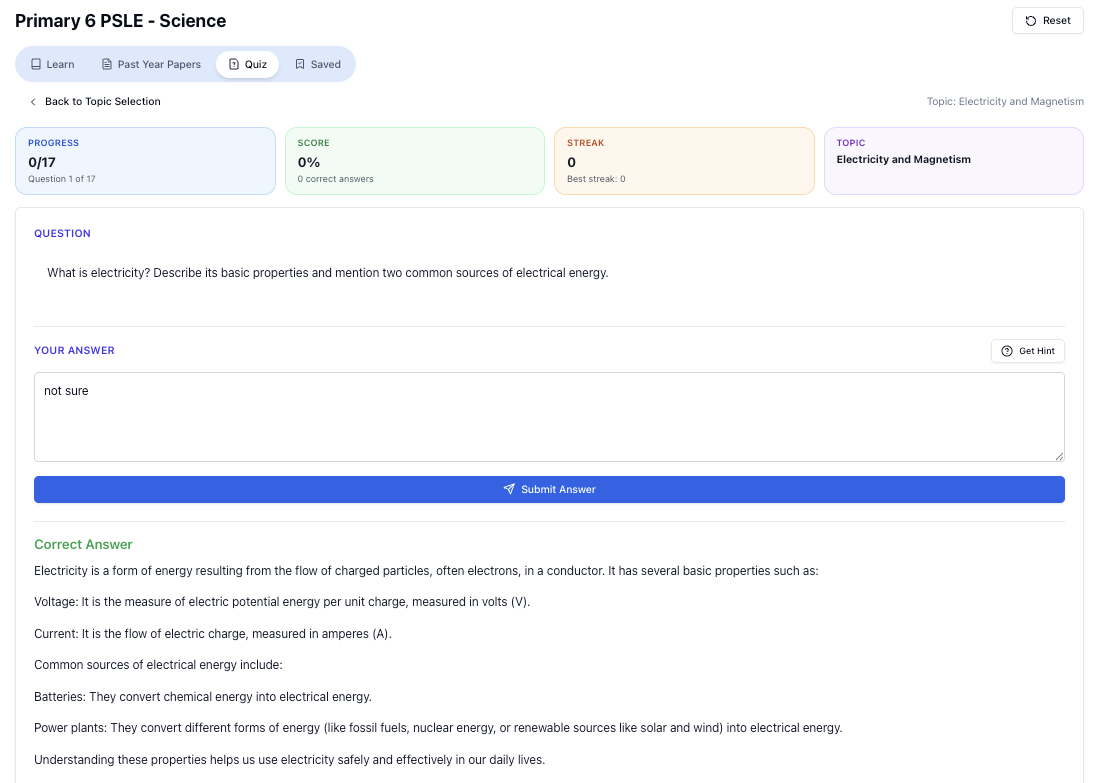 ## Ready to practise? If you want 𝑎 Singapore-focused AI tutor you can use immediately (website, no sign-up), try Tutorly here: - [https://tutorly.sg/ai-tutor-singapore](https://tutorly.sg/ai-tutor-singapore) - [https://tutorly.sg/app](https://tutorly.sg/app) --- ## Related Articles - [How To Master 𝑂 Level Math Algebra Questions (Singapore Secondary Level) With Smart Worksheet Practice](/blog/𝑜-level-math-algebra-questions-singapore-secondary-level) - [PSLE Math Practice Questions Singapore: 𝐴 Targeted Worksheet Guide With Full Solutions](/blog/psle-math-practice-questions-singapore) - [𝑂 Level Chemistry Mole Concept Questions: Singapore Secondary Level Worksheet Practice Guide](/blog/𝑜-level-chemistry-mole-concept-questions-singapore-secondary-level)
Free on Tutorly.sg
Practise with step-by-step help — free to start
On Tutorly.sg/app you can practise unlimited Singapore syllabus questions, get instant explanations when you are stuck, and use past-year papers — no sign-up needed to start.
- ✓ PSLE, O Level, A Level, and more
- ✓ Step-by-step working when you are stuck
- ✓ Works on phone and laptop