

Free on Tutorly.sg
Practise with step-by-step help — free to start
On Tutorly.sg/app you can practise unlimited Singapore syllabus questions, get instant explanations when you are stuck, and use past-year papers — no sign-up needed to start.
- ✓ PSLE, O Level, A Level, and more
- ✓ Step-by-step working when you are stuck
- ✓ Works on phone and laptop
If you’re in JC and doing H2 Math, you already know this: integration is everywhere.
It shows up in pure integration questions, in vectors, in complex numbers, in applications of integration, and of course in those 12–18 mark A Level structured questions that decide your grade.
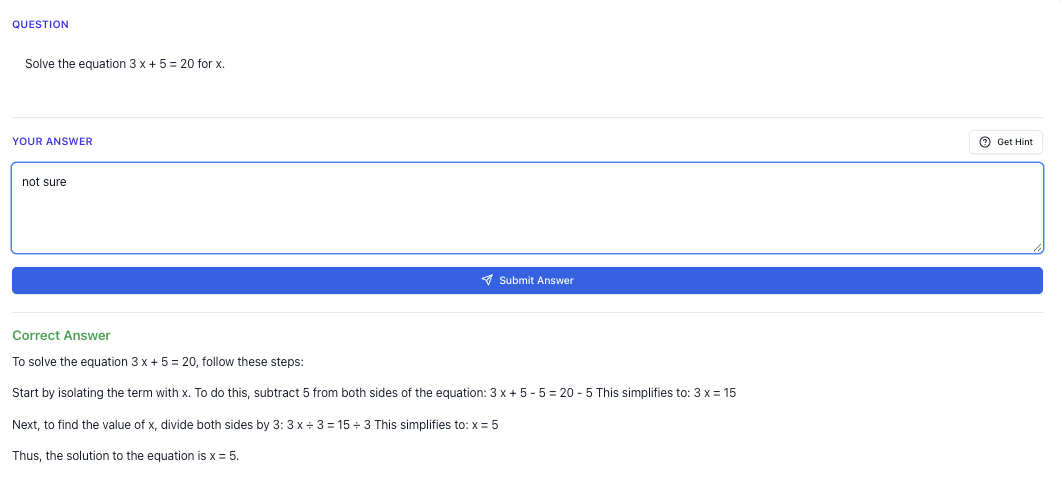
“Stuck on a question? See simple explanations that help you understand fast.”
👉 Give it a try and turn confusion into clarity in minutes.
This guide is written for you as a JC student in Singapore, following the MOE A Level H2 Math syllabus. I’ll walk you through:
- Core integration techniques that actually appear in A Level questions
- How to decide which method to use
- Common traps that cost marks
- A mini “worksheet” of exam-style questions (including harder variants)
- How to use Tutorly.sg as your practice buddy for integration
Tutorly.sg is a AI tutor website (not an app) built specifically for Singapore students from Primary to JC, aligned to the MOE syllabus. It’s been mentioned on Channel NewsAsia (CNA) and used by thousands of students in Singapore, so you’re in good company if you use it to drill integration.
Step-by-step tutorial
Let’s build from the ground up, but always with A Level exam-style thinking.
1. Know your core integration “toolbox”
For H2 Math, these are the main techniques you must be fluent in:
- Direct integration (power rule, exponentials, trig)
- Substitution
- Integration by parts
- Partial fractions
- Trigonometric identities / special forms
- Definite integrals and area/volume applications
You don’t need to memorise 100 random formulas. You need to recognise patterns and link them to the right tool.
1.1 Direct integration: your default move
If the integrand is a simple power of 𝑥, exponential, or standard trig, apply the basic rules:
- for
Example (warm-up):
Find .
You get:
Nothing fancy. But the exam twist is usually that this is just one part of a longer question, not the whole thing.
2. Substitution: when you see a “function inside a function”
Use substitution when you spot a composite function where the derivative of the inside appears (or almost appears) outside.
Typical patterns:
- , , ,
- giving
- Quadratic surds like or
2.1 Classic substitution example
Evaluate .
Step 1: Choose 𝑢
Let .
So .
Step 2: Substitute
In exams, this kind of step is often hidden in a longer question, e.g. they first ask you to show that a derivative simplifies to some form, then ask you to evaluate an integral.
3. Integration by parts: product of functions
Use integration by parts when you see a product of two functions where:
- One becomes simpler when differentiated (e.g. polynomial, , ), and
- The other is easy to integrate (e.g. , , )
Formula:
3.1 Example with polynomial and exponential
Evaluate .
Let:
Then:
A Level questions often chain this with limits, or ask you to prove a reduction formula using repeated integration by parts.
4. Partial fractions: rational functions
Use partial fractions when you have a rational function (polynomial divided by polynomial) and:
- Degree of numerator < degree of denominator (if not, do long division first), and
- Denominator factorises into linear or irreducible quadratic factors.
General idea: rewrite
as a sum like
Then integrate term by term.
4.1 Standard exam-style example
Evaluate .
Step 1: Factor denominator
Step 2: Set up partial fractions
So:
Equate coefficients:
- So
Hence:
In Paper 2, they love to combine this with definite limits or area under curve questions.
5. Trig identities and special forms
You’ll often see integrals involving:
- , , , etc.
Also, classic forms for inverse trig:
Recognising these quickly saves a lot of time in the exam.
6. Definite integrals and applications
For A Level H2 Math in Singapore, you’re expected to:
- Evaluate definite integrals
- Interpret them as area under a curve (and sometimes volume of revolution)
- Handle situations where the graph goes below the 𝑥-axis (negative area)
Example:
If and on [𝑎, 𝑏], then area between the curve and 𝑥-axis is:
Examiners like to test whether you understand this conceptually, not just mechanically.
Exam strategy guide
Now that you’ve refreshed the techniques, let’s talk about exam tactics for A Level H2 Math integration questions.
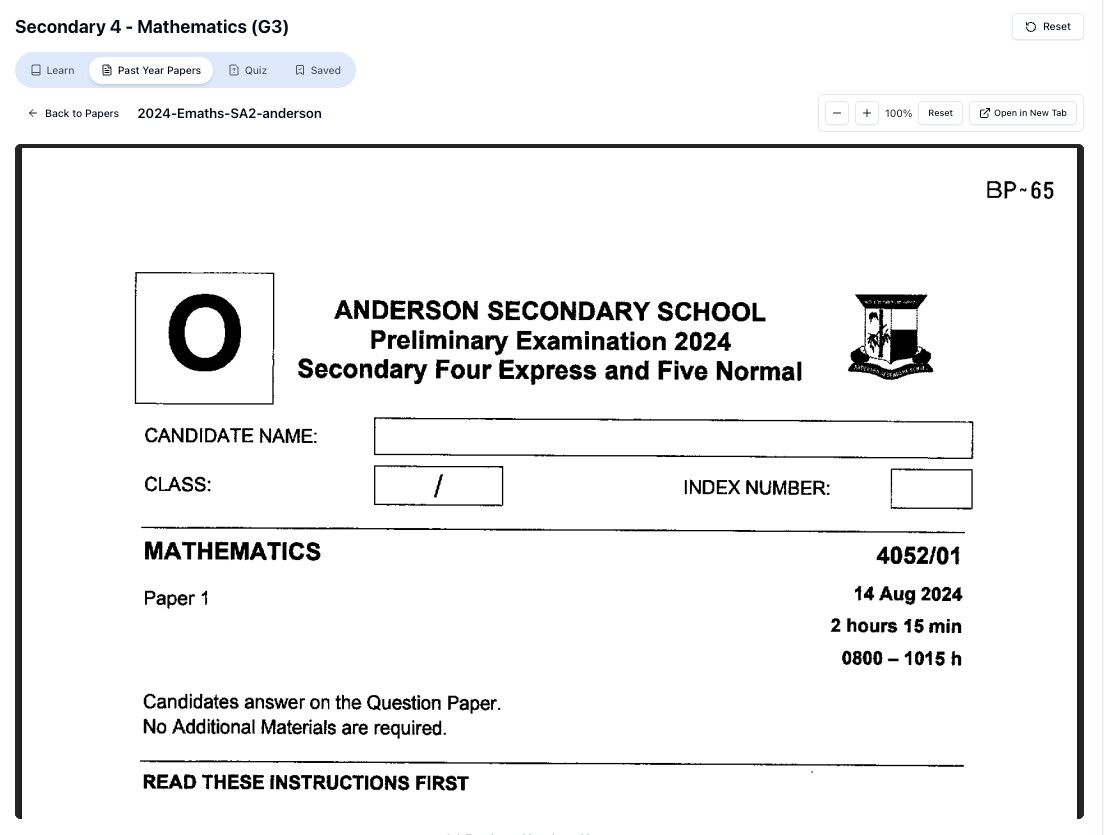
“Access more than 1000+ past year papers to practice”
👉 Start a paper today and test yourself like it’s the real exam.
1. Read the question for structure, not just the integral
Many A Level questions are structured:
- Show that some expression simplifies to a nice form
- Use that to evaluate a definite integral
- Interpret the result (area, rate of change, etc.)
Before you start differentiating or integrating, ask:
- Is this a “show that” step meant to guide me?
- Is there a hint for substitution / partial fractions hidden in the algebra?
- Is the final part asking for a numerical answer or interpretation?
2. Decide method in under 20 seconds
Here’s a quick mental flow you can use in the exam:
-
Is it a straightforward power / exponential / trig?
→ Try direct integration. -
Is there a clear “inside function” with its derivative outside?
→ Try substitution. -
Is it a product of two functions (poly × trig/exp/log)?
→ Try integration by parts. -
Is it a rational function (fraction of polynomials)?
→ Check degree:- If numerator degree ≥ denominator degree → do long division first.
- Then factor denominator → partial fractions.
-
Is it a weird trig expression?
→ Try identities: rewrite in terms of , , , , etc.
If your method doesn’t simplify the integrand within 2–3 lines, reconsider your choice. Don’t be stubborn with a wrong method; that’s how you lose time.
3. Manage your time across the paper
In A Level H2 Math:
- Integration usually appears in both Paper 1 and Paper 2
- A big integration question can be 8–12 marks
- You can’t afford to spend 25 minutes stuck on one part
Practical tips:
- If you’re stuck for more than 3–4 minutes on a single integral, move on and come back later.
- Even if you can’t evaluate an integral, you can often use the given result in later parts to pick up method marks.
- Write something for each part. A correct setup of substitution or partial fractions can still earn marks even if the final answer is wrong.
4. Show clear working for method marks
Markers in Singapore look for:
- Correct choice of substitution / parts / partial fractions
- Clear algebraic steps
- Correct limits when you change variable in definite integrals
For example, if you use substitution in a definite integral:
Instead of switching back to 𝑥 halfway, you can:
- Change limits from 𝑥-values to 𝑢-values, or
- Integrate in terms of 𝑢, then substitute back to 𝑥 and apply original limits
Both are acceptable, but be consistent and clear.
5. Use your GC smartly (but don’t depend on it)
For A Level:
- You can use your graphing calculator to check definite integrals numerically.
- But you must still show algebraic working for full marks.
Strategy:
- After you’ve done the integral, quickly key it into your GC to see if the numerical value matches.
- If it doesn’t, you know you made a mistake and can scan your steps for sign errors, wrong limits, etc.
When you’re practising on Tutorly.sg, you can do something similar: attempt the question yourself, then compare with the step-by-step solution Tutorly gives after checking your final answer.
Worksheet practice
Here’s a mini “worksheet” of integration questions tailored to A Level H2 Math. Try them first without looking up solutions. Then you can use Tutorly or your school notes to check your methods.
I’ll label them by difficulty and method.
Section A: Core skills (warm-up, but exam-relevant)
Free on Tutorly.sg
Practise with step-by-step help — free to start
On Tutorly.sg/app you can practise unlimited Singapore syllabus questions, get instant explanations when you are stuck, and use past-year papers — no sign-up needed to start.
- ✓ PSLE, O Level, A Level, and more
- ✓ Step-by-step working when you are stuck
- ✓ Works on phone and laptop
Q1 (Substitution, basic)
Evaluate:
Hint: Let .
Q2 (Integration by parts)
Evaluate:
Hint: Let , .
Q3 (Partial fractions, standard)
Evaluate:
Hint: Factor denominator: .
Q4 (Definite integral, area)
Given that , find the area of the region enclosed between the curve and the 𝑥-axis.
Hint: Find the roots, set up between them, and handle sign if needed.
Section B: Exam-style medium questions
Q5 (Substitution with definite integral)
Evaluate:
Hint: Let . Don’t forget to change the limits.
Q6 (Integration by parts, repeated)
Evaluate:
Hint: You’ll need integration by parts twice. Each time, differentiate the polynomial and integrate .
Q7 (Partial fractions + definite integral)
Evaluate:
Hint: Factor denominator , decompose, then integrate term by term.
Q8 (Trig identity + substitution)
Evaluate:
Hint: Use and consider .
Section C: Hard exam variants (closer to A Level level-of-difficulty)
These are the ones that feel more like actual A Level Paper 2 parts. If you can handle these, you’re in good shape.
Q9 (Tricky substitution with quadratic surd)
Evaluate:
Steps to think about:
- Spot that derivative of is -2𝑥.
- Let .
- Rewrite integral in terms of 𝑢.
This type of surd integral appears quite often in mock papers and school exams.
Q10 (Mixed: algebra manipulation + substitution)
Given that , evaluate:
Then, hence or otherwise, evaluate:
Thinking process:
- For the first integral, use substitution .
- For the second, try to express as .
This “hence or otherwise” style is very typical of A Level questions.
Q11 (Integration by parts leading to a reduction formula)
Show that:
Then, hence find:
Strategy:
- Do integration by parts with , .
- Once you’ve shown the general result, just substitute the limits 0 and 1.
Q12 (Area with curve crossing the axis)
The curve intersects the 𝑥-axis at .
(a) Sketch the general shape in your mind (you don’t have to draw to scale in the exam, but you should understand which parts are above/below the axis).
(b) Find the total area of the regions enclosed between the curve and the 𝑥-axis.
Hints:
- Break the area into two parts: from -2 to $0, and from \0 to \2$.
- Decide where 𝑦 is positive or negative.
- Use , which might become on some intervals.
This is a classic A Level style: combining roots, sign analysis, and definite integrals.
“Doing Secondary Science? Pick a topic and practise like it’s a real exam — with clear answers right after.”
👉 Try Tutorly now and start a Science topic in seconds.

How to use Tutorly.sg with these questions
You can turn this worksheet into a proper practice session using Tutorly.sg:
- Go to Tutorly.sg and choose JC / H2 Math.
- Type in a question (e.g. “Evaluate ∫ x^2 e^x dx”) or paste a school question.
- Try it on your own first.
- Submit your final answer. Tutorly will check it and, if it’s wrong or you’re unsure, show you a full step-by-step worked solution that follows MOE/A Level style.
Because Tutorly has already been used by thousands of students in Singapore and featured on CNA, the explanations are tuned to what local teachers and examiners expect, not some random overseas syllabus.
You can also ask Tutorly to generate more questions of a similar type:
- “Give me 5 more H2 Math integration by parts questions, increasing difficulty.”
- “Give me exam-style questions combining partial fractions and definite integrals.”
This is very useful when you’re revising for promos, J2 block tests, prelims, or the actual A Levels.
Common mistakes
Let’s go through the errors that cause the most lost marks for Singapore JC students in integration.
1. Forgetting +C in indefinite integrals
In long questions, one missing +𝐶 can lead to:
- Losing 1 mark
- Confusing yourself in later parts that depend on the general solution
Train yourself: every indefinite integral → automatically write “+ C”.
2. Wrong or missing limits after substitution
In definite integrals with substitution, students often:
- Change variable to 𝑢
- Integrate in terms of 𝑢
- But forget to change the limits, or
- Mix 𝑢-limits with 𝑥 in the final expression
You have two safe options:
-
Change limits immediately
- Convert to 𝑢-values
- Do everything in 𝑢 and never go back to 𝑥
-
Keep original limits, but revert to 𝑥 before applying them
- Integrate in 𝑢, get expression in 𝑢
- Substitute 𝑢 back in terms of 𝑥
- Then apply
Pick one method and stick to it clearly.
3. Sign errors with trig and surds
Common ones:
- (not )
- (not )
- When dealing with , forgetting that derivative of is -2𝑥 (negative sign)
These are small errors but can ruin a 4–5 mark part. When revising, drill these basic derivatives and integrals until they’re instant.
4. Wrong method choice (forcing integration by parts)
A very common JC mistake is to see a product and immediately do integration by parts, even when substitution is easier.
Example:
Many students go for integration by parts, which becomes messy. But actually:
Let
So:
Much cleaner. In exams, always pause for a few seconds to ask: “Is there a nicer method?”
5. Partial fractions: algebra mistakes
Typical errors:
- Wrong factorisation of denominator
- Incorrect solving for constants 𝐴, 𝐵, 𝐶
- Forgetting that irreducible quadratics need (Ax + 𝐵) on top, not just 𝐴
For example, if denominator is , then:
not
When practising partial fractions questions on Tutorly, pay attention to the algebra in the step-by-step solutions, not just the final integral.
6. Misinterpreting area when the curve is below the axis
Many A Level questions test whether you know that:
- gives signed area
- Actual area is
So if on [𝑎, 𝑏]:
Students often forget the minus sign and lose 2–3 marks in an otherwise correct solution. Always think: is the curve above or below the axis on this interval?
7. Over-relying on the calculator
Your GC is great for checking answers, but:
- It won’t give you method marks in the exam
- It can’t handle every weird algebraic manipulation the exam expects
When you practise:
- Do the
Try Tutorly.sg (Singapore)
Start here: AI Tutor Singapore
Try Tutorly on the website (no sign-up): https://tutorly.sg/app
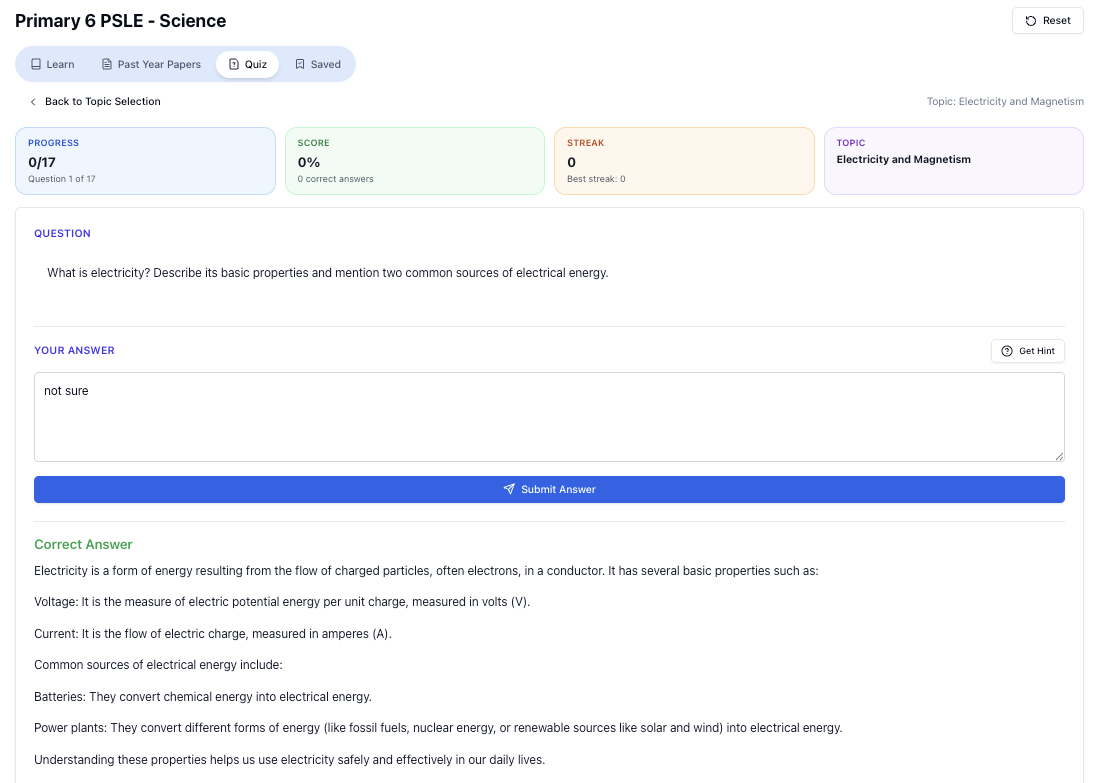
“Practice PSLE Science questions and get clear, step-by-step answers instantly.”
👉 Try a question now and see how fast you can improve.
Ready to practise?
If you want a Singapore-focused AI tutor you can use immediately (website, no sign-up), try Tutorly here:
Related Articles
Free on Tutorly.sg
Practise with step-by-step help — free to start
On Tutorly.sg/app you can practise unlimited Singapore syllabus questions, get instant explanations when you are stuck, and use past-year papers — no sign-up needed to start.
- ✓ PSLE, O Level, A Level, and more
- ✓ Step-by-step working when you are stuck
- ✓ Works on phone and laptop